















































KI-Beratung Beta

Produktbild: Nuclear Magnetic Resonance Spectroscopy

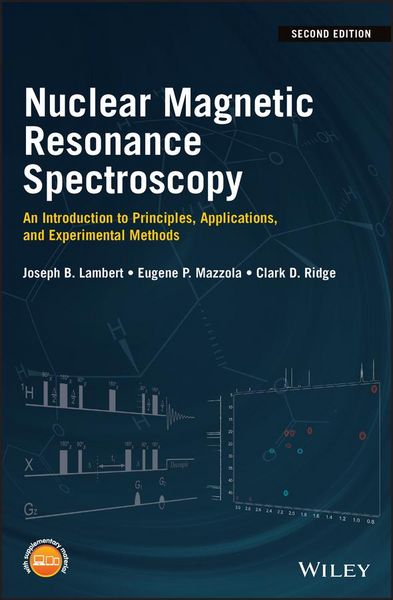
Nuclear Magnetic Resonance Spectroscopy An Introduction to Principles, Applications, and Experimental Methods

106,99 €

inkl. gesetzl. MwSt., Versandkostenfrei


Beschreibung

Produktdetails

Einband

Gebundene Ausgabe

Erscheinungsdatum

11.01.2019

Verlag

John Wiley & Sons Inc

Seitenzahl

480

Maße (L/B/H)

25,1/17,2/3,2 cm

Gewicht

1056 g

Auflage

2nd edition

Sprache

Englisch

ISBN

978-1-119-29523-5

Beschreibung

Produktdetails

Einband

Gebundene Ausgabe

Erscheinungsdatum

11.01.2019

Verlag

John Wiley & Sons Inc

Seitenzahl

480

Maße (L/B/H)

25,1/17,2/3,2 cm

Gewicht

1056 g

Auflage

2nd edition

Sprache

Englisch

ISBN

978-1-119-29523-5

Herstelleradresse

Libri GmbH
Europaallee 1
36244 Bad Hersfeld
DE

Email: gpsr@libri.de

Ein neues Kapitel für Ihre Bücher

Ein neues Kapitel für Ihre Bücher

Schenken Sie Ihren alten Schätzen ein zweites Leben und erhalten Sie dafür eine Thalia Geschenkkarte.

Jetzt verkaufen
Jetzt verkaufen

Noch keine Bewertungen vorhanden

Verfassen Sie die erste Bewertung zu diesem Artikel

Helfen Sie anderen Kundinnen und Kunden durch Ihre Meinung.

Kundinnen und Kunden meinen

Bewertungen (0)

Die Leseprobe wird geladen.
  • Produktbild: Nuclear Magnetic Resonance Spectroscopy
  • Preface to First Edition

    Preface to Second Edition

    Symbols

    Abbreviations

    1. Introduction

    1.1. Magnetic Properties of Nuclei

    1.2. The Chemical Shift

    1.3. Excitation and Relaxation

    1.4. Pulsed Experiments

    1.5. The Coupling Constant

    1.6. Quantitation and Complex Splitting

    1.7. Commonly Studied Nuclides

    1.8. Dynamic Effects

    1.9. Spectra of Solids

    Problems

    Tips on Solving NMR Problems

    Bibliography

    2. Introductory Experimental Methods

    2.1. The Spectrometer

    2.2. Sample Preparation

    2.3. Optimizing the Signal

    2.3a. Sample Tube Placement

    2.3b. Probe Tuning

    2.3c. Field/Frequency Locking

    2.3d. Spectrometer Shimming

    2.4. Determination of NMR Spectra-Acquisition Parameters

    2.4a. Number of Data Points

    2.4b. Spectral Width

    2.4c. Filter Bandwidth

    2.4d. Acquisition Time

    2.4e. Transmitter Offset

    2.4f. Flip Angle

    2.4g. Receiver Gain

    2.4h. Number of Scans

    2.4i. Steady-State Scans

    2.4j. Oversampling and Digital Filtration

    2.4k. Decoupling for X Nuclei

    2.4l. Typical NMR Experiments

    2.5. Determination of NMR Spectral-Processing Parameters

    2.5a. Exponential Weighting

    2.5b. Zero Filling

    2.5c. FID Truncation and Spectral Artifacts

    2.5d. Resolution

    2.6. Determination of NMR Spectra:  Spectral Presentation

    2.6a. Signal Phasing and Baseline Correction

    2.6b. Zero Referencing

    2.6c. Determination of Certain NMR Parameters

    2.7. Calibrations

    2.7a. Pulse Width (Flip Angle)

    2.8b. Decoupler Field Strength

    Problems

    Bibliography

    3. The Chemical Shift

    3.1. Factors That Influence Proton Shifts

    3.2. Proton Chemical Shifts and Structure

    3.2a. Saturated Aliphatics

    3.2b. Unsaturated Aliphatics

    3.2c. Aromatics

    3.2d. Protons on Oxygen and Nitrogen

    3.2e. Programs for Empirical Calculations

    3.3. Medium and Isotope Effects

    3.4. Factors That Influence Carbon Shifts

    3.5. Carbon Chemical Shifts and Structure

    3.5a. Saturated Aliphatics

    3.5b. Unsaturated Compounds

    3.5c. Carbonyl Groups

    3.5d. Programs for Empirical Calculation

    3.6. Tables of Chemical Shifts

    Problems

    Further Tips on Solving NMR Problems

    Bibliography

    4. The Coupling Constant

    4.1. First- and Second-Order Effects

    4.2. Chemical and Magnetic Equivalence

    4.3. Signs and Mechanisms of Coupling

    4.4. Couplings over One Bond

    4.5. Geminal Couplings

    4.6. Vicinal Couplings

    4.7. Long-Range Couplings

    4.8. Spectral Analysis

    4.9. Tables of Coupling Constants

    Problems

    Bibliography

    5. Further Topics in One-Dimensional NMR Spectroscopy

    5.1. Spin-Lattice and Spin-Spin Relaxation

    5.2. Reactions on the NMR Time Scale

    5.3. Multiple Resonance

    5.4. The Nuclear Overhauser Effect

    5.5. Spectral Editing

    5.6. Sensitivity Enhancement

    5.7. Carbon Connectivity

    5.8. Phase Cycling, Composite Pulses, and Shaped Pulses

    Problems

    Bibliography

    6. Two-Dimensional NMR Spectroscopy

    6.1. Proton-Proton Correlation Through J Coupling

    6.2. Proton-Heteronucleus Correlation

    6.3. Proton-Proton Correlation Through Space or Chemical Exchange

    6.4. Carbon-Carbon Correlation

    6.5. Higher Dimensions

    6.6. Pulsed Field Gradients

    6.7. Diffusion-Ordered Spectroscopy

    6.7. Summary of Two-Dimensional Methods

    Problems

    Bibliography

    7. Advanced Experimental Methods

    Part A. One-Dimensional Techniques

    7.1. T1 Measurements

    7.2. 13C Spectral Editing Experiments

    7.2a. The APT Experiment

    7.2b. The DEPT Experiment

    7.3. NOE Experiments

    7.3a. The NOE Difference Experiment

    7.3b. The Double-Pulse, Field-Gradient, Spin-Echo NOE Experiment

    Part B. Two-Dimensional Techniques

    7.4. Two-Dimensional NMR Data-Acquisition Parameters

    7.4a. Number of Data Points

    7.4b. Number of Time Increments

    7.4c. Spectral Widths

    7.4d. Acquisition Time

    7.4e. Transmitter Offset

    7.4f. Flip Angle

    7.4g. Relaxation Delay

    7.4h. Receiver Gain

    7.4i. Number of Scans per Time Increment

    7.4j. Steady-State Scans

    7.5. Two-Dimensional NMR Data-Processing Parameters

    7.5a. Weighting Functions

    7.5b. Zero Filling

    7.5c. Digital Resolution

    7.5d. Linear Prediction

    7.6. Two-Dimensional NMR Data Display

    7.6a. Phasing and Zero Referencing

    7.6b. Symmetrization

    7.6c. Use of Cross Sections in Analysis

    Part C. Two-Dimensional Techniques:  The Experiments

    7.7. Homonuclear Chemical-Shift Correlation Experiments via Scalar Coupling

    7.7a. The COSY Family:  COSY-90°, COSY-45°, Long-Range COSY, and DQF-COSY

    7.7b. The TOCSY Experiment

    7.8. Direct Heteronuclear Chemical-Shift Correlation via Scalar Coupling

    7.8a. The HMQC Experiment

    7.8b. The HSQC Experiment

    7.8c. The HETCOR Experiment

    7.9. Indirect Heteronuclear Chemical-Shift Correlation via Scalar Coupling

    7.9a. The HMBC Experiment

    7.9b. The FLOCK Experiment

    7.9c. The HSQC-TOCSY Experiment

    7.10. Homonuclear Chemical-Shift Correlation via Dipolar Coupling

    7.10a. The NOESY Experiment

    7.10b. The ROESY Experiment

    7.11. 1D and Advanced 2D Experiments

    7.11a. The 1D TOCSY Experiment

    7.11b. The 1D NOESY and ROESY Experiments

    7.11c. The Multiplicity-Edited HSQC Experiment

    7.11d. The H2BC Experiment

    7.11e. Nonuniform Sampling

    7.11f. Pure Shift NMR

    7.11g. Covariance NMR

    7.12. Pure Shift-Covariance NMR

    Bibliography

    8. Structural Elucidation:  An Example

    Part A. Spectral Analysis

    8.1. 1H NMR Data

    8.2. 13C NMR Data

    8.3. The DEPT Experiment

    8.4. The HSQC Experiment

    8.5. The COSY Experiment

    8.6. The HMBC Experiment

    8.7. General Molecular Assembly Strategy

    8.8. A Specific Molecular Assembly Procedure

    8.9. The NOESY Experiment

    Part B Computer-Assisted Structure Elucidation

    8.10. CASE Procedures

    8.11. T-2 Toxin

    Appendix 1 Derivation of the NMR Equation

    Appendix 2 The Bloch Equations

    Appendix 3 Quantum Mechanical Treatment of the Two-Spin System

    Appendix 4 Analysis of Second-Order, Three- and Four-Spin Systems by Inspection

    Appendix 5 Relaxation

    Appendix 6 Product-Operator Formalism and Coherence-Level Diagrams

    Bibliography

    Appendix 7 Stereochemical Considerations

    A7.1. Homotopic Groups

    A7.2. Enantiotopic Groups

    A7.3. Diastereotopic Groups

    Bibliography

    Index