















































KI-Beratung Beta

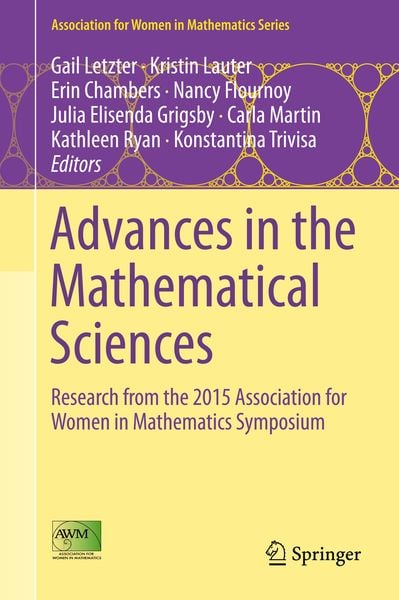
Produktbild: Advances in the Mathematical Sciences
Band 6 - 10%

Advances in the Mathematical Sciences Research from the 2015 Association for Women in Mathematics Symposium

10% sparen

143,99 € UVP 160,49 €

inkl. gesetzl. MwSt., Versandkostenfrei


Beschreibung

Produktdetails

Einband

Gebundene Ausgabe

Erscheinungsdatum

20.08.2016

Abbildungen

XVII, 436 p. 141 illus., 97 illus. in color.

Herausgeber

Gail Letzter + weitere

Verlag

Springer

Seitenzahl

436

Maße (L/B/H)

24,1/16/3 cm

Gewicht

794 g

Auflage

1st ed. 2016

Sprache

Englisch

ISBN

978-3-319-34137-8

Beschreibung

Produktdetails

Einband

Gebundene Ausgabe

Erscheinungsdatum

20.08.2016

Abbildungen

XVII, 436 p. 141 illus., 97 illus. in color.

Herausgeber

Verlag

Springer

Seitenzahl

436

Maße (L/B/H)

24,1/16/3 cm

Gewicht

794 g

Auflage

1st ed. 2016

Sprache

Englisch

ISBN

978-3-319-34137-8

Herstelleradresse

Springer-Verlag GmbH
Europaplatz 3
69115 Heidelberg
DE

Email: ProductSafety@springernature.com

Ein neues Kapitel für Ihre Bücher

Ein neues Kapitel für Ihre Bücher

Schenken Sie Ihren alten Schätzen ein zweites Leben und erhalten Sie dafür eine Thalia Geschenkkarte.

Jetzt verkaufen
Jetzt verkaufen

Noch keine Bewertungen vorhanden

Verfassen Sie die erste Bewertung zu diesem Artikel

Helfen Sie anderen Kundinnen und Kunden durch Ihre Meinung.

Kundinnen und Kunden meinen

Bewertungen (0)

  • Produktbild: Advances in the Mathematical Sciences
  • Preface.- Floer field philosophy (K. Wehrheim).- An elementary fact about unlinked braid closures (E. Grigsby & S. M. Wehrli).- Symmetric unions without cosmetic crossing changes (A. H. Moore).- The total Thurston–Bennequin number of complete bipartite Legendrian graphs (D. O'Donnol and E. Pavelescu).- Coverings of open books (T. Ito and K. Kawamuro).- Understanding locomotor rhythm in the lamprey central pattern generator (N. Massarelli, A. Yau, K. Hoffman, T. Kiemel and E. Tytell).- Applications of knot theory: using knot theory to unravel biochemistry mysteries (C. R. Price).- Metapopulation and non-proportional vaccination models overview (M. Cruz-Aponte).- Controlling a cockroach infestation (H. Albert, A. Buchmann, L. Ohm, A. Radunskaya, and E. Swanson).- The impact of violence interruption on the diffusion of violence: a mathematical modeling approach (S. A. Wiley, M. Z. Levy, and C. C. Branas).- Cramér's theorem is atypical (N. Gentert, S. Kim, and K. Ramanan).- Counting and partition function analysis for subordinate killed Brownian motion (S. Bryant).- A statistical change point analysis approach for modeling the ratio of next generation sequencing reads (J. Chen and H. Li).- A center-level approach to estimating the effect of center characteristics on center outcomes (J. Le-Rademacher).- False discovery rate based on extreme values in high dimension (J. Park, D. Park, and J. W. Davis).- Asymptotic and oscillatory behavior of dynamic equations on time scales (R. Higgins).- Using applications to motivate the learning of differential equations (K. M. Bliss & J. M. Libertini).- What is a good question? (B. Servatius).- Information measures of frequency distributions with an application to labeled graphs (C. Joslyn & E. Purvine).- Integrating and sampling cuts in bounded treewidth graphs (I. Bezáková, E. W. Chambers, and K. Fox).- Considerations on the implementation and use of Anderson acceleration on distributed memory and GPU-based parallel computers (J. Loffeld & C. S. Woodward).