















































KI-Beratung Beta

Produktbild: The Human Right to Water
- 22%

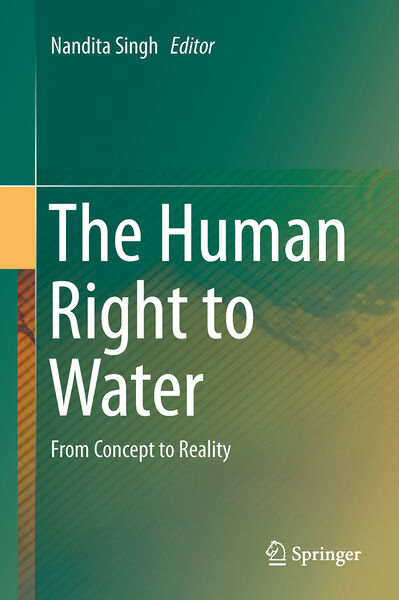
The Human Right to Water From Concept to Reality

22% sparen

115,99 € UVP 149,79 €

inkl. gesetzl. MwSt., Versandkostenfrei


Beschreibung

The discourse on the human right to water presents deliberations on the concept, content and rationale for the right, with little attention to the practical question of translating the right into reality. This book aims to fill this void by focusing on ‘realization’ of the right by its holders, examining...

Beschreibung

The discourse on the human right to water presents deliberations on the concept, content and rationale for the right, with little attention to the practical question of translating the right into reality. This book aims to fill this void by focusing on ‘realization’ of the right by its holders, examining how effective the mechanisms are for ‘implementing’ the right in enabling its universal realization. In a quest to answer this question, the book draws a conceptual differentiation between ‘implementation’ and ‘realization’ of the right, arguing that unlike implementation - which is an objective process of creation and implementation of measures such as legal frameworks, institutional structures or policy and action guidelines, realization of the right is a subjective process that extends much beyond. It takes shape within specific contextual settings which may include varied situations, yet remains neglected in the related academic and action forums. This book attempts to address this void by discussing some of the most significant contexts and the underlying problems and concerns that strongly influence realization of the human right to water. It contends that if the right is to be truly realized, these different contexts - which can be further classified as 'objective' and 'subjective' - must be understood, analysed and appropriately addressed before framing and implementing relevant action. The book further situates the human right to water discourse in a broader interdisciplinary perspective, expanding its scope beyond the narrower legal dimensions, linking it to the wider field of water resources management/governance. Through the novel ideas it proposes, the book makes an innovative and unique contribution in the field of human right to water which is of great scientific value.

Portrait


Nandita Singh is Docent in Water Resources Management and engaged in research and teaching in water and environmental management at the Department of Sustainable Development, Environmental Science and Engineering, Royal Institute of Technology (KTH), Stockholm, Sweden. She is the recipient of many fellowships, awards and distinctions, including the prestigious Wennergren Foundation fellowship for postdoctoral research at KTH. She was awarded the University Gold Medal for academic excellence in Masters and has the distinction of being placed in the famous ‘Marquis Who’s Who in the World, 2006’ for her outstanding contribution in defining an alternate model on water resources management based on integration of local perspective in the global paradigm. She also holds a distinguished place among the ‘Leading Scientists of the World’ (2006) compiled by the International Biographical Centre, Cambridge, England. She is an academician, author and activist in water sector with a long experience in research, education and advocacy in the areas of water policy, gender and water, human right to water, climate change and water, integrated water resources management, water quality management, participatory approach in water management, and traditional water management systems. She has authored several international publications and is the co-founder of Millennium Water Story (MWS), which is an information, education and communication initiative. She has conducted extensive research on water management and governance issues leading to several important policy recommendations. 

She has been instrumental in establishing and strengthening educational cooperation between Sweden and India through the Linnaeus-Palme Academic Exchange Program supported by the Swedish International Development Cooperation Agency (SIDA) and the Erasmus Mundus Program supported by the European Commission. She has been a visiting faculty at the National Law School of India University, Bangalore for eight years and at A. N. College, Magadh University, Patna under these programs. She has served as an expert in the water sector independently and as member in working groups in Sweden, India and also at many other places, including evaluation of the working of non-governmental organizations in the sector and of projects for research funding agencies. She is a regular reviewer of research articles for several international peer-reviewed journals and has also been an adviser on water issues to the private sector.

Produktdetails

Einband

Gebundene Ausgabe

Erscheinungsdatum

21.10.2016

Abbildungen

XXIII, 238 p. 26 illus., 21 illus. in color.

Herausgeber Nandita Singh

Produktdetails

Einband

Gebundene Ausgabe

Erscheinungsdatum

21.10.2016

Abbildungen

XXIII, 238 p. 26 illus., 21 illus. in color.

Herausgeber Nandita Singh
Verlag Springer
Seitenzahl

238

Maße (L/B/H)

24,1/16/1,9 cm

Gewicht

561 g

Auflage

1st ed. 2016

Sprache

Englisch

ISBN

978-3-319-40285-7

Herstelleradresse

Springer-Verlag GmbH
Europaplatz 3
69115 Heidelberg
DE

Email: ProductSafety@springernature.com

Ein neues Kapitel für Ihre Bücher

Ein neues Kapitel für Ihre Bücher

Schenken Sie Ihren alten Schätzen ein zweites Leben und erhalten Sie dafür eine Thalia Geschenkkarte.

Jetzt verkaufen
Jetzt verkaufen

Noch keine Bewertungen vorhanden

Verfassen Sie die erste Bewertung zu diesem Artikel

Helfen Sie anderen Kundinnen und Kunden durch Ihre Meinung.

Kundinnen und Kunden meinen

Bewertungen (0)

  • Produktbild: The Human Right to Water
  • 1. Introduction.- 2. Realizing the human right to water in local communities: An actor-oriented analysis.- 3. Monitoring and evaluation of rural water supply in Uganda: Implications for achieving the human right to water.- 4. Arsenic in Drinking Water: An Emerging Human Right Challenge in India.- 5. Climate Change and Human Right to Water: Problems and Prospects.- 6. Policy Paradoxes and Women’s Right to Water in Mining Areas of Ghana.- 7. Human Right to Water in a Bottled Water Regime.- 8. Groundwater Management and the Human Right to Water in India: The need for a Decentralized Approach.- 9. Achieving Clean Water to all is a Question of Politics.- 10. Human Right to Water Obligations, Corporate Entities and Accountability Mechanisms.- 11. A Right-based Policy Framework for Governing Municipal Water Services.- 12. Human Right to Water in Trans-boundary Water Regimes.- 13. Translating the Human Right to Water into reality: Concluding Remarks. <