















































KI-Beratung Beta

  • Produktbild: A Changing United Nations
  • Produktbild: A Changing United Nations

A Changing United Nations Multilateral Evolution and the Quest for Global Governance

Aus der Reihe Global Issues

48,99 €

inkl. gesetzl. MwSt., Versandkostenfrei


Beschreibung

The United Nations is at a critical juncture. It is faced with two distinct choices: to remain a 'decision frozen in time' or to develop a long-term adaptation agenda (and strategy) that would allow it to be a relevant institution of global governance for the twenty-first century. Reform and reflexive...

Beschreibung

The United Nations is at a critical juncture. It is faced with two distinct choices: to remain a 'decision frozen in time' or to develop a long-term adaptation agenda (and strategy) that would allow it to be a relevant institution of global governance for the twenty-first century. Reform and reflexive institutional adjustments have failed to address underlying problems facing this organization. After fifty-five years of existence it is still considered an inefficient and ineffective world body. Worse yet, its relevance is being questioned. This study offers a critique of existing UN change processes and then shifts focus to considerations of institutional learning strategies that would allow the UN to maintain relevance amidst the evolution of global governance arrangements.

Rezension

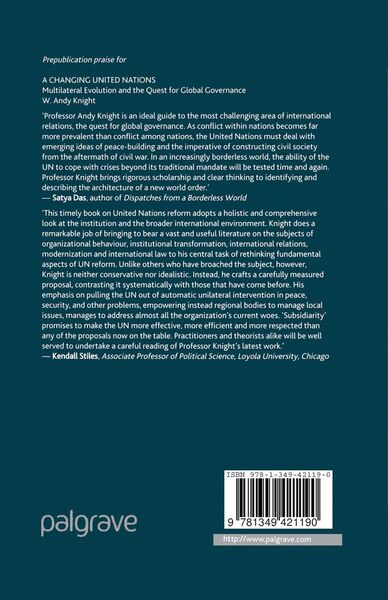
'Professor Andy Knight is an ideal guide to the most challenging area of international relations, the quest for global governance. As conflict within nations becomes far more prevalent than conflict among nations, the United Nations must deal with emerging ideas of peace-building and the imperative of constructing civil society from the aftermath of civil war. In an increasingly borderless world, the ability of the UN to cope with crises beyond its traditional mandate will be tested time and again. Professor Knight brings rigorous scholarship and clear thinking to identifying and describing the architecture of a new world order.' - Satya Das, author of Dispatches from a Borderless World


'Knight's book, at times very insightful and eloquent, makes a modest contribution in helping us confront this puzzle.' - American Political Science Review


'Knight argues his case carefully and lucidly.' - International Journal


'...a carefully measured proposal, contrasting it systematically with those that have come before...Practitioners and theorists alike will be well served to undertake a careful reading of Professor Knight's latest work.' - Dr Kendall Stiles, Associate Professor of Political Science, Loyola University Chicago

Produktdetails

Einband

Taschenbuch

Erscheinungsdatum

01.01.2000

Abbildungen

XX, 257 p.

Verlag Palgrave Macmillan UK

Produktdetails

Einband

Taschenbuch

Erscheinungsdatum

01.01.2000

Abbildungen

XX, 257 p.

Verlag Palgrave Macmillan UK
Seitenzahl

257

Maße (L/B/H)

21,6/14/1,6 cm

Gewicht

356 g

Auflage

1st ed. 2000

Sprache

Englisch

ISBN

978-1-349-42119-0

Herstelleradresse

Springer-Verlag GmbH
Tiergartenstr. 17
69121 Heidelberg
DE

Email: ProductSafety@springernature.com

Ein neues Kapitel für Ihre Bücher

Ein neues Kapitel für Ihre Bücher

Schenken Sie Ihren alten Schätzen ein zweites Leben und erhalten Sie dafür eine Thalia Geschenkkarte.

Jetzt verkaufen
Jetzt verkaufen

Noch keine Bewertungen vorhanden

Verfassen Sie die erste Bewertung zu diesem Artikel

Helfen Sie anderen Kundinnen und Kunden durch Ihre Meinung.

Kundinnen und Kunden meinen

Bewertungen (0)

  • Produktbild: A Changing United Nations
  • Produktbild: A Changing United Nations
  • Dedication List of Tables and Figures Foreword Preface Acknowledgements List of Acronyms Introduction Rationalist and Reflectivist Approaches to Multilateralism and Governance Multilateral Evolution and UN Change Processes Developing Institutional Foundations: Learning in the UN The UN's Global Agenda and the Reflexive Adaptation Process The Managed Change Process at the UN Post-Cold War Multilateralism and the New UN Reform Agenda Subsidiarity and Global Governance Conclusions Appendices Notes Bibliography Indexes