KI-Beratung Beta

Gutscheinbedingungen

Gültig bis 11.11.2026 | Gültig für Spielzeug, Filme, Musik, Software, Games, Geschenke & Trends, Schreibwaren, Hörbücher und Hörbuch-Downloads (außer Abo & Shelfies), gebrauchte Bücher, nicht preisgebundene Bücher und Kalender | Einlösbar unter thalia.de und in der Thalia App | Click & Collect nur mit Online-Zahlung (Paypal/Kreditkarte) vorab | Einzelne Artikel können ausgeschlossen sein | Nicht kombinierbar mit anderen Gutscheinen oder Preisaktionen | Nur einmal pro Einkauf einlösbar | Gutschein wird auf max. 500€ Bestellwert angerechnet | Keine Barauszahlung | Digitale Hörbücher nur für Android  | Nicht gültig für preisgebundene Artikel (aufgrund der Buchpreisbindung sind Gutscheine nicht auf Bücher, eBooks, Presse einlösbar), tolino eReader & Zubehör, Abonnements & Flatrates, Geschenkkarten, Versandkosten und Services

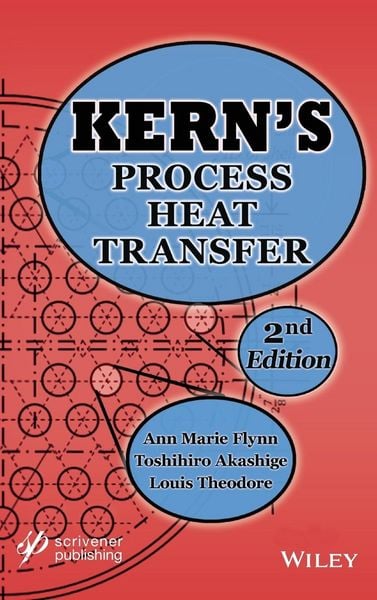
Produktbild: Kern's Process Heat Transfer

Kern's Process Heat Transfer

174,99 €

inkl. gesetzl. MwSt., Versandkostenfrei


Beschreibung

This edition ensures the legacy of the original 1950 classic, Process Heat Transfer, by Donald Q. Kern that by many is held to be the gold standard.

This second edition book is divided into three parts: Fundamental Principles; Heat Exchangers; and Other Heat Transfer Equipment/ Considerations.

  • Part...

Beschreibung

This edition ensures the legacy of the original 1950 classic, Process Heat Transfer, by Donald Q. Kern that by many is held to be the gold standard.

This second edition book is divided into three parts: Fundamental Principles; Heat Exchangers; and Other Heat Transfer Equipment/ Considerations.

  • Part I provides a series of chapters concerned with introductory topics that are required when solving heat transfer problems. This part of the book deals with topics such as steady-state heat conduction, unsteady-state conduction, forced convection, free convection, and radiation.
  • Part II is considered by the authors to be the "meat" of the book, and the primary reason for undertaking this project. Other than minor updates, Part II remains relatively unchanged from the first edition. Notably, it includes Kern's original design methodology for double-pipe, shell-and-tube, and extended surface heat exchangers. Part II also includes boiling and condensation, boilers, cooling towers and quenchers, as well as newly designed open-ended problems.
  • Part III of the book examines other related topics of interest, including refrigeration and cryogenics, batch and unsteady-state processes, health & safety, and the accompanying topic of risk. In addition, this part also examines the impact of entropy calculations on exchanger design.

A 36-page Appendix includes 12 tables of properties, layouts and design factors.

WHAT IS NEW IN THE 2ND EDITION

Changes that are addressed in the 2nd edition so that Kern's original work continues to remain relevant in 21st century process engineering include:

  • Updated Heat Exchanger Design
  • Increased Number of Illustrative Examples
  • Energy Conservation/ Entropy Considerations
  • Environmental Considerations
  • Health & Safety
  • Risk Assessment
  • Refrigeration and Cryogenics

Rezension

"Congratulations to the authors for keeping Kern's classic heat transfer book alive and relevant. This new edition is a wonderful contribution to the chemical engineering literature. As with the classic first edition, the new book can be used as either a reference book for the practicing engineer or a textbook for the undergraduate/graduate engineering student. This book was masterfully updated by a team of experts."
-Rita L. D'Aquino, Former Senior Editor of Chemical Engineering Magazine

Produktdetails

Einband

Gebundene Ausgabe

Erscheinungsdatum

05.06.2019

Verlag John Wiley & Sons Inc
Seitenzahl

726

Produktdetails

Einband

Gebundene Ausgabe

Erscheinungsdatum

05.06.2019

Verlag John Wiley & Sons Inc
Seitenzahl

726

Maße (L/B/H)

23,5/15,7/4,3 cm

Gewicht

1183 g

Auflage

2nd edition

Sprache

Englisch

ISBN

978-1-119-36364-4

Herstelleradresse

Libri GmbH
Europaallee 1
36244 Bad Hersfeld
DE

Email: gpsr@libri.de

Ein neues Kapitel für Ihre Bücher

Ein neues Kapitel für Ihre Bücher

Schenken Sie Ihren alten Schätzen ein zweites Leben und erhalten Sie dafür eine Thalia Geschenkkarte.

Jetzt verkaufen
Jetzt verkaufen

Noch keine Bewertungen vorhanden

Verfassen Sie die erste Bewertung zu diesem Artikel

Helfen Sie anderen Kundinnen und Kunden durch Ihre Meinung.

Kundinnen und Kunden meinen

Bewertungen (0)

Die Leseprobe wird geladen.
  • Produktbild: Kern's Process Heat Transfer
  • Table of Contents (First Edition) vii

    Preface to the First Edition xiii

    Preface to the Second Edition xv

    Acknowledgement xix

    Part I Fundamentals and Principles 1

    1. Introduction to Process Heat Transfer 3

    1.1 Units and Dimensional Analysis 4

    1.2 Key Physical Properties 10

    1.3 Key Process Variables and Concepts 14

    1.4 Laws of Thermodynamics 22

    1.5 Heat-related Theories and Transfer Mechanisms 26

    1.6 Fluid Flow and Pressure Drop Calculations 28

    1.7 Process Heat Transfer 35

    Reference 40

    2 Steady-State and Unsteady-State Heat Conduction 43

    2.1 Flow of Heat through a Wall 46

    2.2 Flow of Heat through a Composite Wall: Resistances in Series 50

    2.3 Flow of Heat through a Pipe Wall 54

    2.4 Microscopic Approach: Steady-State Conduction 63

    2.5 Unsteady-State Heat Conduction 68

    2.6 Microscopic Approach: Unsteady-State Conduction 71

    Reference 77

    3 Forced and Free Convection 79

    3.1 Forced Convection Principles 82

    3.2 Convective Resistances 87

    3.3 Heat Transfer Coefficients: Quantitative Information 89

    3.4 Convection Heat Transfer: Microscopic Approach 105

    3.5 Free Convection Principles and Applications 108

    3.6 Environmental Applications 120

    Reference 126

    4 Radiation 129

    4.1 The Origin of Radiant Energy 132

    4.2 The Distribution of Radiant Energy 133

    4.3 Radiant Exchange Principles 138

    4.4 Kirchoff 's Law 139

    4.5 Emissivity Factors and Energy Interchange 145

    4.6 View Factors 152

    Reference 157

    Part II - Heat Exchangers 159

    5. The Heat Transfer Equation 161

    5.1 Heat Exchanger Equipment Classification 162

    5.2 Energy Relationships 163

    5.3 The Log Mean Temperature Difference (LMTD) Driving Force 166

    5.4 The Overall Heat Transfer Coefficient 183

    5.5 The Heat Transfer Equation 208

    Reference 216

    6 Double Pipe Heat Exchangers 217

    6.1 Equipment Description and Details 218

    6.2 Key Describing Equations 225

    6.3 Pressure Drop in Pipes and Pipe Annuli 244

    6.4 Calculation of Exit Temperatures 251

    6.5 Open-Ended Problems 254

    6.6 Kern's Design Methodology 262

    Reference 286

    7 Shell and Tube Heat Exchangers 287

    7.1 Equipment Description and Details 288

    7.2 Key Describing Equations 305

    7.3 Open-Ended Problems 331

    7.4 Kern's Design Methodology 337

    7.5 Other Design Procedures and Applications 348

    7.6 Computer Aided Heat Exchanger Design 370

    Reference 377

    8 Finned heat Exchangers 379

    8.1 Fin Details 380

    8.2 Equipment Description 386

    8.3 Key Describing Equations 388

    8.4 Fin Effectiveness and Performance 396

    8.5 Kern's Design Methodology 416

    8.6 Other Fin Considerations 430

    Reference 432

    9 Other Heat Exchangers 433

    9.1 Condensers 435

    9.2 Evaporators 447

    9.3 Boilers and Furnace 466

    9.4 Waste Heat Boilers 476

    9.5 Quenchers 484

    9.6 Cogeneration/Combined Heat and Power 488

    9.7 Cooling towers 494

    9.8 Heat pipes 504

    Reference 506

    Part III - Peripheral Topics 509

    10 Other Heat Transfer Considerations 511

    10.1 Insulation and Refractory 512

    10.2 Refrigeration and Cryogenics 529

    10.3 Instrumentation and Controls 542

    10.4 Batch and Unsteady-state Processes 551

    10.5 Operation, Maintenance and Inspection (OM & I) 558

    10.6 Economics and Finance 565

    Reference 581

    11. Entropy Considerations and Analysis 585

    11.1 Qualitative Review of the Second Law 586

    11.2 Describing Equations 587

    11.3 The Heat Exchanger Dilemma 591

    11.4 Application to a Heat Ex