















































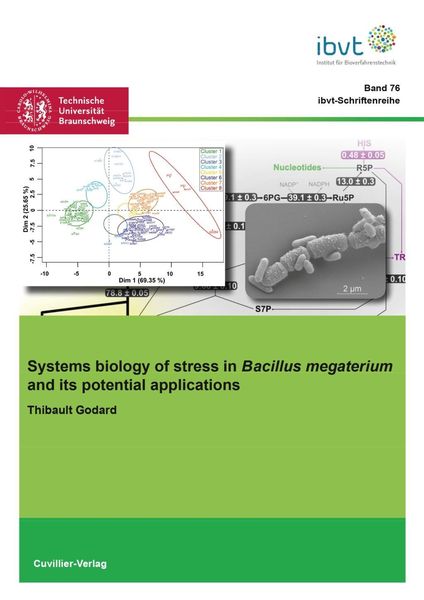
Systems biology of stress in Bacillus megaterium and its potential applications
-
- Taschenbuch ausgewählt
- eBook
-
Sprache:Englisch
60,50 €
inkl. gesetzl. MwSt.,
Beschreibung
Produktdetails
Einband
Taschenbuch
Erscheinungsdatum
06.09.2016
Herausgeber
Rainer KrullVerlag
Cuvillier VerlagSeitenzahl
236
Maße (L/B/H)
21/14,8/1,3 cm
Gewicht
311 g
Sprache
Englisch
ISBN
978-3-7369-9336-5
Generally, once a producer has been genetically designed, optimal process parameters are established to maximise its potential for industrial production. Despite this upstream work, bacterial cells are constantly exposed to various kinds of stress during the whole production process, including e.g. mechanical induced stress, high nutrient or product concentrations and variations of temperature, medium composition or oxygen availability. In this context, the main objective of this work was to investigate more deeply the impact of harsh cultivation temperatures (between 15 and 45°C) and osmotic stress (mimicked using up to 1.8 M NaCl) on the metabolism of the wild-type B. megaterium DSM319 during unlimited growth. To this end, a holistic study including transcriptome, proteome, metabolome and fluxome analyses was performed to offer an integrated picture of cellular adaptation and to find underlying genetic targets for the development of more robust production hosts. Interestingly, while both stress conditions resulted in disruption of redox balance, decreased biomass yields and reduced substrate uptake rates, the flux distribution within the central carbon and energy metabolism as well as the levels of the corresponding mRNAs and proteins were only locally affected. On the contrary, significant modulation of metabolite pools was observed and might constitute a key mechanism to compensate for loss of enzyme activity and maintain or adjust metabolic fluxes under stressful conditions. In addition, specific responses occurring at every biological level were detected in both cases. In particular, exposure at high and low temperature triggered the production of so-called heat and cold shock proteins, respectively, whose functions support sustained growth under these adverse conditions. Under ionic osmotic stress, on the other hand, the whole metabolic machinery was reorganised towards production of the osmoprotectant proline using an alternative pathway only active under this condition. More surprisingly, although B. megaterium has long been known for its capacity to produce the biopolymer polyhydroxybutyric acid (PHB), a positive correlation between intracellular PHB content and salt concentration could be demonstrated for the first time. As neither the concentration of the enzymes involved in the classical PHB-pathway nor that of their related mRNAs significantly increased, these proteins were systematically overproduced in new plasmid strains, resulting in an up to 75 % higher PHB content. Finally, in silico modelling using elementary flux mode analysis was applied and highlighted new genetic targets for the further improvement of PHB production in B. megaterium.
Ein neues Kapitel für Ihre Bücher
Ein neues Kapitel für Ihre Bücher
Schenken Sie Ihren alten Schätzen ein zweites Leben und erhalten Sie dafür eine Thalia Geschenkkarte.
Noch keine Bewertungen vorhanden
Verfassen Sie die erste Bewertung zu diesem Artikel
Helfen Sie anderen Kundinnen und Kunden durch Ihre Meinung.
Kurze Frage zu unserer Seite
Vielen Dank für Ihr Feedback
Wir nutzen Ihr Feedback, um unsere Produktseiten zu verbessern. Bitte haben Sie Verständnis, dass wir Ihnen keine Rückmeldung geben können. Falls Sie Kontakt mit uns aufnehmen möchten, können Sie sich aber gerne an unseren Kund*innenservice wenden.
zum Kundenservice