















































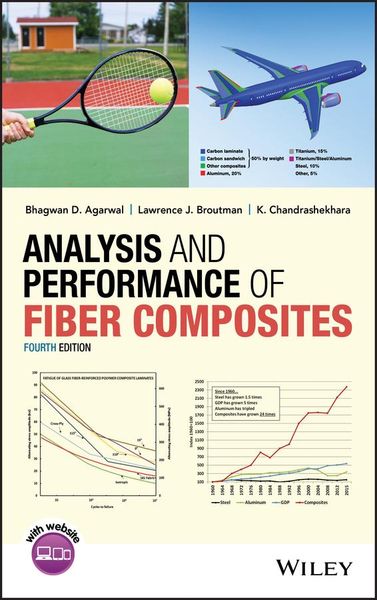
Analysis and Performance of Fiber Composites
161,99 €
inkl. gesetzl. MwSt.,
Beschreibung
Produktdetails
Einband
Gebundene Ausgabe
Erscheinungsdatum
30.10.2017
Verlag
John Wiley & SonsSeitenzahl
576
Maße (L/B/H)
23,1/15,7/3,3 cm
Gewicht
907 g
Auflage
4th edition
Sprache
Englisch
ISBN
978-1-119-38998-9
Updated and expanded coverage of the latest trends and developments in fiber composite materials, processes, and applications
Analysis and Performance of Fiber Composites, Fourth Edition features updated and expanded coverage of all technical aspects of fiber composites, including the latest trends and developments in materials, manufacturing processes, and materials applications, as well as the latest experimental characterization methods.
Fiber reinforced composite materials have become a fundamental part of modern product manufacturing. Routinely used in such high-tech fields as electronics, automobiles, aircraft, and space vehicles, they are also essential to everyday staples of modern life, such as containers, piping, and appliances. Little wonder, when one considers their ease of fabrication, outstanding mechanical properties, design versatility, light weight, corrosion and impact resistance, and excellent fatigue strength. This Fourth Edition of the classic reference the standard text for composite materials courses, worldwide offers an unrivalled review of such an important class of engineering materials.
Still the most comprehensive, up-to-date treatment of the mechanics, materials, performance, analysis, fabrication, and characterization of fiber composite materials available, Analysis and Performance of Fiber Composites, Fourth Edition features:
- Expanded coverage of materials and manufacturing, with additional information on materials, processes, and material applications
- Updated and expanded information on experimental characterization methods including many industry specific tests
- Discussions of damage identification techniques using nondestructive evaluation (NDE)
- Coverage of the influence of moisture on performance of polymer matrix composites, stress corrosion of glass fibers and glass reinforced plastics, and damage due to low-velocity impact
- New end-of-chapter problems and exercises with solutions found on an accompanying website
- Computer analysis of laminates
No other reference provides such exhaustive coverage of fiber composites with such clarity and depth. Analysis and Performance of Fiber Composites, Fourth Edition is, without a doubt, an indispensable resource for practicing engineers, as well as students of mechanics, mechanical engineering, and aerospace engineering.
Ein neues Kapitel für Ihre Bücher
Ein neues Kapitel für Ihre Bücher
Schenken Sie Ihren alten Schätzen ein zweites Leben und erhalten Sie dafür eine Thalia Geschenkkarte.
Noch keine Bewertungen vorhanden
Verfassen Sie die erste Bewertung zu diesem Artikel
Helfen Sie anderen Kundinnen und Kunden durch Ihre Meinung.
Kurze Frage zu unserer Seite
Vielen Dank für Ihr Feedback
Wir nutzen Ihr Feedback, um unsere Produktseiten zu verbessern. Bitte haben Sie Verständnis, dass wir Ihnen keine Rückmeldung geben können. Falls Sie Kontakt mit uns aufnehmen möchten, können Sie sich aber gerne an unseren Kund*innenservice wenden.
zum Kundenservice