















































KI-Beratung Beta

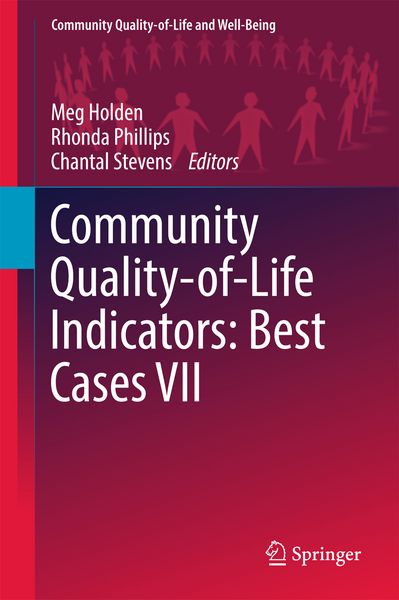
  • Produktbild: Community Quality-of-Life Indicators: Best Cases VII
  • Produktbild: Community Quality-of-Life Indicators: Best Cases VII

Community Quality-of-Life Indicators: Best Cases VII

49,99 €

inkl. gesetzl. MwSt., Versandkostenfrei


Beschreibung

Produktdetails

Einband

Gebundene Ausgabe

Erscheinungsdatum

24.04.2017

Abbildungen

VIII, 184 p. 47 illus.

Herausgeber

Meg Holden + weitere

Verlag

Springer

Seitenzahl

184

Maße (L/B/H)

24,1/16/1,7 cm

Gewicht

407 g

Auflage

1st ed. 2017

Sprache

Englisch

ISBN

978-3-319-54617-9

Beschreibung

Portrait

Meg Holden (PhD, New School for Social Research) is a social scientist whose research investigates the promises and results of sustainability planning in cities around the world. She is an Associate Professor of urban studies and geography at Simon Fraser University in Vancouver, Canada. Meg served as a board member of the Community Indicators Consortium from 2011-2016 and she currently serves as editorial board member of the journal Applied Research in Quality of Life as well as the Springer book series on Community Quality of Life and Wellbeing. Meg is the author of Pragmatic Justifications for the Sustainable City: Acting in the common place (Routledge, 2017).


Rhonda Phillips, Ph.D., FACIP, has research and outreach efforts that focus on quality of life and well-being related to community and economic development. At Purdue University, she serves as inaugural Dean of the Honors College and a professor in the Agricultural Economics Department. She is author or editorof over 20 books, including Sustainable Communities: Creating a Durable Local Economy, and Introduction to Community Development.  Formerly a Senior Sustainability Scientist with the Wrigley Global Institute of Sustainability, Rhonda also served as director and professor in the School of Community Resources and Development at Arizona State University. She is a member of the College of Fellows of the American Institute of Certified Planners, and immediate past president of the International Society for Quality-of-Life Studies. 


Chantal Stevens is a Performance Management Analyst for the King County Auditor's Office where she also holds the position of Program Oversight Manager for the Countywide Community Forums, an innovative collaboration between the public and King County to improve public engagement. She previously served on the CIC board from 2004-2007, and again in 2012. Chantal was formerly the Executive Director of Sustainable Seattle, a pioneer inthe development of community indicators. She was the co- lead of the first conference dedicated to the exploration of CI-PM integration, and is currently an active advocate for community indicators and public engagement as a key element of a functioning performance management system at King County. She holds a BS and MMA from the University of Washington.

Produktdetails

Einband

Gebundene Ausgabe

Erscheinungsdatum

24.04.2017

Abbildungen

VIII, 184 p. 47 illus.

Herausgeber

Verlag

Springer

Seitenzahl

184

Maße (L/B/H)

24,1/16/1,7 cm

Gewicht

407 g

Auflage

1st ed. 2017

Sprache

Englisch

ISBN

978-3-319-54617-9

Herstelleradresse

Springer-Verlag KG
Sachsenplatz 4-6
1201 Wien
AT

Email: ProductSafety@springernature.com

Ein neues Kapitel für Ihre Bücher

Ein neues Kapitel für Ihre Bücher

Schenken Sie Ihren alten Schätzen ein zweites Leben und erhalten Sie dafür eine Thalia Geschenkkarte.

Jetzt verkaufen
Jetzt verkaufen

Noch keine Bewertungen vorhanden

Verfassen Sie die erste Bewertung zu diesem Artikel

Helfen Sie anderen Kundinnen und Kunden durch Ihre Meinung.

Kundinnen und Kunden meinen

Bewertungen (0)

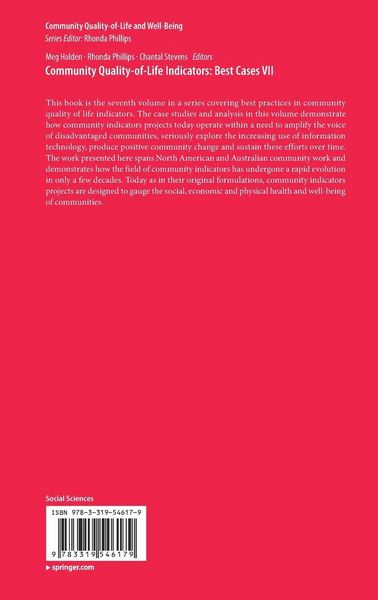
  • Produktbild: Community Quality-of-Life Indicators: Best Cases VII
  • Produktbild: Community Quality-of-Life Indicators: Best Cases VII
  • Preface; Rhonda Phillips, Meg Holden and Chantal Stevens.- Introduction; Chantal Stevens, Lyle Wray.- PART I. Community Indicators Identifying Different Types of Disadvantage.- Chapter 1. Environmental Justice in Australia: Measuring the Relationship between Industrial Odour Exposure and Community Disadvantage; Lucy Gunn, Billy Greenham, Melanie Davern, Suzanne Mavoa, Elizabeth Jean Taylor and Mark Bannister.- Chapter 2. Aligning Local and Regional Data to Achieve a More Inclusive Economy: A Northeast Ohio Model; Emily Garr Pacetti.- Chapter 3. Addressing Disparities and Improving the System of Care for Veterans Through the Community Assessment Process; Samantha Green, Melanie Espino.- Chapter 4. Economic Issues for Women in Texas; Jennifer Lee, Frances Deviney.- PART II. Comprehensiveness and Collaboration in Community Indicators.- Chapter 5. Comprehensive Sustainability Indicators: The Houston Sustainability Indicators Program; Lester King.- Chapter 6. Collaboration to Promote Use of Community Indicators: Communication is Key; Craig Helmstetter, Paul Mattessich, Ruth Hamberg and Nancy Harzler.- Chapter 7. Getting to Groundbreaking, But No Further: Network Failure in a Housing Indicators Collaborative; Meg Holden and Daniel Sturgeon.- Chapter 8. Community Indicators and the Collective Goods Criterion for Impact; Frank Ridzi.