















































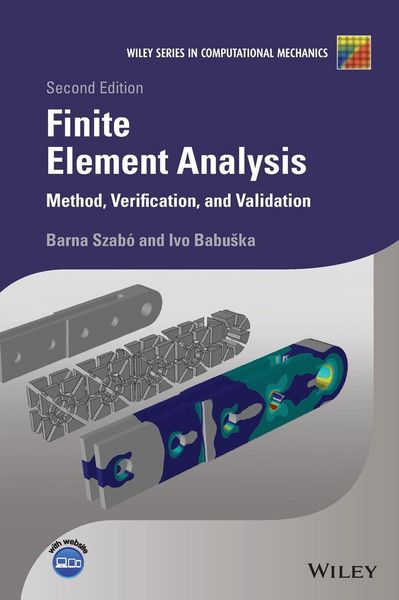
Finite Element Analysis Method, Verification and Validation
156,99 €
inkl. gesetzl. MwSt.,
Beschreibung
Produktdetails
Einband
Gebundene Ausgabe
Erscheinungsdatum
22.06.2021
Verlag
John Wiley & Sons IncSeitenzahl
384
Maße (L/B/H)
25,4/18,4/3 cm
Gewicht
897 g
Auflage
2nd edition
Sprache
Englisch
ISBN
978-1-119-42642-4
An updated and comprehensive review of the theoretical foundation of the finite element method
The revised and updated second edition of Finite Element Analysis: Method, Verification, and Validation offers a comprehensive review of the theoretical foundations of the finite element method and highlights the fundamentals of solution verification, validation, and uncertainty quantification. Written by noted experts on the topic, the book covers the theoretical fundamentals as well as the algorithmic structure of the finite element method. The text contains numerous examples and helpful exercises that clearly illustrate the techniques and procedures needed for accurate estimation of the quantities of interest. In addition, the authors describe the technical requirements for the formulation and application of design rules.
Designed as an accessible resource, the book has a companion website that contains a solutions manual, PowerPoint slides for instructors, and a link to finite element software. This important text:
* Offers a comprehensive review of the theoretical foundations of the finite element method
* Puts the focus on the fundamentals of solution verification, validation, and uncertainty quantification
* Presents the techniques and procedures of quality assurance in numerical solutions of mathematical problems
* Contains numerous examples and exercises
Written for students in mechanical and civil engineering, analysts seeking professional certification, and applied mathematicians, Finite Element Analysis: Method, Verification, and Validation, Second Edition includes the tools, concepts, techniques, and procedures that help with an understanding of finite element analysis.
Ein neues Kapitel für Ihre Bücher
Ein neues Kapitel für Ihre Bücher
Schenken Sie Ihren alten Schätzen ein zweites Leben und erhalten Sie dafür eine Thalia Geschenkkarte.
Noch keine Bewertungen vorhanden
Verfassen Sie die erste Bewertung zu diesem Artikel
Helfen Sie anderen Kundinnen und Kunden durch Ihre Meinung.
Kurze Frage zu unserer Seite
Vielen Dank für Ihr Feedback
Wir nutzen Ihr Feedback, um unsere Produktseiten zu verbessern. Bitte haben Sie Verständnis, dass wir Ihnen keine Rückmeldung geben können. Falls Sie Kontakt mit uns aufnehmen möchten, können Sie sich aber gerne an unseren Kund*innenservice wenden.
zum Kundenservice