KI-Beratung Beta

Gutscheinbedingungen

Gültig bis 30.11.2026 | Gültig für nicht preisgebundene fremdsprachige Bücher | Einzelne Artikel können ausgeschlossen sein | Online auf thalia.de und in der Thalia App einlösbar | Click & Collect nur mit Online-Zahlung (Paypal/Kreditkarte) vorab | Nicht kombinierbar mit anderen Gutscheinen oder Preisaktionen | Nur einmal pro Einkauf einlösbar | Gutschein wird auf max. 500€ Bestellwert angerechnet | Keine Barauszahlung | Nicht gültig für Versandkosten und Services

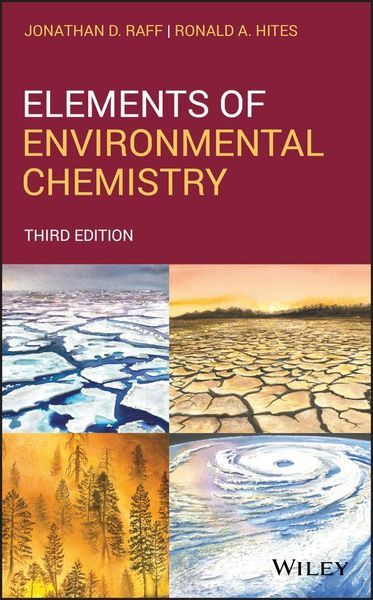
Produktbild: Elements of Environmental Chemistry

Elements of Environmental Chemistry

92,99 €

inkl. gesetzl. MwSt., Versandkostenfrei


Beschreibung

A practical approach to environmental chemistry, Elements of Environmental Chemistry, 3rd Edition provides readers with the fundamentals of environmental chemistry and a toolbox for putting them into practice. This is a concise, accessible, and hands-on volume designed for students and professionals...

Beschreibung

A practical approach to environmental chemistry, Elements of Environmental Chemistry, 3rd Edition provides readers with the fundamentals of environmental chemistry and a toolbox for putting them into practice. This is a concise, accessible, and hands-on volume designed for students and professionals working in the chemical and environmental sciences.

The 3rd Edition has been completely revised and rearranged. The first chapter on tool skills has been expanded to include thermodynamic considerations and measurement issues. The former chapter on the partitioning of organic compounds has been expanded to cover the fates of organic compounds, with an emphasis on developing the reader's "chemical intuition" for predicting a chemical's fate based on structure. The material on lead, mercury, pesticides, PCBs, dioxins, and flame retardants has been expanded and combined into the last chapter and supplemented with more references to the literature. The problem sets have been extended and now include over 130 problems, some of which can be solved using Excel.

Produktdetails

Einband

Gebundene Ausgabe

Erscheinungsdatum

04.08.2020

Verlag John Wiley & Sons
Seitenzahl

288

Produktdetails

Einband

Gebundene Ausgabe

Erscheinungsdatum

04.08.2020

Verlag John Wiley & Sons
Seitenzahl

288

Maße (L/B/H)

23,1/15,2/1,8 cm

Gewicht

567 g

Auflage

3rd edition

Sprache

Englisch

ISBN

978-1-119-43487-0

Herstelleradresse

Libri GmbH
Europaallee 1
36244 Bad Hersfeld
DE

Email: gpsr@libri.de

Ein neues Kapitel für Ihre Bücher

Ein neues Kapitel für Ihre Bücher

Schenken Sie Ihren alten Schätzen ein zweites Leben und erhalten Sie dafür eine Thalia Geschenkkarte.

Jetzt verkaufen
Jetzt verkaufen

Noch keine Bewertungen vorhanden

Verfassen Sie die erste Bewertung zu diesem Artikel

Helfen Sie anderen Kundinnen und Kunden durch Ihre Meinung.

Kundinnen und Kunden meinen

Bewertungen (0)

Die Leseprobe wird geladen.
  • Produktbild: Elements of Environmental Chemistry
  • Preface xi

    1 Simple Tool Skills 1

    1.1 Unit Conversions 1

    1.2 Estimating 4

    1.3 Ideal Gas Law 6

    1.4 Stoichiometry 9

    1.5 Thermodynamic Considerations 10

    1.5.1 Enthalpy 11

    1.5.2 Entropy 13

    1.5.3 Gibbs Free Energy 14

    1.6 Measurement Issues 15

    1.7 Problem Set 24

    2 Mass Balance and Kinetics 29

    2.1 Steady-State Mass Balance 29

    2.1.1 Flows, Stocks, and Residence Times 29

    2.1.2 Adding Multiple Flows 35

    2.1.3 Fluxes Are Not Flows! 37

    2.2 Nonsteady-State Mass Balance 39

    2.2.1 Up-Going Curve 40

    2.2.2 Down-Going Curve 43

    2.2.3 Working with Real Data 45

    2.3 Chemical Kinetics 49

    2.3.1 First-Order Reactions 50

    2.3.2 Second-Order Reactions 50

    2.3.3 Michaelis-Menten Kinetics 52

    2.4 Problem Set 56

    3 Atmospheric Chemistry 63

    3.1 Atmospheric Structure 63

    3.2 Light and Photochemistry 65

    3.3 Atmospheric Oxidants 69

    3.4 Kinetics of Atmospheric Reactions 70

    3.4.1 Pseudo-Steady-State Example 70

    3.4.2 Arrhenius Equation 71

    3.5 Stratospheric Ozone 72

    3.5.1 Formation and Loss Mechanisms 72

    3.5.2 Chapman Reaction Kinetics 77

    3.6 Smog 80

    3.7 Problem Set 84

    4 Climate Change 93

    4.1 Historical Perspective 93

    4.2 Blackbody Radiation and Earth's Temperature 94

    4.3 Absorption of Infrared Radiation 97

    4.4 Greenhouse Effect 98

    4.5 Earth's Radiative Balance 99

    4.5.1 Greenhouse Gases 99

    4.5.2 Albedo 101

    4.5.3 Solar Constant 101

    4.5.4 Combined Effects 101

    4.6 Aerosols and Clouds 101

    4.7 Radiative Forcing 103

    4.8 Global Warming Potentials 104

    4.9 Concluding Remarks 106

    4.10 Problem Set 108

    5 Carbon Dioxide Equilibria 113

    5.1 pH and Equilibrium Constants 113

    5.2 Pure Rain 116

    5.3 Polluted Rain 119

    5.4 Additional Acid Rain Chemistry and Implications 123

    5.5 Surface Water 125

    5.6 Ocean Acidification 128

    5.7 Problem Set 132

    6 Fates of Organic Compounds 139

    6.1 Molecular Interactions 140

    6.1.1 Electronegativity 140

    6.1.2 Molecular Dipoles and Quadrupoles 141

    6.1.3 Types of Weak Interactions 142

    6.2 Vapor Pressure 145

    6.3 Aqueous Solubility 149

    6.3.1 Solubility of Pure Liquids and Solids 149

    6.3.2 Solubility of Gases 154

    6.4 Partitioning into Organic Phases 158

    6.5 Partitioning into Biota 160

    6.5.1 Bioconcentration 161

    6.5.2 Bioaccumulation 161

    6.5.3 Biomagnification 162

    6.6 Adsorption 162

    6.7 Water-Air Transfer 165

    6.8 Reactive Fates of Organic Pollutants 168

    6.9 Putting It All Together: Partitioning and Persistence 169

    6.10 Problem Set 172

    7 Toxic Stuff: Mercury, Lead, Pesticides, Polychlorinated Biphenyls, Dioxins, and Flame Retardants 181

    7.1 Mercury 181

    7.2 Lead 183

    7.3 Pesticides 188

    7.3.1 Pesticide History 189

    7.3.2 Legacy Pesticides 190

    7.3.3 Current Use Herbicides 194

    7.3.4 Current Use Insecticides 198

    7.3.5 Current Use Fumigants 201

    7.3.6 Current Use Fungicides 203

    7.4 Polychlorinated Biphenyls (PCBs) 203

    7.4.1 PCB Nomenclature 204

    7.4.2 PCB Production and Use 205

    7.4.3 PCBs in the Hudson River 206

    7.4.4 PCBs in Bloomington, Indiana 209

    7.4.5 Yusho and Yu-Cheng Diseases 211

    7.4.6 PCB Conclusions 213

    7.5 Polychlorinated Dibenzo-p-dioxins and Dibenzofurans 214

    7.5.1 Dioxin Nomenclature 214

    7.5.2 Chick Edema Disease 215

    7.5.3 Agent Orange 216

    7.5.4 Times Beach, Missouri 218

    7.5.5 Seveso, Italy 219

    7.5.6 Combustion Sources of Dioxins 222

    7.5.7 US Di