















































KI-Beratung Beta

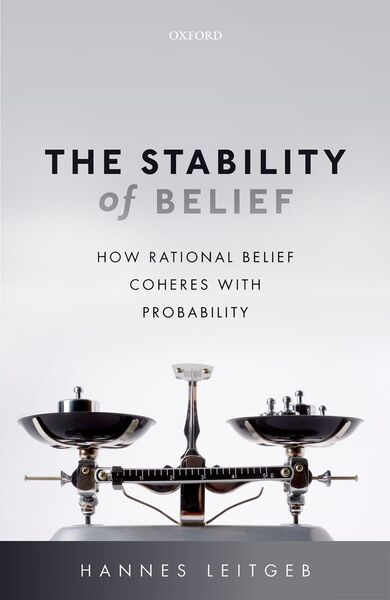
Produktbild: The Stability of Belief

The Stability of Belief How Rational Belief Coheres with Probability

98,49 €

inkl. gesetzl. MwSt.

Beschreibung

In everyday life we normally express our beliefs in all-or-nothing terms: I believe it is going to rain; I don't believe that my lottery ticket will win. In other cases, if possible, we resort to numerical probabilities: my degree of belief that it is going to rain is 80%; the probability that I assign...

Beschreibung

In everyday life we normally express our beliefs in all-or-nothing terms: I believe it is going to rain; I don't believe that my lottery ticket will win. In other cases, if possible, we resort to numerical probabilities: my degree of belief that it is going to rain is 80%; the probability that I assign to my ticket winning is one in a million. It is an open philosophical question how all-or-nothing belief and numerical belief relate to each other, and how we ought to reason with them simultaneously. The Stability of Belief develops a theory of rational belief that aims to answer this question. Hannes Leitgeb develops a joint normative theory of all-or-nothing belief and numerical degrees of belief. While rational all-or-nothing belief is studied in traditional epistemology and is usually assumed to obey logical norms, rational degrees of belief constitute the subject matter of Bayesian epistemology and are normally taken to conform to probabilistic norms. One of the central open questions in formal epistemology is what beliefs and degrees of belief have to be like in order for them to cohere with each other. The answer defended in this book is a stability account of belief: a rational agent believes a proposition just in case the agent assigns a stably high degree of belief to it. Leitgeb determines this theory's consequences for, and applications to, learning, suppositional reasoning, decision-making, assertion, acceptance, conditionals, and chance. The volume builds new bridges between logic and probability theory, traditional and formal epistemology, theoretical and practical rationality, and synchronic and diachronic norms for reasoning.

Produktdetails

Format

PDF

Kopierschutz

Ja

Family Sharing

Nein

Text-to-Speech

Nein

Produktdetails

Format

PDF

Format

eBooks im PDF-Format haben eine festgelegte Seitengröße und eignen sich daher nur bedingt zum Lesen auf einem tolino eReader oder Smartphone. Für den vollen Lesegenuss empfehlen wir Ihnen bei PDF-eBooks die Verwendung eines Tablets oder Computers.

Kopierschutz

Ja

Kopierschutz

Zum Lesen dieses eBooks auf Geräten der tolino Familie sowie auf sonstigen eReadern und am PC benötigen Sie eine ByteBook-ID. Weitere Hinweise zum Lesen von kopiergeschützten eBooks finden Sie unter Hilfe/Downloads.

Family Sharing

Nein

Family Sharing

Mit Family Sharing können Sie eBooks innerhalb Ihrer Familie (max. sechs Mitglieder im gleichen Haushalt) teilen. Sie entscheiden selbst, welches Buch Sie mit welchem Familienmitglied teilen möchten. Auch das parallele Lesen durch verschiedene Familienmitglieder ist durch Family Sharing möglich. Um eBooks zu teilen oder geteilt zu bekommen, muss jedes Familienmitglied ein Konto bei Thalia oder einem anderen tolino-Buchhändler haben. Weitere Informationen finden Sie unter Hilfe/Family-Sharing.

Text-to-Speech

Nein

Text-to-Speech

Bedeutet Ihnen Stimme mehr als Text? Mit der Funktion Text-to-Speech können Sie sich im tolino webReader und in der aktuellen Thalia – Lesen & Hören App das eBook vorlesen lassen. Weitere Informationen finden Sie unter Hilfe/Text-to-Speech.

Erscheinungsdatum

24.03.2017

Verlag Oxford University Press
Seitenzahl

368 (Printausgabe)

Dateigröße

5011 KB

Sprache

Englisch

EAN

9780191047015

Barrierefreiheit
  • keine Information zur Barrierefreiheit bekannt

Noch keine Bewertungen vorhanden

Verfassen Sie die erste Bewertung zu diesem Artikel

Helfen Sie anderen Kundinnen und Kunden durch Ihre Meinung.

Kundinnen und Kunden meinen

Bewertungen (0)

Weitere Artikel finden Sie in

Die Leseprobe wird geladen.
  • Produktbild: The Stability of Belief