















































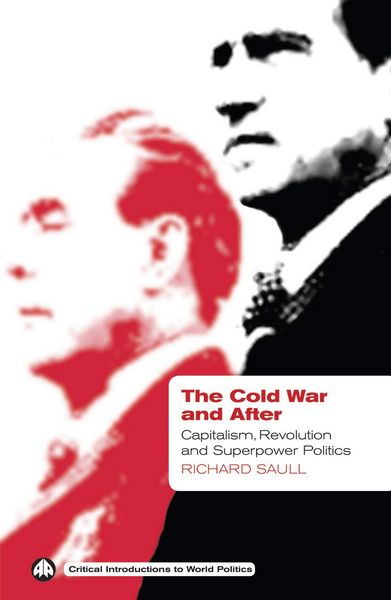
The Cold War and After Capitalism, Revolution and Superpower Politics
Aus der Reihe
Critical Introductions to World Politics
-
- Taschenbuch
- eBook ausgewählt
-
Form:Einzelkauf Download
-
Sprache:Englisch
40,99 €
inkl. gesetzl. MwSt.Beschreibung
Produktdetails
Format
ePUB
Kopierschutz
Ja
Family Sharing
Nein
Text-to-Speech
Ja
Erscheinungsdatum
20.01.2007
Verlag
Pluto PressSeitenzahl
288 (Printausgabe)
Dateigröße
1354 KB
Auflage
1. Auflage
Sprache
Englisch
EAN
9781783719426
'Richard Saull provides us with major new insights into the turbulent history of the twentieth century - once dominated by a fear of revolution and now driven by new worries about weapons of mass destruction and global jihad. A must read for those looking for another way of thinking about our dark times.'
Professor Michael Cox, Department of International Relations and Director of the Cold War Studies Centre at the London School of Economics
'Rick Saull provides a comprehensive reinterpretation of world politics in the 'short twentieth century' (1917-91). ... Whatever your perspective, this book will challenge you to rethink your views of Cold War politics, and the post-Cold War world.' Mark Rupert, Professor of Political Science, Maxwell School of Citizenship & Public Affairs, Syracuse University, USA
'An indispensable book.'
Professor Marilyn Young, Department of History, New York University
'Sophisticated and illuminating. The book exposes the thin superficiality of mainstream efforts to capture and explain the dynamics of the Cold War. And it raises fundamental theoretical issues about the sociology of contemporary international politics. Richard Saull's fascinating and challenging book will be indispensable not only for students of Cold War history but for students of international relations theory.'
Peter Gowan, Professor of International Relations, London Metropolitan University
The Cold War is often presented as a power struggle between the Soviet Union and the US. Richard Saull challenges this assumption. He broadens our understanding of the defining political conflict of the twentieth century by stressing the social and ideological differences of the superpowers and how these differences conditioned their international behaviour.
Saull argues that US-Soviet antagonism was part of a wider conflict between capitalism and communism involving states and social forces other than the superpowers. The US was committed to containing revolutionary movements that emerged out of uneven capitalist development. Saull not only provides a richer international history of the Cold War than mainstream approaches, but is also explains why revolutionary domestic transformations caused international crises. Tracing the origins of resistance to American power, Saull's book provides an ideal alternative perspective on the Cold War and its end.
Noch keine Bewertungen vorhanden
Verfassen Sie die erste Bewertung zu diesem Artikel
Helfen Sie anderen Kundinnen und Kunden durch Ihre Meinung.
Kurze Frage zu unserer Seite
Vielen Dank für Ihr Feedback
Wir nutzen Ihr Feedback, um unsere Produktseiten zu verbessern. Bitte haben Sie Verständnis, dass wir Ihnen keine Rückmeldung geben können. Falls Sie Kontakt mit uns aufnehmen möchten, können Sie sich aber gerne an unseren Kund*innenservice wenden.
zum Kundenservice