















































KI-Beratung Beta

Gutscheinbedingungen

Gültig bis 30.11.2026 | Gültig für nicht preisgebundene fremdsprachige Bücher | Einzelne Artikel können ausgeschlossen sein | Online auf thalia.de und in der Thalia App einlösbar | Click & Collect nur mit Online-Zahlung (Paypal/Kreditkarte) vorab | Nicht kombinierbar mit anderen Gutscheinen oder Preisaktionen | Nur einmal pro Einkauf einlösbar | Gutschein wird auf max. 500€ Bestellwert angerechnet | Keine Barauszahlung | Nicht gültig für Versandkosten und Services

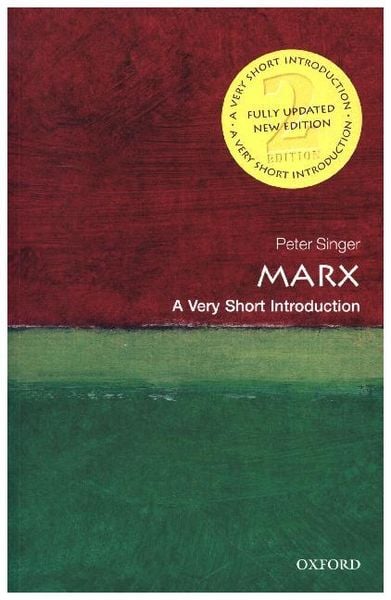
Produktbild: Marx

Marx A Very Short Introduction

Aus der Reihe Very Short Introductions

13,99 €

inkl. gesetzl. MwSt., Versandkostenfrei


Beschreibung

Karl Marx is one of the most influential philosophers of all time, whose theories have shaped and directed political, economic, and social thought for 150 years. Considering Marx's life and impact, renowned philosopher Peter Singer identifies the central vision that unifies Marx's thought, enabling us...

Beschreibung

Karl Marx is one of the most influential philosophers of all time, whose theories have shaped and directed political, economic, and social thought for 150 years. Considering Marx's life and impact, renowned philosopher Peter Singer identifies the central vision that unifies Marx's thought, enabling us to grasp Marx's views as a whole. Presenting Marx as a philosopher primarily concerned with human freedom, rather than as an economist or a social scientist, Singer
explains Marx's key ideas on alienation, historical materialism, and the economic theory of Capital, in plain English.
In this new edition, Singer explores whether Marx remains relevant to the twenty first century, and if so, how. Does the fact that eight billionaires now own as much as the bottom half of the world's population give support to Marxist thinking? Does the ease with which conservative politicians can win over working class voters by appealing to nationalism undermines Marx's view of class struggle and the inevitability of victory for the proletariat? Singer ponders key questions such as these,
and also discusses the place of the internet as a 'productive force' when analysed in Marxist theory. He concludes with an assessment of Marx's legacy, asking if there is any realistic prospect of replacing capitalism with a better system of production and distribution in the twenty first century.
ABOUT THE SERIES: The Very Short Introductions series from Oxford University Press contains hundreds of titles in almost every subject area. These pocket-sized books are the perfect way to get ahead in a new subject quickly. Our expert authors combine facts, analysis, perspective, new ideas, and enthusiasm to make interesting and challenging topics highly readable.

Rezension

An admirably balanced portrait of the man and his achievement. The Observer

Produktdetails

Einband

Taschenbuch

Erscheinungsdatum

01.05.2018

Abbildungen

12 black and white images

Verlag Oxford University Press

Produktdetails

Einband

Taschenbuch

Erscheinungsdatum

01.05.2018

Abbildungen

12 black and white images

Verlag Oxford University Press
Seitenzahl

160

Maße (L/B/H)

17,5/11,3/1,5 cm

Gewicht

119 g

Auflage

2nd edition

Sprache

Englisch

ISBN

978-0-19-882107-6

Herstelleradresse

Libri GmbH
Europaallee 1
36244 Bad Hersfeld
DE

Email: gpsr@libri.de

Ein neues Kapitel für Ihre Bücher

Ein neues Kapitel für Ihre Bücher

Schenken Sie Ihren alten Schätzen ein zweites Leben und erhalten Sie dafür eine Thalia Geschenkkarte.

Jetzt verkaufen
Jetzt verkaufen

Noch keine Bewertungen vorhanden

Verfassen Sie die erste Bewertung zu diesem Artikel

Helfen Sie anderen Kundinnen und Kunden durch Ihre Meinung.

Kundinnen und Kunden meinen

Bewertungen (0)

Die Leseprobe wird geladen.
  • Produktbild: Marx
    • 1: A life and its legacy
    • 2: The young Hegelian
    • 3: From God to money
    • 4: Enter the proletariat
    • 5: The first Marxism
    • 6: Tracing the development of the Materialist theory of history
    • 7: The goal of history
    • 8: Economics
    • 9: Communism and revolution
    • 10: Was Marx right?
    • 11: Is Marx still relevant?
    • Further Reading
    • Index