















































KI-Beratung Beta

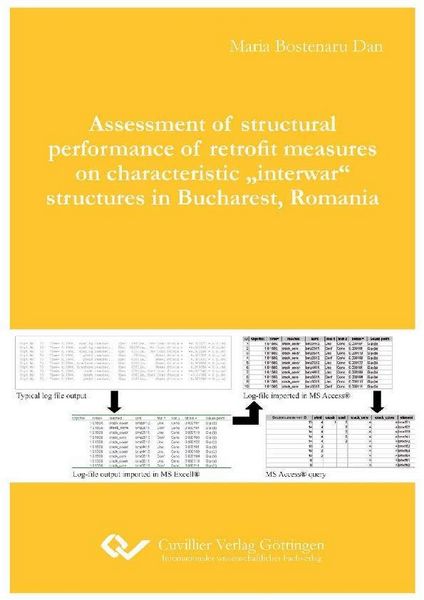
Produktbild: Assessment of structural performance of retrofit measures on characteristic "interwar" structures in Bucharest, Romania

Assessment of structural performance of retrofit measures on characteristic "interwar" structures in Bucharest, Romania

26,67 €

inkl. gesetzl. MwSt.

Beschreibung

This study is dedicated to the preservation of the heritage of the Modern Movement, particularly through improving the structural response to seismic solicitations, which are common in some of the areas where significant works in this style can be found, including Bucharest, Romania. The focus is on...

Beschreibung

This study is dedicated to the preservation of the heritage of the Modern Movement,
particularly through improving the structural response to seismic solicitations, which are
common in some of the areas where significant works in this style can be found,
including Bucharest, Romania. The focus is on developing and validating methodology
according to which the vulnerability of "interwar" buildings, which is the other name
given to the blocks of flats which witnessing the Modern Movement in the Romanian
capital. To complement this study with a geographical generalisation, the models
proposed have been also tested for selected earthquakes, taking into account that the
Modern Movement left its traces in form of that very characteristic blocks of flats there
as well.
Residences in form of blocks of flats of the Modern Movement have been built in
Bucharest in the 1930s. They present a reinforced concrete frame structure, which infill
walls of masonry bricks, although the later could only be limitedly taken into account in
this study. However, the method used remains perfectly valid.
To determine the impacts of strong ground motion on a certain type of buildings, several
approaches have been applied:
- the static pushover curve analysis
- displacement based dynamic time-history analysis
- stress-strain approach based on the dynamic time-history analysis
These simulation types have been applied first to simple models, reproducing what in an
experimentallaboratory might be tested, then to models of progressivelly more
complicated buildings, from regular frame structures, to real building models, which all
the irregularities usual in the building practice in that time. The methodology adopted
included use of several computer support tools, beginning with software for converting
accelerograms, fibre based finite elements, spread shet and database programs.
A further step in testing the general validity has been the use of the same methodology
for simplified models of real buildings which have been found to be of the same typology
as the models studied more extenisivelly. This examination has shown that the
methodology proposed is perfectly valid for them. The integration within the general
frame of assessment of structural performance has been made comparing the computed
damages with real damage types. For this purpose a matrix of damages suffered by
"interwar" buildings, previously developed by the author, has been used. It proved again,
that the predictions for the buildings with the same geometrical characteristics as those
which have been object of this study were close to the reality.
The innovative part of this study relies in the stress-strain based approach applied to
building models of this size. Such an analysis allows not only description of failure mode
and determination of limit states eventually reached by the building, but also the specific
determination of the number and, if necessary, position of structural members suffering
different types of damage. This kind of output can build the input for other
interdisciplinary studies. Of interest for the author is the economic study regarding the
retrofit/repair needs of damaged elements as opposed to preventive retrofit. In this
sense, an issue for further research, which has been only marginally handled within this
work is the retrofit of previously damaged structures, an issue, which perfectly suits into
the methodology already proposed and validated.

Produktdetails

Format

PDF

Kopierschutz

Nein

Family Sharing

Ja

Text-to-Speech

Nein

Produktdetails

Format

PDF

Format

eBooks im PDF-Format haben eine festgelegte Seitengröße und eignen sich daher nur bedingt zum Lesen auf einem tolino eReader oder Smartphone. Für den vollen Lesegenuss empfehlen wir Ihnen bei PDF-eBooks die Verwendung eines Tablets oder Computers.

Kopierschutz

Nein

Kopierschutz

Dieses eBook können Sie uneingeschränkt auf allen Geräten der tolino Familie, allen sonstigen eReadern und am PC lesen. Das eBook ist nicht kopiergeschützt und kann ein personalisiertes Wasserzeichen enthalten. Weitere Hinweise zum Lesen von eBooks mit einem personalisierten Wasserzeichen finden Sie unter Hilfe/Downloads.

Family Sharing

Ja

Family Sharing

Mit Family Sharing können Sie eBooks innerhalb Ihrer Familie (max. sechs Mitglieder im gleichen Haushalt) teilen. Sie entscheiden selbst, welches Buch Sie mit welchem Familienmitglied teilen möchten. Auch das parallele Lesen durch verschiedene Familienmitglieder ist durch Family Sharing möglich. Um eBooks zu teilen oder geteilt zu bekommen, muss jedes Familienmitglied ein Konto bei Thalia oder einem anderen tolino-Buchhändler haben. Weitere Informationen finden Sie unter Hilfe/Family-Sharing.

Text-to-Speech

Nein

Text-to-Speech

Bedeutet Ihnen Stimme mehr als Text? Mit der Funktion Text-to-Speech können Sie sich im tolino webReader und in der aktuellen Thalia – Lesen & Hören App das eBook vorlesen lassen. Weitere Informationen finden Sie unter Hilfe/Text-to-Speech.

Erscheinungsdatum

10.11.2010

Verlag Cuvillier Verlag eBooks
Seitenzahl

228 (Printausgabe)

Dateigröße

19321 KB

Sprache

Englisch

EAN

9783736935457

Barrierefreiheit
  • keine Information zur Barrierefreiheit bekannt

Noch keine Bewertungen vorhanden

Verfassen Sie die erste Bewertung zu diesem Artikel

Helfen Sie anderen Kundinnen und Kunden durch Ihre Meinung.

Kundinnen und Kunden meinen

Bewertungen (0)

Weitere Artikel finden Sie in

Die Leseprobe wird geladen.
  • Produktbild: Assessment of structural performance of retrofit measures on characteristic "interwar" structures in Bucharest, Romania