















































KI-Beratung Beta

Gutscheinbedingungen

Gültig bis 30.11.2026 | Gültig für nicht preisgebundene fremdsprachige Bücher | Einzelne Artikel können ausgeschlossen sein | Online auf thalia.de und in der Thalia App einlösbar | Click & Collect nur mit Online-Zahlung (Paypal/Kreditkarte) vorab | Nicht kombinierbar mit anderen Gutscheinen oder Preisaktionen | Nur einmal pro Einkauf einlösbar | Gutschein wird auf max. 500€ Bestellwert angerechnet | Keine Barauszahlung | Nicht gültig für Versandkosten und Services

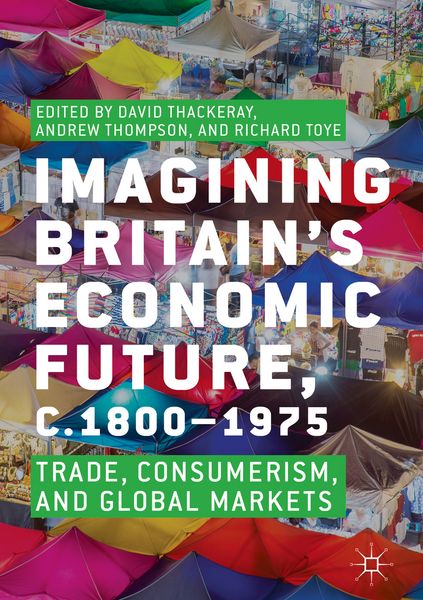
  • Produktbild: Imagining Britain’s Economic Future, c.1800–1975
  • Produktbild: Imagining Britain’s Economic Future, c.1800–1975

Imagining Britain’s Economic Future, c.1800–1975 Trade, Consumerism, and Global Markets

116,99 €

inkl. gesetzl. MwSt., Versandkostenfrei


Beschreibung

Following the Brexit vote, this book offers a timely historical assessment of the different ways that Britain’s economic future has been imagined and how British ideas have influenced global debates about market relationships over the past two centuries. The 2016 EU referendum hinged to a substantial...

Beschreibung

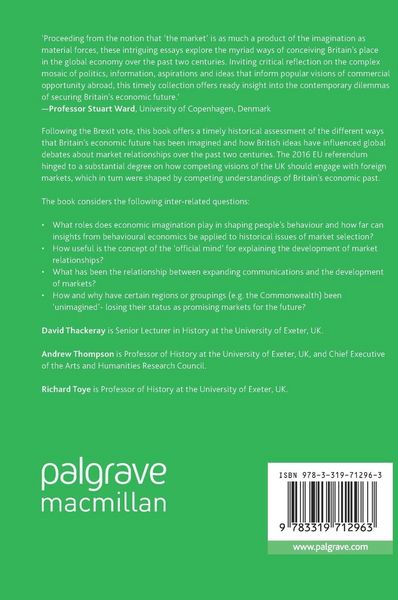
Following the Brexit vote, this book offers a timely historical assessment of the different ways that Britain’s economic future has been imagined and how British ideas have influenced global debates about market relationships over the past two centuries. The 2016 EU referendum hinged to a substantial degree on how competing visions of the UK should engage with foreign markets, which in turn were shaped by competing understandings of Britain’s economic past.


The book considers the following inter-related questions:


-          What roles does economic imagination play in shaping people’s behaviour and how far can insights from behavioural economics be applied to historical issues of market selection?


-          How useful is the concept of the ‘official mind’ for explaining the development of market relationships?


-          What has been the relationship between expanding communications and the development of markets?


-          How and why have certain regions or groupings (e.g. the Commonwealth) been ‘unimagined’- losing their status as promising markets for the future?

Portrait

David Thackeray is Senior Lecturer in History at the University of Exeter, UK.


Andrew Thompson is Professor of History at the University of Exeter, UK, and Chief Executive of the Arts and Humanities Research Council.


Richard Toye is Professor of History at the University of Exeter, UK. 

Produktdetails

Einband

Gebundene Ausgabe

Erscheinungsdatum

16.04.2018

Abbildungen

XV, 308 p. 10 illus., 6 illus. in color.

Herausgeber David Thackeray + weitere

Produktdetails

Einband

Gebundene Ausgabe

Erscheinungsdatum

16.04.2018

Abbildungen

XV, 308 p. 10 illus., 6 illus. in color.

Herausgeber
Verlag Springer
Seitenzahl

308

Maße (L/B/H)

21,6/15,3/2,3 cm

Gewicht

494 g

Sprache

Englisch

ISBN

978-3-319-71296-3

Herstelleradresse

Springer-Verlag GmbH
Europaplatz 3
69115 Heidelberg
DE

Email: ProductSafety@springernature.com

Ein neues Kapitel für Ihre Bücher

Ein neues Kapitel für Ihre Bücher

Schenken Sie Ihren alten Schätzen ein zweites Leben und erhalten Sie dafür eine Thalia Geschenkkarte.

Jetzt verkaufen
Jetzt verkaufen

Noch keine Bewertungen vorhanden

Verfassen Sie die erste Bewertung zu diesem Artikel

Helfen Sie anderen Kundinnen und Kunden durch Ihre Meinung.

Kundinnen und Kunden meinen

Bewertungen (0)

  • Produktbild: Imagining Britain’s Economic Future, c.1800–1975
  • Produktbild: Imagining Britain’s Economic Future, c.1800–1975
  • 1 Introduction; David Thackeray, Andrew Thompson and Richard Toye.- Part 1- Markets of the future.- 2 Imagining the opium trade: Britain’s justification for the first Anglo-Chinese War; Hao Gao.- 3 Business in the borderlands: American trade in the South African marketplace, 1871-1902; Stephen Tuffnell; 4 Imagining New Zealand’s economy in the mid-twentieth century; Glen O’ Hara.- Part 2- Imagining global trade.- 5 Racing round the world: geographical board games and Britain’s global expansion, 1780-1850; Paul Young.- 6 British free trade and the international feminist vision for peace, c.1846-1946; Marc-William Palen.- 7 What was a British buy? Empire, Europe and the politics of patriotic trade in Britain, c.1945-63; David Thackeray and Richard Toye.- 8 How self-service happened: the vision and reality of changing market practices in Britain; Lawrence Black and Thomas Spain.- Part 3- Rethinking decolonisation.- 9 Less than an empire and more than British: foreign investor competition in Ghana and Nigeria in the 1960s; Stephanie Decker.- 10 ‘Information after imperialism’: British overseas representation and Francophone Africa (1957-1967); Andrew Smith.- 11 Constructing colonial capitalism: the public relations campaigns of Hong Kong business groups, 1959-1966; David Clayton.- 12 Un-imagining markets: Chambers of Commerce, globalisation and the political economy of the Commonwealth of Nations, 1945-1975; Andrew Dilley.- 13 Commercial preferences: Economics and Britain’s European choices, 1945-2016; Piers Ludlow.