















































KI-Beratung Beta

Gutscheinbedingungen

Gültig bis 30.11.2026 | Gültig für nicht preisgebundene fremdsprachige Bücher | Einzelne Artikel können ausgeschlossen sein | Online auf thalia.de und in der Thalia App einlösbar | Click & Collect nur mit Online-Zahlung (Paypal/Kreditkarte) vorab | Nicht kombinierbar mit anderen Gutscheinen oder Preisaktionen | Nur einmal pro Einkauf einlösbar | Gutschein wird auf max. 500€ Bestellwert angerechnet | Keine Barauszahlung | Nicht gültig für Versandkosten und Services

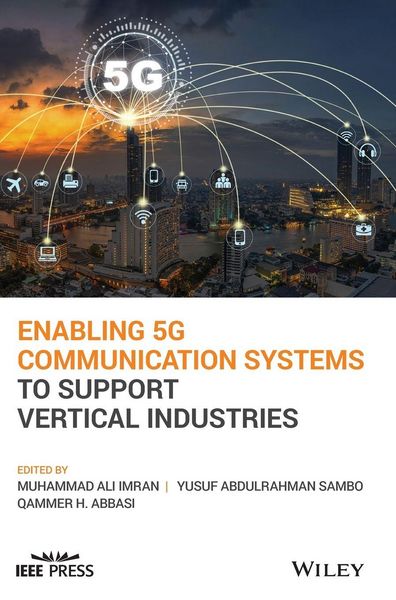
Produktbild: Enabling 5g Communication Systems to Support Vertical Industries

Enabling 5g Communication Systems to Support Vertical Industries

Aus der Reihe Wiley - IEEE

141,99 €

inkl. gesetzl. MwSt., Versandkostenfrei


Beschreibung

How 5G technology can support the demands of multiple vertical industries   Recent advances in technologyhave created new vertical industries that are highly dependent on the availability and reliability of data between multiple locations. The 5G system, unlike previous generations, will be entirely data...

Beschreibung

How 5G technology can support the demands of multiple vertical industries
 
Recent advances in technologyhave created new vertical industries that are highly dependent on the availability and reliability of data between multiple locations. The 5G system, unlike previous generations, will be entirely data driven--addressing latency, resilience, connection density, coverage area, and other vertical industry criteria. Enabling 5G Communication Systems to Support Vertical Industries demonstrates how 5G communication systems can meet the needs unique to vertical industries for efficient, cost-effective delivery of service. Covering both theory and practice, this book explores solutions to problems in specific industrial sectors including smart transportation, smart agriculture, smart grid, environmental monitoring, and disaster management.
 
The 5G communication system will have to provide customized solutions to accommodate each vertical industry's specific requirements. Whether an industry practitioner designingthe next generation of wireless communications or a researcher needing to identify open issues and classify their research, this timely book:
* Covers the much-discussed topics of supporting multiple vertical industries and new ICT challenges
* Addresses emerging issues and real-world problems surrounding 5G technology in wireless communication and networking
* Explores a comprehensive array of essential topics such as connected health, smart transport, smart manufacturing, and more
* Presents important topics in a clear, concise style suitable for new learners and professionals alike
* Includes contributions from experts and industry leaders, system diagrams, charts, tables, and examples
 
Enabling 5G Communication Systems to Support Vertical Industries is a valuable resource telecom engineers industry professionals, researchers, professors, doctorate, and postgraduate students requiring up-to-date information on supporting vertical industries with 5G technology systems.

Produktdetails

Einband

Gebundene Ausgabe

Erscheinungsdatum

26.08.2019

Herausgeber Muhammad Ali Imran + weitere
Verlag John Wiley & Sons Inc

Produktdetails

Einband

Gebundene Ausgabe

Erscheinungsdatum

26.08.2019

Herausgeber
Verlag John Wiley & Sons Inc
Seitenzahl

288

Maße (L/B/H)

24,4/17,3/1,8 cm

Gewicht

590 g

Auflage

1. Auflage

Sprache

Englisch

ISBN

978-1-119-51553-1

Herstelleradresse

Libri GmbH
Europaallee 1
36244 Bad Hersfeld
DE

Email: gpsr@libri.de

Ein neues Kapitel für Ihre Bücher

Ein neues Kapitel für Ihre Bücher

Schenken Sie Ihren alten Schätzen ein zweites Leben und erhalten Sie dafür eine Thalia Geschenkkarte.

Jetzt verkaufen
Jetzt verkaufen

Noch keine Bewertungen vorhanden

Verfassen Sie die erste Bewertung zu diesem Artikel

Helfen Sie anderen Kundinnen und Kunden durch Ihre Meinung.

Kundinnen und Kunden meinen

Bewertungen (0)

Die Leseprobe wird geladen.
  • Produktbild: Enabling 5g Communication Systems to Support Vertical Industries
  • About the Editors xi
     
    List of Contributors xiii
     
    Preface xvii
     
    1 Enabling the Verticals of 5G: Network Architecture, Design and Service Optimization 1
    Andy Sutton
     
    1.1 Introduction 1
     
    1.2 Use Cases 3
     
    1.3 5G Network Architecture 4
     
    1.4 RAN Functional Decomposition 7
     
    1.5 Designing a 5G Network 9
     
    1.6 Network Latency 11
     
    1.7 5G Network Architecture Design 13
     
    1.8 Summary 20
     
    Acknowledgements 21
     
    References 21
     
    2 Industrial Wireless Sensor Networks and 5G Connected Industries 23
    Mohsin Raza, Sajjad Hussain, Nauman Aslam, Hoa Le-Minh and Huan X. Nguyen
     
    2.1 Overview 23
     
    2.2 Industrial Wireless Sensor Networks 24
     
    2.2.1 Wired and Wireless Networks in Industrial Environment 24
     
    2.2.2 Transformation of WSNs for Industrial Applications 24
     
    2.2.3 IWSN Architecture 25
     
    2.3 Industrial Traffic Types and its Critical Nature 28
     
    2.3.1 Safety/Emergency Traffic 28
     
    2.3.2 Critical Control Traffic 28
     
    2.3.3 Low-Risk Control Traffic 28
     
    2.3.4 Periodic Monitoring Traffic 28
     
    2.3.5 Critical Nature and Time Deadlines 29
     
    2.4 Existing Works and Standards 30
     
    2.4.1 Wireless Technologies 30
     
    2.4.2 Industry-Related IEEE Standards 31
     
    2.4.2.1 IEEE 802.15.4 31
     
    2.4.2.2 IEEE 802.15.4e 32
     
    2.5 Ultra-Reliable Low-Latency Communications (URLLC) in IWSNS 33
     
    2.6 Summary 37
     
    References 37
     
    3 Haptic Networking Supporting Vertical Industries 41
    Luis Sequeira, Konstantinos Antona koglou, Maliheh Mahlouji and Toktam Mahmoodi
     
    3.1 Tactile Internet Use Cases and Requirements 41
     
    3.1.1 Quality of Service 42
     
    3.1.2 Use Cases and Requirements 43
     
    3.2 Teleoperation Systems 45
     
    3.2.1 Classification of Teleoperation Systems 45
     
    3.2.2 Haptic Control and Data Reduction 46
     
    3.2.2.1 Performance of Teleoperation Control Schemes 48
     
    3.2.2.2 Haptic Data Reduction 59
     
    3.2.2.3 Kinesthetic Data Reduction 59
     
    3.2.2.4 Tactile Data Reduction 62
     
    3.2.3 Combining Control Schemes and Data Reduction 63
     
    Acknowledgment 64
     
    References 64
     
    4 5G-Enhanced Smart Grid Services 75
    Muhammad Ismail, Islam Safak Bayram, Khalid Qaraqe and Erchin Serpedin
     
    4.1 Introduction 75
     
    4.2 Smart Grid Services and Communication Requirements 78
     
    4.2.1 Smart Grid Fundamentals 78
     
    4.2.1.1 Data Collection and Management Services 78
     
    4.2.1.2 Control and Operation Services 81
     
    4.2.2 Communication Requirements for Smart Grid Services 87
     
    4.3 Smart Grid Services Supported by 5G Networks 90
     
    4.3.1 Data Collection and Management Services 90
     
    4.3.1.1 Data Collection Services 91
     
    4.3.1.2 Data Management Services 95
     
    4.3.2 Operation Decision-Making Services 96
     
    4.3.2.1 Demand Side Management Services 96
     
    4.3.2.2 Electric Vehicle Charging and Discharging Services 98
     
    4.4 Summary and Future Research 99
     
    Acknowledgment 100
     
    References 100
     
    5 Evolution of Vehicular Communications within the Context of 5G Systems 103
    Kostas Katsaros and Mehrdad Dianati
     
    5.1 Introduction 103
     
    5.2 Vehicular Connectivity 104
     
    5.2.1 Cellular V2X 105
     
    5.2.1.1 Release 14 - First C-V2X Services 105
     
    5.2.1.2 Release 15 - First Taste of 5G 108
     
    5.2.1.3 Release 16 - Fully-Fledged 5G 108
     
    5.2.2 Dedicated Short Range Communication (DSRC) 110
     
    5.2.2.1 Co-Existence 110
     
    5.