















































KI-Beratung Beta

  • Produktbild: Children’s Knowledge-in-Interaction
  • Produktbild: Children’s Knowledge-in-Interaction
- 13%

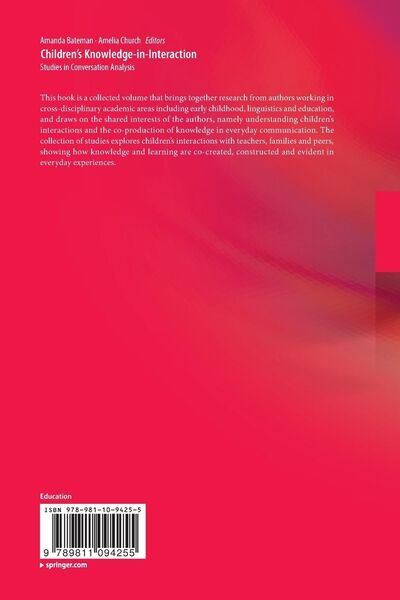
Children’s Knowledge-in-Interaction Studies in Conversation Analysis

13% sparen

129,99 € UVP 149,79 €

inkl. gesetzl. MwSt., Versandkostenfrei


Beschreibung

Produktdetails

Einband

Taschenbuch

Erscheinungsdatum

21.04.2018

Abbildungen

XVIII, 369 p. 63 illus.

Herausgeber

Amanda Bateman + weitere

Verlag

Springer Singapore

Seitenzahl

369

Maße (L/B/H)

23,5/15,5/2,1 cm

Gewicht

587 g

Auflage

Softcover reprint of the original 1st ed. 2017

Sprache

Englisch

ISBN

978-981-10-9425-5

Beschreibung

Portrait


Amanda Bateman currently works at the University of Waikato, New Zealand as a senior lecturer in early childhood education. She has led various research projects using conversation analysis to explore peer-peer relationships and teacher-child interactions, and is currently Principal Investigator on a project exploring children’s storytelling in early childhood through to primary school. Her book Conversation Analysis and Early Childhood Education: The Co-Production of Knowledge and Relationships discusses findings from her project investigating teacher-child interactions in New Zealand early childhood education.

Amelia Church is a lecturer at the Melbourne Graduate School of Education at The University of Melbourne, where she teaches courses in research methods in early childhood education and applied conversation analysis as well as qualitative research methods. She holds a PhD in linguistics from Monash University and published this research as part of the Ashgate series Directions in Ethnomethodology and Conversation Analysis, which is included in the book Preference Organisation and Peer Disputes: How young children resolve conflict. Her current research involves children’s talk, classroom interactions, and how misunderstanding is resolved in talk-in-interaction.

Produktdetails

Einband

Taschenbuch

Erscheinungsdatum

21.04.2018

Abbildungen

XVIII, 369 p. 63 illus.

Herausgeber

Verlag

Springer Singapore

Seitenzahl

369

Maße (L/B/H)

23,5/15,5/2,1 cm

Gewicht

587 g

Auflage

Softcover reprint of the original 1st ed. 2017

Sprache

Englisch

ISBN

978-981-10-9425-5

Herstelleradresse

Springer-Verlag GmbH
Tiergartenstr. 17
69121 Heidelberg
DE

Email: ProductSafety@springernature.com

Ein neues Kapitel für Ihre Bücher

Ein neues Kapitel für Ihre Bücher

Schenken Sie Ihren alten Schätzen ein zweites Leben und erhalten Sie dafür eine Thalia Geschenkkarte.

Jetzt verkaufen
Jetzt verkaufen

Noch keine Bewertungen vorhanden

Verfassen Sie die erste Bewertung zu diesem Artikel

Helfen Sie anderen Kundinnen und Kunden durch Ihre Meinung.

Kundinnen und Kunden meinen

Bewertungen (0)

Weitere Artikel finden Sie in

  • Produktbild: Children’s Knowledge-in-Interaction
  • Produktbild: Children’s Knowledge-in-Interaction
  • 1 Children's Knowledge-in-interaction: An introduction.- 2 Epistemic Trajectories in the Classroom: How children respond in informing sequences.- 3 Questions and Answers, a Seesaw and Embodied Action: How a preschool teacher and children accomplish educational practice.- 4 Web searching as a context to build on young children's displayed knowledge.- 5 Mathematics Knowledge in Early Childhood: Intentional teaching in the third turn.- 6 Pursuing a Telling: Managing a multi-unit turn in children's storytelling.- 7 Co-producing Cultural Knowledge: Children telling tales in the school playground.- 8 Don't laugh! Socialization of laughter and smiling in pre-school and school settings.- 9 Schoolyard Suspect: Blame negotiations, category work and conflicting versions among children and teachers.- 10 The Preschool Entrance Hall: A bilingual transit zone for preschoolers.- 11 Sparkling, Wrinkling, Softly Tinkling: On poetry and word meaning in a bilingual primary classroom.- 12 Relating with anUnborn Baby: Expectant mothers socializing their toddlers in Japanese families.- 13 Young children's initial assessments in Japanese.- 14 Learning how to use the word 'Know': Examples from a single-case study.- 15 The emergence of Story-telling.- 16 "What does it say about it?": Doing reading and doing writing as part of family mealtime.- 17 Producing knowledge with digital technologies in sibling interaction.- 18 "You can get cyberbullied by your friends": Claiming authority to categorise a past event as bullying.- 19 'It's gonna work': Spontaneous activity and knowledge management by a child with Asperger's Syndrome.