















































KI-Beratung Beta

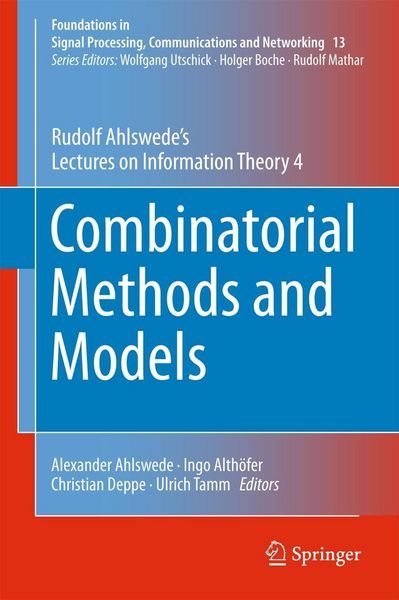
Produktbild: Combinatorial Methods and Models
Band 13

Combinatorial Methods and Models Rudolf Ahlswede's Lectures on Information Theory 4

90,94 €

inkl. gesetzl. MwSt.

Beschreibung

The fourth volume of Rudolf Ahlswede's lectures on Information Theory is focused on Combinatorics. Ahlswede was originally motivated to study combinatorial aspects of Information Theory via zero-error codes: in this case the structure of the coding problems usually drastically changes from probabilistic...

Beschreibung

The fourth volume of Rudolf Ahlswede's lectures on Information Theory is focused on Combinatorics. Ahlswede was originally motivated to study combinatorial aspects of Information Theory via zero-error codes: in this case the structure of the coding problems usually drastically changes from probabilistic to combinatorial. The best example is Shannon's zero error capacity, where independent sets in graphs have to be examined. The extension to multiple access channels leads to the Zarankiewicz problem.

A code can be regarded combinatorially as a hypergraph; and many coding theorems can be obtained by appropriate colourings or coverings of the underlying hypergraphs. Several such colouring and covering techniques and their applications are introduced in this book. Furthermore, codes produced by permutations and one of Ahlswede's favourite research fields -- extremal problems in Combinatorics -- are presented.

Whereas the first part of the book concentrateson combinatorial methods in order to analyse classical codes as prefix codes or codes in the Hamming metric, the second is devoted to combinatorial models in Information Theory. Here the code concept already relies on a rather combinatorial structure, as in several concrete models of multiple access channels or more refined distortions. An analytical tool coming into play, especially during the analysis of perfect codes, is the use of orthogonal polynomials.

Classical information processing concerns the main tasks of gaining knowledge and the storage, transmission and hiding of data. The first task is the prime goal of Statistics. For transmission and hiding data, Shannon developed an impressive mathematical theory called Information Theory, which he based on probabilistic models. The theory largely involves the concept of codes with small error probabilities in spite of noise in the transmission, which is modeled by channels. The lectures presentedin this work are suitable for graduate students in Mathematics, and also for those working in Theoretical Computer Science, Physics, and Electrical Engineering with a background in basic Mathematics. The lectures can be used as the basis for courses or to supplement courses in many ways. Ph.D. students will also find research problems, often with conjectures, that offer potential subjects for a thesis. More advanced researchers may find questions which form the basis of entire research programs.

Rezension

“This good book is recommended for researchers, faculty, and graduate students in mathematics, theoretical computer science, physics, or electrical engineering.” (Michael M. Dediu, Mathematical Reviews, March, 2018)
“The book under review is the fourth volume of Rudolf Ahlswede’s lectures on Information Theory. … The lectures presented in this work are suitable for graduate students in Mathematics, Theoretical Computer Science, and Electrical Engineering with a background in basic Mathematics. The lectures can be used as the basis for courses or to supplement courses in many ways. Ph.D. students can find research problems, often with conjectures, that offer potential subjects for a thesis.” (Nikolai L. Manev, zbMATH 1397.94002, 2018)

Produktdetails

Format

PDF

Kopierschutz

Nein

Family Sharing

Nein

Text-to-Speech

Nein

Produktdetails

Format

PDF

Format

eBooks im PDF-Format haben eine festgelegte Seitengröße und eignen sich daher nur bedingt zum Lesen auf einem tolino eReader oder Smartphone. Für den vollen Lesegenuss empfehlen wir Ihnen bei PDF-eBooks die Verwendung eines Tablets oder Computers.

Kopierschutz

Nein

Kopierschutz

Dieses eBook können Sie uneingeschränkt auf allen Geräten der tolino Familie, allen sonstigen eReadern und am PC lesen. Das eBook ist nicht kopiergeschützt und kann ein personalisiertes Wasserzeichen enthalten. Weitere Hinweise zum Lesen von eBooks mit einem personalisierten Wasserzeichen finden Sie unter Hilfe/Downloads.

Family Sharing

Nein

Family Sharing

Mit Family Sharing können Sie eBooks innerhalb Ihrer Familie (max. sechs Mitglieder im gleichen Haushalt) teilen. Sie entscheiden selbst, welches Buch Sie mit welchem Familienmitglied teilen möchten. Auch das parallele Lesen durch verschiedene Familienmitglieder ist durch Family Sharing möglich. Um eBooks zu teilen oder geteilt zu bekommen, muss jedes Familienmitglied ein Konto bei Thalia oder einem anderen tolino-Buchhändler haben. Weitere Informationen finden Sie unter Hilfe/Family-Sharing.

Text-to-Speech

Nein

Text-to-Speech

Bedeutet Ihnen Stimme mehr als Text? Mit der Funktion Text-to-Speech können Sie sich im tolino webReader und in der aktuellen Thalia – Lesen & Hören App das eBook vorlesen lassen. Weitere Informationen finden Sie unter Hilfe/Text-to-Speech.

Erscheinungsdatum

30.06.2017

Herausgeber
Verlag Springer
Seitenzahl

385 (Printausgabe)

Dateigröße

5072 KB

Auflage

1st ed. 2018

Sprache

Englisch

EAN

9783319531397

Barrierefreiheit
  • keine Information zur Barrierefreiheit bekannt

Noch keine Bewertungen vorhanden

Verfassen Sie die erste Bewertung zu diesem Artikel

Helfen Sie anderen Kundinnen und Kunden durch Ihre Meinung.

Kundinnen und Kunden meinen

Bewertungen (0)

Weitere Artikel finden Sie in

  • Produktbild: Combinatorial Methods and Models