















































KI-Beratung Beta

Gutscheinbedingungen

Gültig bis 30.11.2026 | Gültig für nicht preisgebundene fremdsprachige Bücher | Einzelne Artikel können ausgeschlossen sein | Online auf thalia.de und in der Thalia App einlösbar | Click & Collect nur mit Online-Zahlung (Paypal/Kreditkarte) vorab | Nicht kombinierbar mit anderen Gutscheinen oder Preisaktionen | Nur einmal pro Einkauf einlösbar | Gutschein wird auf max. 500€ Bestellwert angerechnet | Keine Barauszahlung | Nicht gültig für Versandkosten und Services

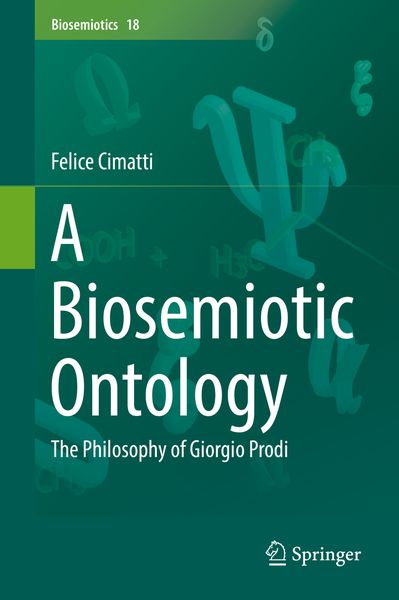
Produktbild: A Biosemiotic Ontology
Band 18

A Biosemiotic Ontology The Philosophy of Giorgio Prodi

Aus der Reihe Biosemiotics

87,99 €

inkl. gesetzl. MwSt., Versandkostenfrei


Beschreibung

Giorgio Prodi (1928-1987) was an important Italian scientist who developed an original philosophy based on two basic assumptions: 1. life is mainly a semiotic phenomenon; 2. matter is somewhat a semiotic phenomenon.

Prodi applies Peirce's cenopythagorean categories to all phenomena of life and matter:...

Beschreibung

Giorgio Prodi (1928-1987) was an important Italian scientist who developed an original philosophy based on two basic assumptions: 1. life is mainly a semiotic phenomenon; 2. matter is somewhat a semiotic phenomenon.

Prodi applies Peirce's cenopythagorean categories to all phenomena of life and matter: Firstness, Secondness, and Thirdness. They are interconnected meaning that the very ontology of the world, according to Prodi, is somewhat semiotic. In fact, when one describes matter as “made of” Firstness and Secondness, this means that matter ‘intrinsically’ implies semiotics (with Thirdness also being present in the world).

At the very heart of Prodi’s theory lies a metaphysical hypothesis which is an ambitious theoretical gesture that places Prodi in an awkward position with respect to the customary philosophical tradition. In fact, his own ontology is neither dualistic nor monistic. Such a conclusion is unusual and weird, but much less unusual in present time than itwas when it was first introduced. The actual resurgence of various “realisms” make Prodi’s semiotic realism much more interesting than when he first proposed his philosophical approach. What is uncommon, in Prodi perspective, is that he never separated semiotics from the materiality of the world. Prodi does not agree with the “standard” structuralist view of semiosis as an artificial and unnatural activity. On the contrary, Prodi believed semiosis (that is, the interconnection between Firstness, Secondness and Thirdness) lies at the very bottom of life. On one hand, Prodi maintains a strong realist stance; on the other, a realism that includes semiosis as ‘natural’ phenomena. This last view is very unusual because all forms, more or less, of realism exclude semiosis from nature but they frequently “reduce” semiosis to non-semiotic elements. According to Prodi, semiosis is a completely natural phenomenon.

Produktdetails

Einband

Gebundene Ausgabe

Erscheinungsdatum

23.11.2018

Abbildungen

V, 159 p. 20 illus., 6 illus. in color.

Verlag Springer

Produktdetails

Einband

Gebundene Ausgabe

Erscheinungsdatum

23.11.2018

Abbildungen

V, 159 p. 20 illus., 6 illus. in color.

Verlag Springer
Seitenzahl

159

Maße (L/B/H)

24,1/16/1,5 cm

Gewicht

403 g

Sprache

Englisch

ISBN

978-3-319-97902-1

Herstelleradresse

Springer-Verlag GmbH
Europaplatz 3
69115 Heidelberg
DE

Email: ProductSafety@springernature.com

Ein neues Kapitel für Ihre Bücher

Ein neues Kapitel für Ihre Bücher

Schenken Sie Ihren alten Schätzen ein zweites Leben und erhalten Sie dafür eine Thalia Geschenkkarte.

Jetzt verkaufen
Jetzt verkaufen

Noch keine Bewertungen vorhanden

Verfassen Sie die erste Bewertung zu diesem Artikel

Helfen Sie anderen Kundinnen und Kunden durch Ihre Meinung.

Kundinnen und Kunden meinen

Bewertungen (0)

  • Produktbild: A Biosemiotic Ontology

  • Chapter 1.  Introduction.- Chapter 2. Life.- Chapter 3. Scientist because Philosopher, Philosopher because Scientist.- Chapter 4. The Line and the Circle.- Chapter 5. The Biological Model: for an anti-Cartesian semiotics.- Chapter 6. Of the Complementarity of the Sign.- Chapter 7. The Origin of Language.- Chapter 8. Attention and Consciousness.- Chapter 9. Breaking the Circle.- Chapter 10. Language and Ethics.- Chapter 11. The “Darkness” Between Aesthetics and the Sacred.- Chapter 12. Conclusion: Prodi and
    Italian Thought.