














































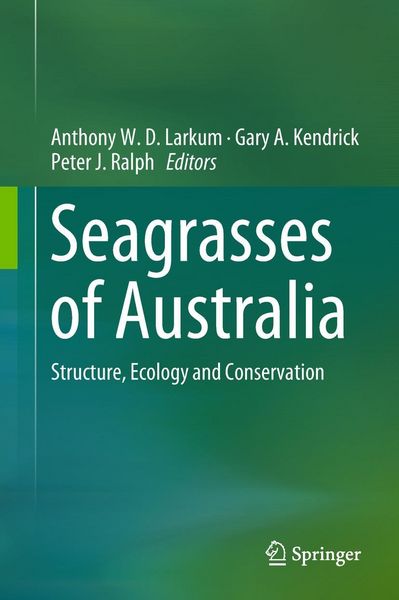
Seagrasses of Australia Structure, Ecology and Conservation
-
- Hardcover
- Taschenbuch
- eBook ausgewählt
-
Form:Einzelkauf Download
-
Sprache:Englisch
341,33 €
inkl. gesetzl. MwSt.Beschreibung
Produktdetails
Format
ePUB
Kopierschutz
Nein
Family Sharing
Nein
Text-to-Speech
Ja
Erscheinungsdatum
27.07.2018
Herausgeber
Anthony W. D. Larkum + weitereVerlag
SpringerSeitenzahl
797 (Printausgabe)
Dateigröße
22735 KB
Auflage
1st ed. 2018
Sprache
Englisch
EAN
9783319713540
This book takes the place of "Biology of Seagrasses: A Treatise on the Biology of Seagrasses with Special Reference to the Australian Region", co-edited by A.W.D. Larkum, A.J. MaCComb and S.A. Shepherd and published by Elsevier in 1989. The first book has been influential, but it is now 25 years since it was published and seagrass studies have progressed and developed considerably since then. The design of the current book follows in the steps of the first book.
There are chapters on taxonomy, floral biology, biogeography and regional studies. The regional studies emphasize the importance of Australia having over half of the world's 62 species, including some ten species published for Australia since the previous book. There are a number of chapters on ecology and biogeography; fish biology and fisheries and dugong biology are prominent chapters. Physiological aspects again play an important part, including new knowledge on the role of hydrogen sulphide in sediments and on photosynthetic processes. Climate change, pollution and environmental degradation this time gain an even more important part of the book. Decline of seagrasses around Australia are also discussed in detail in several chapters. Since the first book was published two new areas have received special attention: blue carbon and genomic studies. Seagrasses are now known to be a very important player in the formation of blue carbon, i.e. carbon that has a long turnover time in soils and sediments. Alongside salt marshes and mangroves, seagrasses are now recognized as playing a very important role in the formation of blue carbon. And because Australia has such an abundance and variety of seagrasses, their role in blue carbon production and turnover is of great importance. The first whole genomes of seagrasses are now available and Australia has played an important role here. It appears that seagrasses have several different suites of genes as compared with other (land) plants and even in comparison with freshwater hydrophytes. This difference is leading to important molecular biological studies where the new knowledge will be important to the understanding and conservation of seagrass ecosystems in Australia. Thus by reason of its natural abundance of diverse seagrasses and a sophisticated seagrass research community in Australia it is possible to produce a book which will be attractive to marine biologists, coastal scientists and conservationists from many countries around the world.
Noch keine Bewertungen vorhanden
Verfassen Sie die erste Bewertung zu diesem Artikel
Helfen Sie anderen Kundinnen und Kunden durch Ihre Meinung.
Kurze Frage zu unserer Seite
Vielen Dank für Ihr Feedback
Wir nutzen Ihr Feedback, um unsere Produktseiten zu verbessern. Bitte haben Sie Verständnis, dass wir Ihnen keine Rückmeldung geben können. Falls Sie Kontakt mit uns aufnehmen möchten, können Sie sich aber gerne an unseren Kund*innenservice wenden.
zum Kundenservice