















































KI-Beratung Beta

Gutscheinbedingungen

Gültig bis 11.11.2026 | Gültig für Spielzeug, Filme, Musik, Software, Games, Geschenke & Trends, Schreibwaren, Hörbücher und Hörbuch-Downloads (außer Abo & Shelfies), gebrauchte Bücher, nicht preisgebundene Bücher und Kalender | Einlösbar unter thalia.de und in der Thalia App | Click & Collect nur mit Online-Zahlung (Paypal/Kreditkarte) vorab | Einzelne Artikel können ausgeschlossen sein | Nicht kombinierbar mit anderen Gutscheinen oder Preisaktionen | Nur einmal pro Einkauf einlösbar | Gutschein wird auf max. 500€ Bestellwert angerechnet | Keine Barauszahlung | Digitale Hörbücher nur für Android  | Nicht gültig für preisgebundene Artikel (aufgrund der Buchpreisbindung sind Gutscheine nicht auf Bücher, eBooks, Presse einlösbar), tolino eReader & Zubehör, Abonnements & Flatrates, Geschenkkarten, Versandkosten und Services

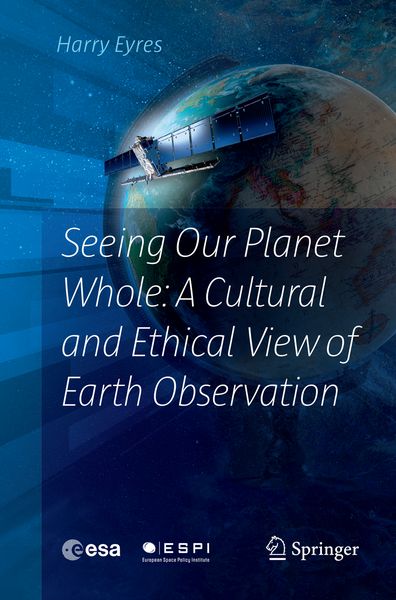
  • Produktbild: Seeing Our Planet Whole: A Cultural and Ethical View of Earth Observation
  • Produktbild: Seeing Our Planet Whole: A Cultural and Ethical View of Earth Observation

Seeing Our Planet Whole: A Cultural and Ethical View of Earth Observation

35,99 €

inkl. gesetzl. MwSt., Versandkostenfrei


Beschreibung

This book shows how our new-found ability to observe the Earth from “the necessary distance” has wide and profound cultural and ethical implications. First of all, it is the outcome of speculations and investigations of human beings in relation to their home planet carried out over millennia. In particular,...

Beschreibung

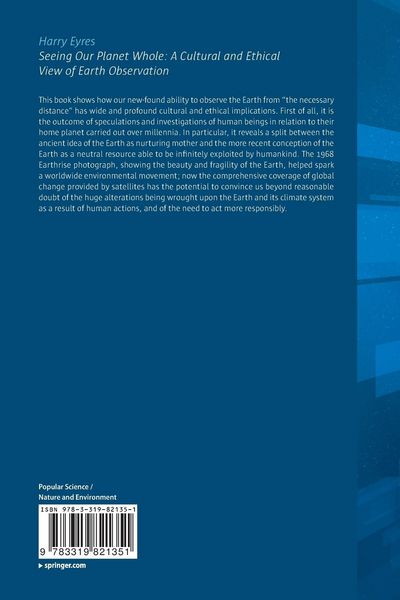
This book shows how our new-found ability to observe the Earth from “the necessary distance” has wide and profound cultural and ethical implications. First of all, it is the outcome of speculations and investigations of human beings in relation to their home planet carried out over millennia. In particular, it reveals a split between the ancient idea of the Earth as nurturing mother and the more recent conception of the Earth as a neutral resource able to be infinitely exploited by humankind. The 1968 Earthrise photograph, showing the beauty and fragility of the Earth, helped spark a worldwide environmental movement; now the comprehensive coverage of global change provided by satellites has the potential to convince us beyond reasonable doubt of the huge alterations being wrought upon the Earth and its climate system as a result of human actions, and of the need to act more responsibly.

Rezension

“Throughout this work, Eyres urges an informed citizenry to take an active part in the care of Earth’s resources. The text contains helpful footnotes … . Summing Up: Recommended. All readers.” (M. Dickinson, Choice, Vol. 54 (9), May, 2017)

Produktdetails

Einband

Taschenbuch

Erscheinungsdatum

16.06.2018

Abbildungen

XIII, 136 p.

Verlag Springer

Produktdetails

Einband

Taschenbuch

Erscheinungsdatum

16.06.2018

Abbildungen

XIII, 136 p.

Verlag Springer
Seitenzahl

136

Maße (L/B/H)

23,5/15,5/0,9 cm

Gewicht

242 g

Auflage

Softcover reprint of the original 1st ed. 2017

Sprache

Englisch

ISBN

978-3-319-82135-1

Herstelleradresse

Springer-Verlag KG
Sachsenplatz 4-6
1201 Wien
AT

Email: ProductSafety@springernature.com

Ein neues Kapitel für Ihre Bücher

Ein neues Kapitel für Ihre Bücher

Schenken Sie Ihren alten Schätzen ein zweites Leben und erhalten Sie dafür eine Thalia Geschenkkarte.

Jetzt verkaufen
Jetzt verkaufen

Noch keine Bewertungen vorhanden

Verfassen Sie die erste Bewertung zu diesem Artikel

Helfen Sie anderen Kundinnen und Kunden durch Ihre Meinung.

Kundinnen und Kunden meinen

Bewertungen (0)

  • Produktbild: Seeing Our Planet Whole: A Cultural and Ethical View of Earth Observation
  • Produktbild: Seeing Our Planet Whole: A Cultural and Ethical View of Earth Observation
  • Introduction.- Cosmology and astronomy from pre-history to the Roman Empire.- Aquinas to Newton.- The Enlightenment, the Romantic Rebellion, the Industrial Age, the nature conservation movement and total war.- The post-war period and the rise of ecological consciousness.- Non-western cultures' attitudes to environment.- The ethical dimension: the slow evolution of environmental ethics.- A short history of earth observation.- The resistances.- The aesthetic dimension.- Earth observation for whom? Towards an environmental democracy.- Conclusion.- Epilogue.