















































KI-Beratung Beta

Produktbild: International Student Connectedness and Identity
Band 6

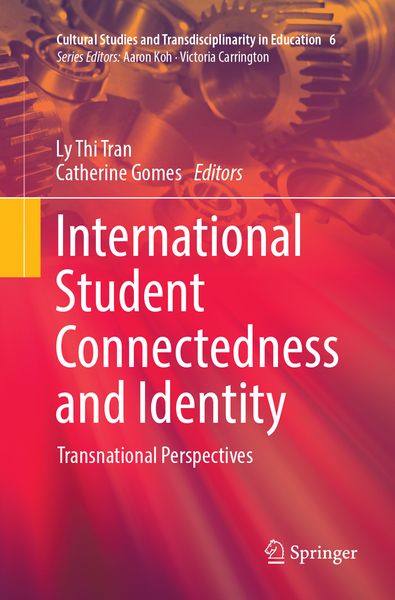
International Student Connectedness and Identity Transnational Perspectives

149,99 €

inkl. gesetzl. MwSt., Versandkostenfrei


Beschreibung

This book focuses on the interrelationship between international student connectedness and identity from transnational and transdisciplinary perspectives. It addresses the core issues surrounding international students’ physical and virtual connectedness to people, places and communities as well as the...

Beschreibung

This book focuses on the interrelationship between international student connectedness and identity from transnational and transdisciplinary perspectives. It addresses the core issues surrounding international students’ physical and virtual connectedness to people, places and communities as well as the conditions that shape their transnational connectedness and identity formation. Further, it analyses the nature, diversity and complexity of international student connectedness and identity development across different national, social and cultural boundaries.

Portrait


Ly Thi Tran
is a senior lecturer at Deakin University’s School of Education in Australia and an Australian Research Council DECRA (Discovery Early Career Researcher Award) fellow. Ly’s research and publications focus on international students, student mobility, international vocational education and training, pedagogy and curriculum in international education and Vietnamese higher education. She has been awarded three grants on international student mobility and staff professional development in international education by the Australian Research Council. Ly’s book entitled
Teaching international students in vocational education: New pedagogical approaches
won the 2014 International Education Association of Australia’s Excellence Award for best Practice/Innovation in International Education. 
Catherine Gomes
is a senior lecturer at RMIT University in Melbourne and recently completed an Australian Research Council DECRA (Discovery Early Career Research Award) fellowship. Her work covers migration, transnationalism and diasporas, particularly transient migration in Australia and Singapore with special interest in international students, their well-being, their social networks and their media and communication use. Catherine is founding editor of
Transitions: Journal of Transient Migration
(Intellect Books) and leader of the RMIT Migration and Digital Media Research Lab at the Digital Ethnography Research Centre (DERC). Her recent books include
Multiculturalism through the Lens: A Guide to Ethnic and Migrant Anxieties in Singapore
(Ethos Books, 2015),
The Asia Pacific in the Age of Transnational Mobility: The Search for Community and Identity on and through Social Media
(Anthem Press, 2016) and
Transient Mobility and Middle Class Identity
(Palgrave Macmillan, 2016). Catherine has also written on identity, gender, ethnicity and race in Chinese cinemas.

Produktdetails

Einband

Taschenbuch

Erscheinungsdatum

11.09.2018

Abbildungen

XXI, 294 p. 11 illus.

Herausgeber Ly Thi Tran + weitere

Produktdetails

Einband

Taschenbuch

Erscheinungsdatum

11.09.2018

Abbildungen

XXI, 294 p. 11 illus.

Herausgeber
Verlag Springer Singapore
Seitenzahl

294

Maße (L/B/H)

23,5/15,5/1,8 cm

Gewicht

482 g

Auflage

Softcover reprint of the original 1st ed. 2017

Sprache

Englisch

ISBN

978-981-10-9664-8

Herstelleradresse

Springer-Verlag KG
Sachsenplatz 4-6
1201 Wien
AT

Email: ProductSafety@springernature.com

Ein neues Kapitel für Ihre Bücher

Ein neues Kapitel für Ihre Bücher

Schenken Sie Ihren alten Schätzen ein zweites Leben und erhalten Sie dafür eine Thalia Geschenkkarte.

Jetzt verkaufen
Jetzt verkaufen

Noch keine Bewertungen vorhanden

Verfassen Sie die erste Bewertung zu diesem Artikel

Helfen Sie anderen Kundinnen und Kunden durch Ihre Meinung.

Kundinnen und Kunden meinen

Bewertungen (0)

  • Produktbild: International Student Connectedness and Identity
  • Introduction.- 1 Student mobility, connectedness and identity.- Part 1 International Student Connectedness/Disconnectedness in the Host Country.- 2 International students and post study employment: The impact of university and host community engagement on the employment outcomes of international students in Australia.- 3 International student connectedness with local teachers and peers: Insights from teachers.- 4 Exploring the lifeworld of international doctoral students: The place of religion and religious organisations.- 5 From 'Somebody' to 'Nobody': International doctoral students' perspectives of home - host connectedness.- 6 Disconnections with the host nation and the significance of international student communities: A case study of Asian international students in Australia and Singapore.- Part 2 International Student and Returnee Connectedness/Disconnectedness with the Home Country.- 7 'So that she feels a part of my life': How international students connect to home through digital media technologies.- 8 Visualizing returnee re-engagement with local workplaces and community: A case study of Ho Chi Minh City, Vietnam.- 9 'Home is where the heart is': The experiences of expatriate PhD students and returnees.- Part 3 Connectedness/Disconnectedness and Identity Development.- 10 Where are we, When are we, and Who are we to each other? Connectedness and the evolving meanings of international education.- 11 International students' dis-connecting from and re-connecting with diverse communities: Fluidity of the Self in Sojourns abroad.- 12 Self-in-the-World Identities: Transformations for the Sojourning student.- Part 4 Student-turned Migrant and Connectedness/Disconnectedness.- 13 Flexible citizens or disconnected transmigrants? Chinese student-turned-migrants in Singapore and their discourse on mobility, flexibility, and identity.- 14 Transnational Student-Migrants and the Negotiation of Connectedness and Self-Identity in Australia: The Pains and Gains.- 15 Transnational belonging and relational practices: Nepali student migration to Denmark.- Conclusion.- 16 International student (dis)connectedness and identities: Why these matter and the way forward.