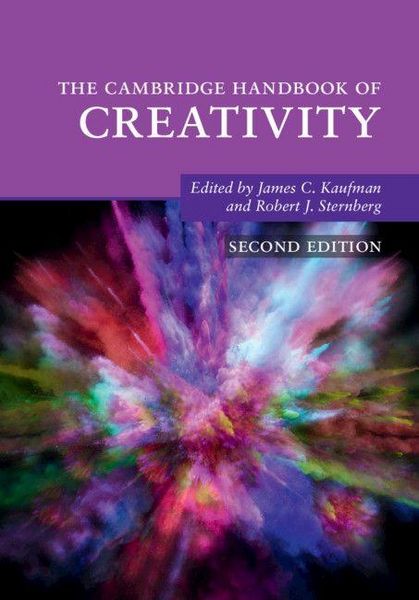
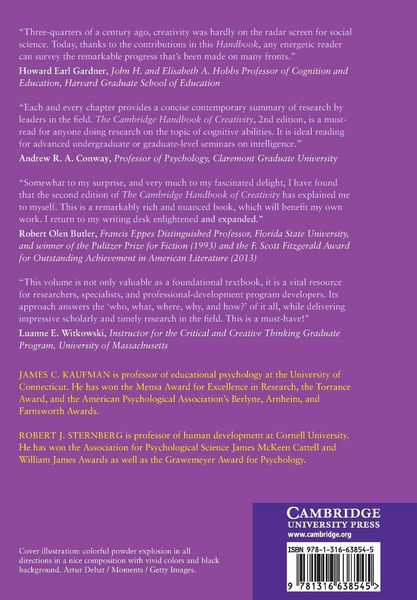
• Produktbild: The Cambridge Handbook of Creativity
  • Produktbild: The Cambridge Handbook of Creativity

The Cambridge Handbook of Creativity

99,99 €

inkl. gesetzl. MwSt., Versandkostenfrei


Beschreibung

Produktdetails

Einband

Taschenbuch

Erscheinungsdatum

11.04.2019

Herausgeber

Kaufman James C. + weitere

Verlag

Cambridge Academic

Seitenzahl

782

Maße (L/B/H)

24,4/17/4,2 cm

Gewicht

1430 g

Sprache

Englisch

ISBN

978-1-316-63854-5

Beschreibung

Produktdetails

Einband

Taschenbuch

Erscheinungsdatum

11.04.2019

Herausgeber

Verlag

Cambridge Academic

Seitenzahl

782

Maße (L/B/H)

24,4/17/4,2 cm

Gewicht

1430 g

Sprache

Englisch

ISBN

978-1-316-63854-5

Herstelleradresse

Libri GmbH
Europaallee 1
36244 Bad Hersfeld
DE

Email: gpsr@libri.de

Ein neues Kapitel für Ihre Bücher

Ein neues Kapitel für Ihre Bücher

Schenken Sie Ihren alten Schätzen ein zweites Leben: Einfach Barcode scannen, Versandetikett ausdrucken, Bücher verschicken und Thalia Geschenkkarte erhalten.

Jetzt verkaufen
Jetzt verkaufen

Kundinnen und Kunden meinen

0 Bewertungen

Informationen zu Bewertungen

Zur Abgabe einer Bewertung ist eine Anmeldung im Konto notwendig. Die Authentizität der Bewertungen wird von uns nicht überprüft. Wir behalten uns vor, Bewertungstexte, die unseren Richtlinien widersprechen, entsprechend zu kürzen oder zu löschen.

Die Bewertungen sind nach Format, Anzahl Sterne und Datum sortiert.

Verfassen Sie die erste Bewertung zu diesem Artikel

Helfen Sie anderen Kund*innen durch Ihre Meinung

Kundinnen und Kunden meinen

0 Bewertungen filtern

Weitere Artikel finden Sie in

Die Leseprobe wird geladen.
  • Produktbild: The Cambridge Handbook of Creativity
  • Produktbild: The Cambridge Handbook of Creativity
  • An introduction to the second edition: divergences and some convergences James C. Kaufman and Robert J. Sternberg; Part I. An Introduction to Creativity; Section 1. The Nature of Creativity: 1. Creativity: a historical perspective Vlad P. Gl¿veanu and James C. Kaufman; 2. A review of creativity theories: what questions are we trying to answer? James C. Kaufman and Vlad P. Gl¿veanu; 3. Assessment of creativity Jonathan A. Plucker, Matthew C. Makel and Meihua Qian; 4. Understanding the development of creativity across the lifespan Anna N. N. Hui, Mavis W. J. He and Wan Chi Wong; 5. Enhancing people's creativity Robert J. Sternberg; Part II. Underpinnings of Creativity; Section 1. Biological Underpinnings: 6. Evolutionary approaches to creativity Aaron Kozbelt; 7. The genetic basis of creativity: a multivariate approach Baptiste Barbot and Henry Eff; 8. Neuroscience of creativity Oshin Vartanian; Section 2. Cognitive Underpinnings of Creativity: 9. Creative cognition Thomas B. Ward and Yuliya Kolomyts; 10. Creativity and cognitive control Mathias Benedek and Emanuel Jauk; 11. Divergent thinking Mark A. Runco and Selcuk Acar; Section 3. Affective Underpinnings of Creativity: 12. In the mood for creativity Matthijs Baas; 13. Emotions and creativity: from process to person and product Zorana Ivcevic and Jessica Hoffmann; 14. Creativity and mental illness Shelley H. Carson; 15. Creativity and healing Marie Forgeard; Part III. Differential Bases for Creativity; Section 1. Individual Differences in Creativity: 16. The relation of creativity to intelligence and wisdom Robert J. Sternberg, James C. Kaufman and Anne M. Roberts; 17. The function of personality in creativity: updates on the creative personality Gregory J. Feist; 18. Motivation and creativity Beth A. Hennessey; 19. Creative self-beliefs Maciej Karwowski, Izabela Lebuda and Ronald A. Beghetto; Section 2. Environmental Differences in Creativity: 20. Cultural perspectives on creativity Todd Lubart, Vlad P. Gl¿veanu, Henrie de Vries, Ana Camargo and Martin Storme; 21. Eastern-Western views of creativity Weihua Niu; 22. Creativity's role in society Dean Keith Simonton; 23. The physical environment and creativity: a theoretical framework Jan Dul; Part IV. Creativity in the World; Section 1. Collaborative Creativity: 24. Improving creativity in organizational settings: applying research on creativity to organizations Roni Reiter-Palmon, Kevin S. Mitchell and Ryan Royston; 25. Leading for creativity: a tripartite model Michael D. Mumford, Robert Martin, Samantha Elliott and Tristan McIntosh; 26. Individual and group creativity R. Keith Sawyer; Section 2. Contexts for Creativity: 27. Creativity in classrooms Ronald A. Beghetto; 28. Play and creativity Sandra W. Russ and Ellen A. Doernberg; 29. The creative city Richard Florida; 30. Creativity's role in everyday life Katherine N. Cotter, Alexander P. Christensen and Paul J. Silvia; Section 3. Manifestations of Creativity: 31. Creative genius Dean Keith Simonton; 32. Creativity and malevolence: past, present and future David H. Cropley and Arthur J. Cropley; 33. Creativity and aesthetics Pablo P. L. Tinio; 34. Imagination is the seed of creativity Rebecca J. M. Gotlieb, Elizabeth Hyde, Mary Helen Immordino-Yang and Scott Kaufman; 35. What is and what can be: the scope and possibilities of creativity and creativity research James C. Kaufman, Vlad P. Gl¿veanu and Robert J. Sternberg