• Produktbild: Handbook of Vascular Motion
  • Produktbild: Handbook of Vascular Motion
- 16%

Handbook of Vascular Motion

16% sparen

204,99 € UVP 245,50 €

inkl. gesetzl. MwSt., Versandkostenfrei


Beschreibung

Produktdetails

Einband

Taschenbuch

Erscheinungsdatum

18.06.2019

Verlag

Elsevier Science & Technology

Seitenzahl

410

Maße (L/B/H)

19,3/23,4/2,4 cm

Gewicht

848 g

Sprache

Englisch

ISBN

978-0-12-815713-8

Beschreibung

Rezension

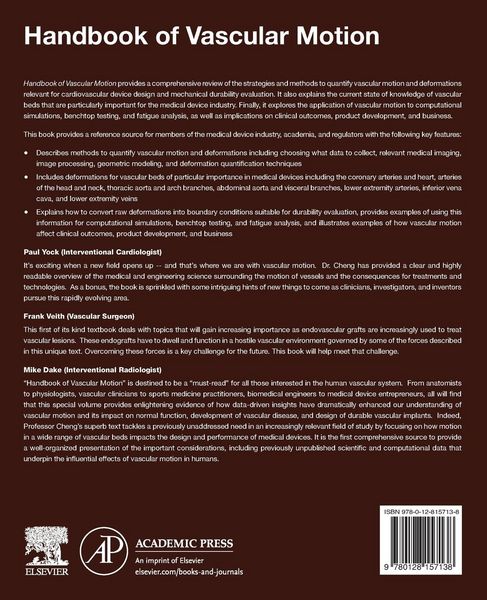
"It s exciting when a new field opens up -- and that s where we are with vascular motion. Dr. Cheng has provided a clear and highly readable overview of the medical and engineering science surrounding the motion of vessels and the consequences for treatments and technologies. As a bonus, the book is sprinkled with some intriguing hints of new things to come as clinicians, investigators, and inventors pursue this rapidly evolving area." --Paul G. Yock - Interventional Cardiologist, Martha Meier Weiland Professor of Medicine, Professor of Bioengineering and Mechanical Engineering (by courtesy), & Director of Byers Center for Biodesign, Stanford University, Stanford, CA

"This first of its kind textbook deals with topics that will gain increasing importance as endovascular grafts are increasingly used to treat vascular lesions. These endografts have to dwell and function in a hostile vascular environment governed by some of the forces described in this unique text. Overcoming these forces is a key challenge for the future. This book will help meet that challenge." --Frank J. Veith - Vascular Surgeon, Professor of Surgery, New York University, New York, NY and Director of VEITHsymposium

"Handbook of Vascular Motion is destined to be a must-read for all those interested in the human vascular system. From anatomists to physiologists, vascular clinicians to sports medicine practitioners, biomedical engineers to medical device entrepreneurs, all will find that this special volume provides enlightening evidence of how data-driven insights have dramatically enhanced our understanding of vascular motion and its impact on normal function, development of vascular disease, and design of durable vascular implants. Indeed, Professor Cheng's superb text tackles a previously unaddressed need in an increasingly relevant field of study by focusing on how motion in a wide range of vascular beds impacts the design and performance of medical devices. It is the first comprehensive source to provide a well-organized presentation of the important considerations, including previously unpublished scientific and computational data that underpin the influential effects of vascular motion in humans." --Michael D. Dake - Interventional Radiologist, Senior Vice President of University of Arizona Health Sciences & Professor of Medical Imaging, Surgery, and Medicine, University of Arizona, Tuscon, AZ

"I very much enjoyed reading this book which provides a wealth of information on the complex and dynamic movement of blood vessels and how this motion can affect the effectiveness and durability of intravascular devices used to treat cardiovascular disease. We have witnessed remarkable advances in the sophistication and effectiveness of implanted medical devices used to treat cardiovascular disease, which is the number one cause of death and disability in the world. However, our understanding of the biomechanical forces acting on these devices as a result of the complex, dynamic movement of blood vessels in everyday life is limited. This is the first book to bring together the large body of scientific information on the movement of blood vessels to show how this motion can impact the durability and function of implanted devices. This book is a must read and reference source for physicians, scientists, biomedical engineers, medical device developers, safety engineers, and regulators who have an interest in improving the treatment of cardiovascular disease." --Christopher K. Zarins - Vascular Surgeon, Emeritus Professor of Surgery, Stanford University, Stanford, CA & Co-Founder and Senior VP of Medical Affairs, HeartFlow, Inc., Redwood City, CA

Produktdetails

Einband

Taschenbuch

Erscheinungsdatum

18.06.2019

Verlag

Elsevier Science & Technology

Seitenzahl

410

Maße (L/B/H)

19,3/23,4/2,4 cm

Gewicht

848 g

Sprache

Englisch

ISBN

978-0-12-815713-8

EU-Ansprechpartner

Zeitfracht Medien GmbH
Ferdinand-Jühlke-Straße 7|99095|Erfurt|DE
produktsicherheit@zeitfracht.de

Herstelleradresse

Elsevier Science & Technology
125 London Wall|EC2Y 5AS|London|GB
tradeorders@elsevier.com

Ein neues Kapitel für Ihre Bücher

Ein neues Kapitel für Ihre Bücher

Schenken Sie Ihren alten Schätzen ein zweites Leben: Einfach Barcode scannen, Versandetikett ausdrucken, Bücher verschicken und Thalia Geschenkkarte erhalten.

Jetzt verkaufen
Jetzt verkaufen

Kundinnen und Kunden meinen

0 Bewertungen

Informationen zu Bewertungen

Zur Abgabe einer Bewertung ist eine Anmeldung im Konto notwendig. Die Authentizität der Bewertungen wird von uns nicht überprüft. Wir behalten uns vor, Bewertungstexte, die unseren Richtlinien widersprechen, entsprechend zu kürzen oder zu löschen.

Die Bewertungen sind nach Format, Anzahl Sterne und Datum sortiert.

Verfassen Sie die erste Bewertung zu diesem Artikel

Helfen Sie anderen Kund*innen durch Ihre Meinung

Kundinnen und Kunden meinen

0 Bewertungen filtern

Die Leseprobe wird geladen.
  • Produktbild: Handbook of Vascular Motion
  • Produktbild: Handbook of Vascular Motion
  • 1. Introduction

    Part I Methods for Quantifying Vascular Deformations2. Deciding What You Need and How to Get It3. Medical Imaging Modalities and Protocols4. Geometric Modeling5. Centerline Deformation Metrics6. Surface Deformation Metrics

    Part II Deformations of Vascular Beds Relevant for Medical Devices7. Coronary Blood Vessels8. Neurovascular Blood Vessels9. Thoracic Aorta and Arch Branches10. Abdominal Aorta and Visceral Arteries11. Lower Extremity Arteries12. Inferior Vena Cava and Lower Extremity Veins13. Upper Extremity Blood Vessels

    Part III Developing and Utilizing Boundary Conditions14. Developing Boundary Conditions for Durability Evaluation15. Summary of Durability Evaluation Methods16. How to Improve Durability in a Pinch17. Areas of Future Research18. Conclusions