















































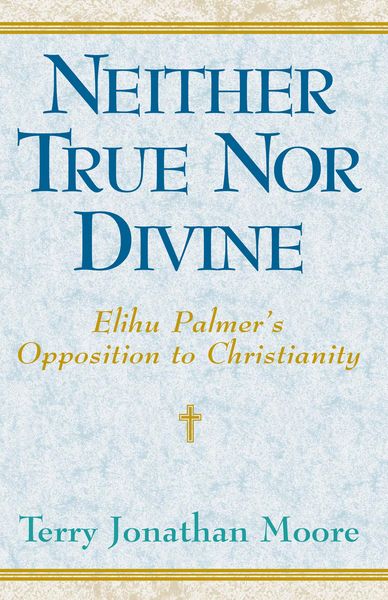
Neither True nor Divine Elihu Palmer's Opposition to Christianity
-
- Einzelkauf Download ausgewählt
-
Sprache:Englisch
3,99 €
inkl. gesetzl. MwSt.Beschreibung
Produktdetails
Format
ePUB
Kopierschutz
Ja
Family Sharing
Nein
Text-to-Speech
Ja
Erscheinungsdatum
01.02.1998
Verlag
Xlibris USSeitenzahl
(Printausgabe)
Dateigröße
389 KB
Sprache
Englisch
EAN
9781984562869
The purpose of the dissertation was to analyze Elihu Palmer's critical responses to Christianity as an historical witness to what Christianity was in his lifetime (1764-1806). Palmer's life story, following the memoir by John Fellows primarily, was interwoven chronologically with analyses of his publications.
The first chapter traced Palmer's eventful first thirty-one years. Born and reared on a farm in Connecticut, Palmer graduated from Dartmouth College in 1787. After supplying the pulpit of First Presbyterian Church, Newtown (Queens), New York, he moved to Augusta, Georgia, where he studied law and lectured on deism. For his denial of the divinity of Jesus Christ, he was fired from a Philadelphia church belonging to the Society of Universal Baptists. He advertised in Philip Freneau's National Gazette and the General Advertiser (later the Aurora) that he would lecture against Christ's divinity. However, Episcopal Bishop William White intimidated landlords to prevent Palmer and John Fitch from renting a public hall for the lecture. Palmer completed his legal studies in western Pennsylvania and returned to Philadelphia in 1793 to open his law practice. He then was blinded in a Yellow Fever epidemic and resumed preaching deism.
The second chapter included analysis of Palmer's publications during his first five years in New York City. His perceptions of Christian doctrines and their social impact were discussed. The last section traced Palmer's tour through Philadelphia and Baltimore as reported in Dennis Driscol's newspaper, the Temple of Reason, and John Hargrove's short-lived Temple of Truth.
The third chapter contrasted the deist movement's potential during the presidency of Thomas Jefferson with its rapid decline after the return of Thomas Paine to America. Palmer's bitterness toward Christianity and his failure to articulate a positive message in competition with revivalists were considered. His belabored critique of the Bible in his magazine, Prospect, was interpreted as a cause of the American deist movement's decline.
The conclusion suggested that Palmer's antithetical relationship to Christianity contributed to the rise of Christian social reform, the further separation of church and state, and biblical criticism.
Noch keine Bewertungen vorhanden
Verfassen Sie die erste Bewertung zu diesem Artikel
Helfen Sie anderen Kundinnen und Kunden durch Ihre Meinung.
Kurze Frage zu unserer Seite
Vielen Dank für Ihr Feedback
Wir nutzen Ihr Feedback, um unsere Produktseiten zu verbessern. Bitte haben Sie Verständnis, dass wir Ihnen keine Rückmeldung geben können. Falls Sie Kontakt mit uns aufnehmen möchten, können Sie sich aber gerne an unseren Kund*innenservice wenden.
zum Kundenservice