
















































KI-Beratung Beta

Gutscheinbedingungen

Gültig bis 11.11.2026 | Gültig für Spielzeug, Filme, Musik, Software, Games, Geschenke & Trends, Schreibwaren, Hörbücher und Hörbuch-Downloads (außer Abo & Shelfies), gebrauchte Bücher, nicht preisgebundene Bücher und Kalender | Einlösbar unter thalia.de und in der Thalia App | Click & Collect nur mit Online-Zahlung (Paypal/Kreditkarte) vorab | Einzelne Artikel können ausgeschlossen sein | Nicht kombinierbar mit anderen Gutscheinen oder Preisaktionen | Nur einmal pro Einkauf einlösbar | Gutschein wird auf max. 500€ Bestellwert angerechnet | Keine Barauszahlung | Digitale Hörbücher nur für Android  | Nicht gültig für preisgebundene Artikel (aufgrund der Buchpreisbindung sind Gutscheine nicht auf Bücher, eBooks, Presse einlösbar), tolino eReader & Zubehör, Abonnements & Flatrates, Geschenkkarten, Versandkosten und Services

  • Produktbild: Signs of Signification
  • Produktbild: Signs of Signification

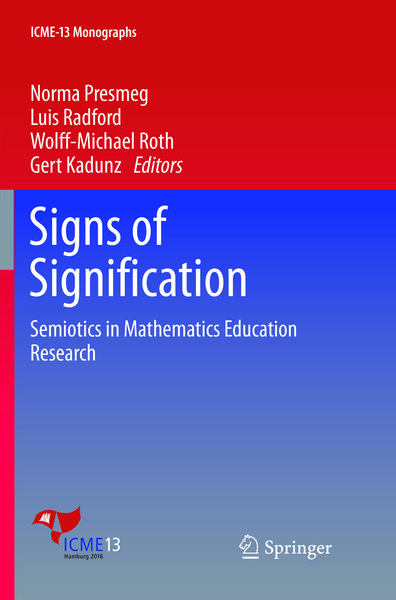
Signs of Signification Semiotics in Mathematics Education Research

Aus der Reihe ICME-13 Monographs

113,99 €

inkl. gesetzl. MwSt., Versandkostenfrei


Beschreibung

Produktdetails

Einband

Taschenbuch

Erscheinungsdatum

04.06.2019

Abbildungen

VIII, 372 p. 113 illus.

Herausgeber

Norma Presmeg + weitere

Verlag

Springer

Seitenzahl

372

Maße (L/B/H)

23,5/15,5/2,1 cm

Gewicht

575 g

Auflage

Softcover reprint of the original 1st ed. 2018

Sprache

Englisch

ISBN

978-3-319-88916-0

Beschreibung

Produktdetails

Einband

Taschenbuch

Erscheinungsdatum

04.06.2019

Abbildungen

VIII, 372 p. 113 illus.

Herausgeber

Verlag

Springer

Seitenzahl

372

Maße (L/B/H)

23,5/15,5/2,1 cm

Gewicht

575 g

Auflage

Softcover reprint of the original 1st ed. 2018

Sprache

Englisch

ISBN

978-3-319-88916-0

Herstelleradresse

Springer-Verlag KG
Sachsenplatz 4-6
1201 Wien
AT

Email: ProductSafety@springernature.com

Ein neues Kapitel für Ihre Bücher

Ein neues Kapitel für Ihre Bücher

Schenken Sie Ihren alten Schätzen ein zweites Leben und erhalten Sie dafür eine Thalia Geschenkkarte.

Jetzt verkaufen
Jetzt verkaufen

Noch keine Bewertungen vorhanden

Verfassen Sie die erste Bewertung zu diesem Artikel

Helfen Sie anderen Kundinnen und Kunden durch Ihre Meinung.

Kundinnen und Kunden meinen

Bewertungen (0)

Weitere Artikel finden Sie in

  • Produktbild: Signs of Signification
  • Produktbild: Signs of Signification
  • Chapter 1. Introduction. The editors.- Section 1: Sociocultural perspectives on semiosis.- Chapter 1. Introduction to Section 1.- Chapter 2. Semiosis and subjectification: The classroom constitution of mathematical objects.- Chapter 3. Birth of signs: A (Spinozist-Marxian) materialist approach.- Chapter 4. Relating computational Cartesian graphs to a real motion: An analysis of high school students’ activity.- Chapter 5. Joint attention in resolving the ambiguity of different presentations: A dual eye-tracking study of the teaching-learning process.- Chapter 6. Attention catching: Connecting the space of joint action and togethering.- Section 2: Language and text orientations.- Introduction to Section 2.- Chapter 7.  A matter of translation.- Chapter 8. Using social semiotics to explore institutional assumptions about mathematics students and teachers.- Chapter 9. Semiotics, epistemology, and mathematics.- Chapter 10. A semiotic-conceptual analysis of conceptual development in learningmathematics.- Section 3: Peircean semiotics, including semiotic chaining and representations.- Introduction to Section 3.- Chapter 11. Adalira Sáenz-Ludlow: Iconicity and diagrammatic reasoning in meaning-making.- Chapter 12. Semiotic representations: A study of dynamic figural register.- Chapter 13. Progressive visualization tasks and semiotic chaining for mathematics teacher preparation: Towards a conceptual framework.- Chapter 14. Primary teachers’ semiotics praxis: Windows into the handling of division tasks.- Section 4: Semiotic resources including gesturing and tools.- Introduction to Section 4.- Chapter 15. Gradual change of perception: Signs, tools, and meaning-making of fractions.- Chapter 16. On the role of gestures for the descriptive analysis of ‘Grundvorstellungen’: A case of linear functions.- Chapter 17. Diagramming and gesturing during mathematizing: Kinesthetic and haptic interactions support mathematical ideation.- Chapter 18. Objectifying the inclusion relationshipof quadrilaterals in a synchronic-interactive and collaborative computer supported environment.- Chapter 19. Discussion and conclusions.