















































KI-Beratung Beta

Gutscheinbedingungen

Gültig bis 11.11.2026 | Gültig für Spielzeug, Filme, Musik, Software, Games, Geschenke & Trends, Schreibwaren, Hörbücher und Hörbuch-Downloads (außer Abo & Shelfies), gebrauchte Bücher, nicht preisgebundene Bücher und Kalender | Einlösbar unter thalia.de und in der Thalia App | Click & Collect nur mit Online-Zahlung (Paypal/Kreditkarte) vorab | Einzelne Artikel können ausgeschlossen sein | Nicht kombinierbar mit anderen Gutscheinen oder Preisaktionen | Nur einmal pro Einkauf einlösbar | Gutschein wird auf max. 500€ Bestellwert angerechnet | Keine Barauszahlung | Digitale Hörbücher nur für Android  | Nicht gültig für preisgebundene Artikel (aufgrund der Buchpreisbindung sind Gutscheine nicht auf Bücher, eBooks, Presse einlösbar), tolino eReader & Zubehör, Abonnements & Flatrates, Geschenkkarten, Versandkosten und Services

  • Produktbild: Teaching and Learning Stochastics
  • Produktbild: Teaching and Learning Stochastics

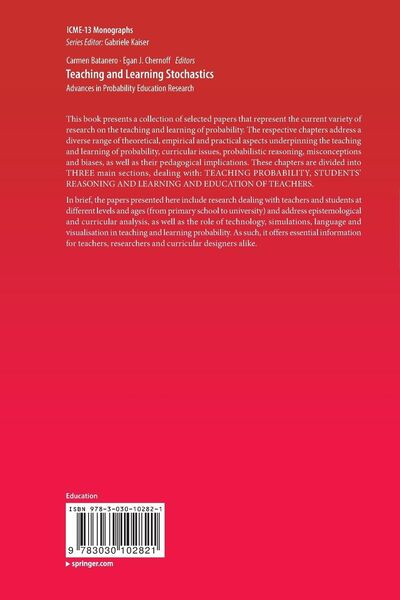
Teaching and Learning Stochastics Advances in Probability Education Research

Aus der Reihe ICME-13 Monographs

167,99 €

inkl. gesetzl. MwSt., Versandkostenfrei


Beschreibung

This book presents a collection of selected papers that represent the current variety of research on the teaching and learning of probability. The respective chapters address a diverse range of theoretical, empirical and practical aspects underpinning the teaching and learning of probability, curricular...

Beschreibung

This book presents a collection of selected papers that represent the current variety of research on the teaching and learning of probability. The respective chapters address a diverse range of theoretical, empirical and practical aspects underpinning the teaching and learning of probability, curricular issues, probabilistic reasoning, misconceptions and biases, as well as their pedagogical implications. These chapters are divided into THREE main sections, dealing with: TEACHING PROBABILITY, STUDENTS' REASONING AND LEARNING AND EDUCATION OF TEACHERS.
In brief, the papers presented here include research dealing with teachers and students at different levels and ages (from primary school to university) and address epistemological and curricular analysis, as well as the role of technology, simulations, language and visualisation in teaching and learning probability. As such, it offers essential information for teachers, researchers and curricular designers alike. 

Produktdetails

Einband

Taschenbuch

Erscheinungsdatum

25.01.2019

Abbildungen

XIII, 384 p. 40 illus.

Herausgeber Carmen Batanero + weitere

Produktdetails

Einband

Taschenbuch

Erscheinungsdatum

25.01.2019

Abbildungen

XIII, 384 p. 40 illus.

Herausgeber
Verlag Springer
Seitenzahl

384

Maße (L/B/H)

23,5/15,5/2,2 cm

Gewicht

604 g

Auflage

Softcover reprint of the original 1st edition 2018

Sprache

Englisch

ISBN

978-3-030-10282-1

Herstelleradresse

Springer-Verlag KG
Sachsenplatz 4-6
1201 Wien
AT

Email: ProductSafety@springernature.com

Ein neues Kapitel für Ihre Bücher

Ein neues Kapitel für Ihre Bücher

Schenken Sie Ihren alten Schätzen ein zweites Leben und erhalten Sie dafür eine Thalia Geschenkkarte.

Jetzt verkaufen
Jetzt verkaufen

Noch keine Bewertungen vorhanden

Verfassen Sie die erste Bewertung zu diesem Artikel

Helfen Sie anderen Kundinnen und Kunden durch Ihre Meinung.

Kundinnen und Kunden meinen

Bewertungen (0)

Weitere Artikel finden Sie in

  • Produktbild: Teaching and Learning Stochastics
  • Produktbild: Teaching and Learning Stochastics
  • Preface.- Section 1. Teaching probability.- Chapter 1. Reasoning with risk: teaching probability and risk as twin concepts.- Chapter 2. Language and lexical ambiguity in the probability register.- Chapter 3. The status of probability in the elementary and lower secondary school mathematics curriculum: the rise and fall of probability in school mathematics in the United States.- Chapter 4. Challenges and opportunities in experimentation-based instruction in probability.- Chapter 5. Visualising conditional probabilities – three perspectives on unit squares and tree diagrams.- Chapter 6. Probability concepts needed for teaching a repeated sampling approach to inference.- Chapter 7. Characterizing the probability problems proposed in university entrance tests in Andalucia.- Chapter 8. Random walks in the didactics of probability: enactive metaphoric learning sprouts .- Chapter 9. The role of statistics anxiety in learning probability.- Section 2. Students’ reasoning and learning.- Chapter 10. What 9- and 10-year old pupils already know and what they can learn about randomness.- Chapter 11. Understanding children’s meaning of randomness in relation to random generators.  .- Chapter 12. Reasoning in decision making under uncertainty and decisions of risi on a game of chance.- Chapter 13. Determinism and empirical commitment in probabilistic reasoning of high school students.- Chapter 14. Students’ reasoning on sample space and probabilities of compound events .- Chapter 15. The six loses: risky decisions between probabilistic reasoning and gut feelings.- Section 3. Education of teachers.- Chapter 16. Comparing the relative probabilities of events.- Chapter 17. Preparing teachers for teaching probability through problem solving.- Chapter 18. Exploring teachers’ attitudes towards probability and its teaching.- Chapter 19. Students’ reflections about a course for learning probability via simulations.- Chapter 20. Prospective teachers reasoning in the context of sampling.- A commentary on teaching and learning stochastics: Advances in probability education research.