KI-Beratung Beta

Gutscheinbedingungen

Gültig bis 30.11.2026 | Gültig für nicht preisgebundene fremdsprachige Bücher | Einzelne Artikel können ausgeschlossen sein | Online auf thalia.de und in der Thalia App einlösbar | Click & Collect nur mit Online-Zahlung (Paypal/Kreditkarte) vorab | Nicht kombinierbar mit anderen Gutscheinen oder Preisaktionen | Nur einmal pro Einkauf einlösbar | Gutschein wird auf max. 500€ Bestellwert angerechnet | Keine Barauszahlung | Nicht gültig für Versandkosten und Services

Produktbild: The Startup Community Way

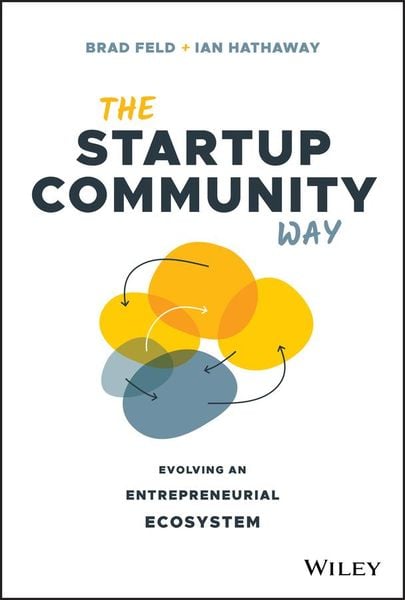
The Startup Community Way Evolving an Entrepreneurial Ecosystem

Aus der Reihe Techstars

27,99 €

inkl. gesetzl. MwSt., Versandkostenfrei


Beschreibung

The Way Forward for Entrepreneurship Around the World   We are in the midst of a startup revolution. The growth and proliferation of innovation-driven startup activity is profound, unprecedented, and global in scope. Today, it is understood that communities of support and knowledge-sharing go along with...

Beschreibung

The Way Forward for Entrepreneurship Around the World
 
We are in the midst of a startup revolution. The growth and proliferation of innovation-driven startup activity is profound, unprecedented, and global in scope. Today, it is understood that communities of support and knowledge-sharing go along with other resources. The importance of collaboration and a long-term commitment has gained wider acceptance. These principles are adopted in many startup communities throughout the world.
 
And yet, much more work is needed. Startup activity is highly concentrated in large cities. Governments and other actors such as large corporations and universities are not collaborating with each other nor with entrepreneurs as well as they could. Too often, these actors try to control activity or impose their view from the top-down, rather than supporting an environment that is led from the bottom-up. We continue to see a disconnect between an entrepreneurial mindset and that of many actors who wish to engage with and support entrepreneurship. There are structural reasons for this, but we can overcome many of these obstacles with appropriate focus and sustained practice.
 
No one tells this story better than Brad Feld and Ian Hathaway. The Startup Community Way: Evolving an Entrepreneurial Ecosystem explores what makes startup communities thrive and how to improve collaboration in these rapidly evolving, complex environments.
 
The Startup Community Way is an explanatory guide for startup communities. Rooted in the theory of complex systems, this book establishes the systemic properties of entrepreneurial ecosystems and explains why their complex nature leads people to make predictable mistakes. As complex systems, value creation occurs in startup communities primarily through the interaction of the "parts" - the people, organizations, resources, and conditions involved - not the parts themselves. This continual process of bottom-up interactions unfolds naturally, producing value in novel and unexpected ways. Through these complex, emergent processes, the whole becomes greater and substantially different than what the parts alone could produce.
 
Because of this, participants must take a fundamentally different approach than is common in much of our civic and professional lives. Participants must take a whole-system view, rather than simply trying to optimize their individual part. They must prioritize experimentation and learning over planning and execution. Complex systems are uncertain and unpredictable. They cannot be controlled, only guided and influenced. Each startup community is unique. Replication is enticing but impossible. The race to become "The Next Silicon Valley" is futile - even Silicon Valley couldn't recreate itself.
 
This book:
* Offers practical advice for entrepreneurs, community builders, government officials, and other stakeholders who want to harness the power of entrepreneurship in their city
* Describes the core components of startup communities and entrepreneurial ecosystems, as well as an explanation of the differences between these two related, but distinct concepts
* Advances a new framework for effective startup community building based on the theory of complex systems and insights from systems thinking
* Includes contributions from leading entrepreneurial voices
* Is a must-have resource for entrepreneurs, venture capitalists, executives, business and community leaders, economic development authorities, policymakers, university officials, and anyone wishing to understand how startup communities work anywhere in the world

Produktdetails

Einband

Gebundene Ausgabe

Erscheinungsdatum

28.07.2020

Verlag John Wiley & Sons Inc
Seitenzahl

368

Produktdetails

Einband

Gebundene Ausgabe

Erscheinungsdatum

28.07.2020

Verlag John Wiley & Sons Inc
Seitenzahl

368

Maße (L/B/H)

23,7/16,4/3,2 cm

Gewicht

579 g

Auflage

1. Auflage

Sprache

Englisch

ISBN

978-1-119-61360-2

Herstelleradresse

Libri GmbH
Europaallee 1
36244 Bad Hersfeld
DE

Email: gpsr@libri.de

Ein neues Kapitel für Ihre Bücher

Ein neues Kapitel für Ihre Bücher

Schenken Sie Ihren alten Schätzen ein zweites Leben und erhalten Sie dafür eine Thalia Geschenkkarte.

Jetzt verkaufen
Jetzt verkaufen

Noch keine Bewertungen vorhanden

Verfassen Sie die erste Bewertung zu diesem Artikel

Helfen Sie anderen Kundinnen und Kunden durch Ihre Meinung.

Kundinnen und Kunden meinen

Bewertungen (0)

Die Leseprobe wird geladen.
  • Produktbild: The Startup Community Way
  • Foreword xiii

    Preface xvii

    Chapter One Introduction 1

    The Next Generation 2

    Our Approach 3

    A Deeper Motivation 5

    The Boulder Thesis 7

    Startup Communities are Complex Adaptive Systems 8

    Where We Were in 2012 10

    Where We are Now in 2020 12

    Using Complexity Theory to Explain Startup Communities 14

    Evolving the Boulder Thesis to the Startup Community Way 17

    Part I Introduction to Startup Communities 21

    Chapter Two Why Startup Communities Exist 23

    What Entrepreneurs Do 23

    The External Environment 25

    Networks over Hierarchies 27

    Networks of Trust 29

    Density and Agglomeration 33

    Quality of Place 35

    Chapter Three The Actors 41

    Leaders, Feeders, and Instigators 42

    Actors 45

    Chapter Four The Factors 59

    The Seven Capitals 60

    Factors 62

    Chapter Five Startup Communities

    versus Entrepreneurial Ecosystems 75

    Entrepreneurial Ecosystems 77

    Alignment of Actors 78

    Different, but Mutually Reinforcing, Purpose 80

    Systems within Systems 81

    Entrepreneurial Success 84

    Community/Ecosystem Fit 85

    Part II Startup Communities as Complex Systems 93

    Chapter Six Putting the System Back into Ecosystem 95

    Introduction to Systems 96

    The Whole System 97

    Simple, Complicated, and Complex Activities 103

    Moving from Activities to Systems 107

    Chapter Seven Unpredictable Creativity 115

    Emergence 117

    Synergies and Nonlinearity 118

    Self-Organization 120

    Dynamism 121

    The Study of Interactions 125

    Chapter Eight The Myth of Quantity 133

    More of Everything 134

    Outliers, Not Averages 136

    Entrepreneurial Recycling 138

    Leaders as Supernodes 140

    Chapter Nine The Illusion of Control 151

    Not Controllable 152

    Not Fully Knowable 154

    Feedbacks and Contagion 156

    Getting Unstuck 158

    Letting Go 160

    Chapter Ten The Absence of a Blueprint 165

    Initial Conditions and Basins of Attraction 168

    The Narrative Fallacy 170

    Building on Strengths and Learning from Failures 172

    Cultivating Topophilia 174

    Chapter Eleven The Measurement Trap 183

    The Fundamental Measurement Problem 184

    Actor and Factor Models: A Categorical Approach 186

    Standardized Metrics Models: A Comparative Approach 188

    Network Models: A Relational Approach 190

    Dynamic Models: An Evolutionary Approach 192

    Cultural-Social Models: A Behavioral Approach 194

    Logic Models: A Causal Approach 195

    Agent-Based Models: A Simulation Approach 198

    Applying the Different Models 199

    Part III From the Boulder Thesis to the Startup Community Way 207

    Chapter Twelve Simplifying Complexity 209

    The Boulder Thesis 210

    The Rainforest 212

    Applying Systems Thinking 214

    Looking Deeply 216

    Leverage Points 219

    Chapter Thirteen Leadership is Key 231

    Be a Mentor 234

    Entrepreneurs as Role Models 235

    Key Leadership Characteristics 237

    Chapter Fourteen Think in Generations 243

    Progress is Uneven and Often Feels Slow 245

    The Endless Long-Term Game 247

    Chapter Fifteen Diversity is a Feature, Not a Bug 255

    Cultivate Diversity 256

    Embracing Diversity 259

    Think Broadly about Entrepreneurship 260

    Chapter Sixteen Be Active, Not Passive 267

    Self-Similarity and Replication 268

    Don't Wait or Ask Permission 269

    Play a Positive-Sum Game 270

    Continuously and Actively Engage 275

    Part IV Conclusion 281

    Chapter Seventeen Conclusion 283

    Reflections 283

    Summary of the Book 285

    Final Thoughts 291

    About the Authors 295

    Acknowledgments 297

    Notes 301

    Index 325