















































KI-Beratung Beta

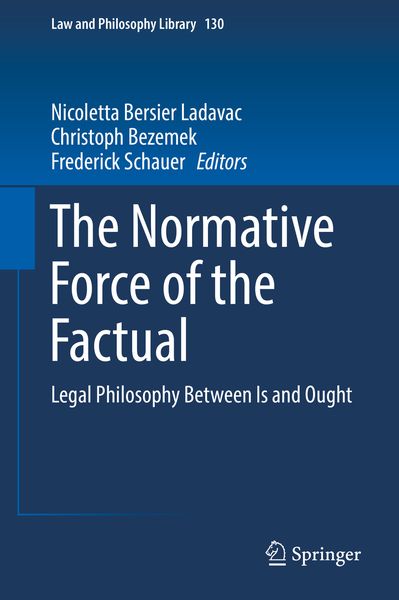
Produktbild: The Normative Force of the Factual
Band 130

The Normative Force of the Factual Legal Philosophy Between Is and Ought

164,99 €

inkl. gesetzl. MwSt., Versandkostenfrei


Beschreibung

This book explores the interrelation of facts and norms. How does law originate in the first place? What lies at the roots of this phenomenon? How is it preserved? And how does it come to an end? Questions like these led Georg Jellinek to speak of the “normative force of the factual” in the early 20th...

Beschreibung

This book explores the interrelation of facts and norms. How does law originate in the first place? What lies at the roots of this phenomenon? How is it preserved? And how does it come to an end? Questions like these led Georg Jellinek to speak of the “normative force of the factual” in the early 20th century, emphasizing the human tendency to infer rules from recurring events, and to perceive a certain practice not only as a fact but as a norm; a norm which not only allows us to distinguish regularity from irregularity, but at the same time, to treat deviances as transgressions. Today, Jellinek’s concept still provides astonishing insights on the dichotomy of “is” and “ought to be”, the emergence of the normative, the efficacy and the defeasibility of (legal) norms, and the distinct character of what legal theorists refer to as “normativity”. It leads us back to early legal history, it connects anthropology and legal theory, and it demonstrates the interdependence of law and the social sciences. In short: it invites us to fundamentally reassess the interrelation of facts and norms from various perspectives. The contributing authors to this volume have accepted that invitation.

Portrait


Nicoletta Bersier Ladavac
, Thémis, Centre d'Etudes de Philosophie du droit, de Sociologie du droit et de Théorie du droit, Geneva.


Christoph Bezemek
is Professor of Law at University of Graz, Institute of Public Law and Political Science. His research focuses on comparative constitutional law, political and legal theory.


Frederick Schauer
is the David and Mary Harrison Distinguished Professor of Law at the University of Virginia and Frank Stanton Professor (Emeritus) of the First Amendment at the Kennedy School of Government, Harvard University. He is the author of numerous publications on constitutional law, in particular on free speech, and on legal theory. He is a Co-Editor of Springer’s Law and Philosophy Library


Produktdetails

Einband

Gebundene Ausgabe

Erscheinungsdatum

05.07.2019

Abbildungen

VIII, 180 p.

Herausgeber Nicoletta Bersier Ladavac + weitere

Produktdetails

Einband

Gebundene Ausgabe

Erscheinungsdatum

05.07.2019

Abbildungen

VIII, 180 p.

Herausgeber
Verlag Springer
Seitenzahl

180

Maße (L/B/H)

24,1/16/1,6 cm

Gewicht

401 g

Auflage

1st ed. 2019

Sprache

Englisch

ISBN

978-3-030-18928-0

Herstelleradresse

Springer-Verlag KG
Sachsenplatz 4-6
1201 Wien
AT

Email: ProductSafety@springernature.com

Ein neues Kapitel für Ihre Bücher

Ein neues Kapitel für Ihre Bücher

Schenken Sie Ihren alten Schätzen ein zweites Leben und erhalten Sie dafür eine Thalia Geschenkkarte.

Jetzt verkaufen
Jetzt verkaufen

Noch keine Bewertungen vorhanden

Verfassen Sie die erste Bewertung zu diesem Artikel

Helfen Sie anderen Kundinnen und Kunden durch Ihre Meinung.

Kundinnen und Kunden meinen

Bewertungen (0)

  • Produktbild: The Normative Force of the Factual

  • On Jellinek’s “Two Sides” of the State.- On Jellinek’s Concept of a Normative Force of the Factual.- A Positivist View on the Normative Force of the Factual.- The Normative Force of the Factual: A Doctrinal Perspective.- The Normative Force of the Factual: A View from International Law.- The Normative Force of the Factual in Analytical Perspective.- The Fact of Norms.- The Factual Force of the Normative.- “Is” and “Ought” and the Problem of Normativity in Hans Kelsen.- Facts and Law.- Reflections on Law and Practical Reasons.- On Normativity.- Deflating Normativity.- Law and Force.- ShillongTacit Knowledge and the Shibboleth of law: A Deconstructive Intersection between Fact and Norm.