
















































KI-Beratung Beta

Gutscheinbedingungen

Gültig bis 11.11.2026 | Gültig für Spielzeug, Filme, Musik, Software, Games, Geschenke & Trends, Schreibwaren, Hörbücher und Hörbuch-Downloads (außer Abo & Shelfies), gebrauchte Bücher, nicht preisgebundene Bücher und Kalender | Einlösbar unter thalia.de und in der Thalia App | Click & Collect nur mit Online-Zahlung (Paypal/Kreditkarte) vorab | Einzelne Artikel können ausgeschlossen sein | Nicht kombinierbar mit anderen Gutscheinen oder Preisaktionen | Nur einmal pro Einkauf einlösbar | Gutschein wird auf max. 500€ Bestellwert angerechnet | Keine Barauszahlung | Digitale Hörbücher nur für Android  | Nicht gültig für preisgebundene Artikel (aufgrund der Buchpreisbindung sind Gutscheine nicht auf Bücher, eBooks, Presse einlösbar), tolino eReader & Zubehör, Abonnements & Flatrates, Geschenkkarten, Versandkosten und Services

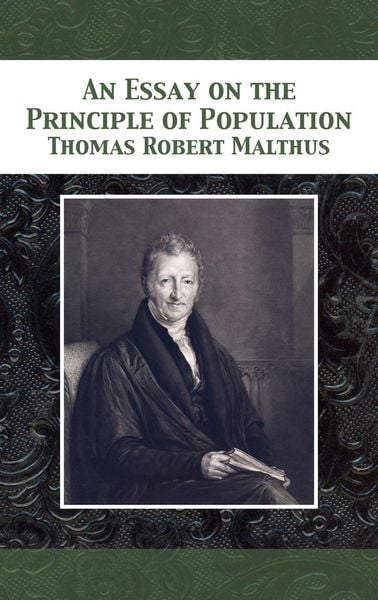
  • Produktbild: An Essay on the Principle of Population
  • Produktbild: An Essay on the Principle of Population

An Essay on the Principle of Population

18,99 €

inkl. gesetzl. MwSt., Versandkostenfrei


Beschreibung

The book An Essay on the Principle of Population was first published anonymously in 1798, but the author was soon identified as Thomas Robert Malthus. The book predicted a grim future, as population would increase geometrically, doubling every 25 years, but food production would only grow arithmetically,...

Beschreibung

The book An Essay on the Principle of Population was first published anonymously in 1798, but the author was soon identified as Thomas Robert Malthus. The book predicted a grim future, as population would increase geometrically, doubling every 25 years, but food production would only grow arithmetically, which would result in famine and starvation, unless births were controlled. While it was not the first book on population, it was revised for over 28 years and has been acknowledged as the most influential work of its era. Malthus's book fuelled debate about the size of the population in the Kingdom of Great Britain and contributed to the passing of the Census Act 1800. This Act enabled the holding of a national census in England, Wales and Scotland, starting in 1801 and continuing every ten years to the present. The book's 6th edition (1826) was independently cited as a key influence by both Charles Darwin and Alfred Russel Wallace in developing the theory of natural selection. A key portion of the book was dedicated to what is now known as Malthus' Iron Law of Population. This name itself is retrospective, based on the iron law of wages, which is the reformulation of Malthus' position by Ferdinand Lassalle, who in turn derived the name from Goethe's "great, eternal iron laws" in Das Göttliche. This theory suggested that growing population rates would contribute to a rising supply of labour that would inevitably lower wages. In essence, Malthus feared that continued population growth would lend itself to poverty and famine. In 1803, Malthus published, under the same title, a heavily revised second edition of his work. His final version, the 6th edition, was published in 1826. In 1830, 32 years after the first edition, Malthus published a condensed version entitled A Summary View on the Principle of Population, which included responses to criticisms of the larger work. Source: Wikipedia

Produktdetails

Einband

Gebundene Ausgabe

Erscheinungsdatum

09.04.2019

Verlag 12th Media Services
Seitenzahl

100

Produktdetails

Einband

Gebundene Ausgabe

Erscheinungsdatum

09.04.2019

Verlag 12th Media Services
Seitenzahl

100

Maße (L/B/H)

24/16,1/1 cm

Gewicht

273 g

Sprache

Englisch

ISBN

978-1-68092-259-2

Herstelleradresse

Libri GmbH
Europaallee 1
36244 Bad Hersfeld
DE

Email: gpsr@libri.de

Ein neues Kapitel für Ihre Bücher

Ein neues Kapitel für Ihre Bücher

Schenken Sie Ihren alten Schätzen ein zweites Leben und erhalten Sie dafür eine Thalia Geschenkkarte.

Jetzt verkaufen
Jetzt verkaufen

Noch keine Bewertungen vorhanden

Verfassen Sie die erste Bewertung zu diesem Artikel

Helfen Sie anderen Kundinnen und Kunden durch Ihre Meinung.

Kundinnen und Kunden meinen

Bewertungen (0)

  • Produktbild: An Essay on the Principle of Population
  • Produktbild: An Essay on the Principle of Population