















































KI-Beratung Beta

Gutscheinbedingungen

Gültig bis 30.11.2026 | Gültig für nicht preisgebundene fremdsprachige Bücher | Einzelne Artikel können ausgeschlossen sein | Online auf thalia.de und in der Thalia App einlösbar | Click & Collect nur mit Online-Zahlung (Paypal/Kreditkarte) vorab | Nicht kombinierbar mit anderen Gutscheinen oder Preisaktionen | Nur einmal pro Einkauf einlösbar | Gutschein wird auf max. 500€ Bestellwert angerechnet | Keine Barauszahlung | Nicht gültig für Versandkosten und Services

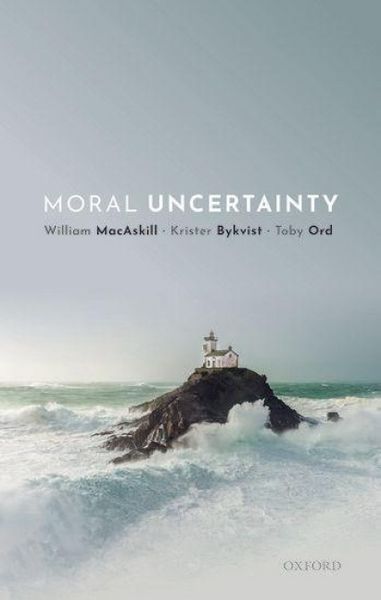
Produktbild: Moral Uncertainty

Moral Uncertainty

112,99 €

inkl. gesetzl. MwSt., Versandkostenfrei


Beschreibung

This is an open access title available under the terms of a CC BY-NC-ND 4.0 International licence. It is free to read at Oxford Scholarship Online and offered as a free PDF download from OUP and selected open access locations. Very often we're uncertain about what we ought, morally, to do. We don't...

Beschreibung

This is an open access title available under the terms of a CC BY-NC-ND 4.0 International licence. It is free to read at Oxford Scholarship Online and offered as a free PDF download from OUP and selected open access locations. Very often we're uncertain about what we ought, morally, to do. We don't know how to weigh the interests of animals against humans, how strong our duties are to improve the lives of distant strangers, or how to think about the ethics of bringing new people into existence. But we still need to act. So how should we make decisions in the face of such uncertainty? Though economists and philosophers have extensively studied the issue of decision-making in the face of uncertainty about matters of fact, the question of decision-making given fundamental moral uncertainty has been neglected. Philosophers William MacAskill, Krister Bykvist, and Toby Ord try to fill this gap. Moral Uncertainty argues that there are distinctive norms that govern how one ought to make decisions. It defends an information-sensitive account of how to make such decisions by developing an analogy between moral uncertainty and social choice, arguing that the correct way to act in the face of moral uncertainty depends on whether the moral theories in which one has credence are merely ordinal, cardinal, or both cardinal and intertheoretically comparable. It tackles the problem of how to make intertheoretical comparisons, discussing potential solutions and the implications of their view for metaethics and practical ethics.

Produktdetails

Einband

Gebundene Ausgabe

Erscheinungsdatum

09.11.2020

Verlag Oxford University Press
Seitenzahl

238

Produktdetails

Einband

Gebundene Ausgabe

Erscheinungsdatum

09.11.2020

Verlag Oxford University Press
Seitenzahl

238

Maße (L/B/H)

22/13,9/2,1 cm

Gewicht

396 g

Sprache

Englisch

ISBN

978-0-19-872227-4

Herstelleradresse

Libri GmbH
Europaallee 1
36244 Bad Hersfeld
DE

Email: gpsr@libri.de

Ein neues Kapitel für Ihre Bücher

Ein neues Kapitel für Ihre Bücher

Schenken Sie Ihren alten Schätzen ein zweites Leben und erhalten Sie dafür eine Thalia Geschenkkarte.

Jetzt verkaufen
Jetzt verkaufen

Noch keine Bewertungen vorhanden

Verfassen Sie die erste Bewertung zu diesem Artikel

Helfen Sie anderen Kundinnen und Kunden durch Ihre Meinung.

Kundinnen und Kunden meinen

Bewertungen (0)

Die Leseprobe wird geladen.
  • Produktbild: Moral Uncertainty
    • Introduction
    • 1: Why We Should Take Moral Uncertainty Seriously
    • 2: Maximizing Expected Choice-Worthiness
    • 3: Ordinal Theories and the Social Choice Analogy
    • 4: Interval-Scale Theories and Variance Voting
    • 5: Intertheoretic Comparisons of Choice-Worthiness
    • 6: Fanaticism and Incomparability
    • 7: Metaethical Implications: Cognitivism Versus Non-Cognitivism
    • 8: Practical Ethics Given Moral Uncertainty
    • 9: Moral Information
    • Conclusion
    • Bibliography