















































KI-Beratung Beta

  • Produktbild: Renal Fibrosis: Mechanisms and Therapies
  • Produktbild: Renal Fibrosis: Mechanisms and Therapies
Band 1165 - 12%

Renal Fibrosis: Mechanisms and Therapies

12% sparen

206,99 € UVP 235,39 €

inkl. gesetzl. MwSt., Versandkostenfrei


Beschreibung

This book systemically presents the latest research on renal fibrosis, covering all the major topics in the field, including the possible mechanisms, biomarkers, and strategies for prevention and treatment of chronic kidney disease (CKD). Due to its high prevalence, CKD represents a huge global economic...

Beschreibung

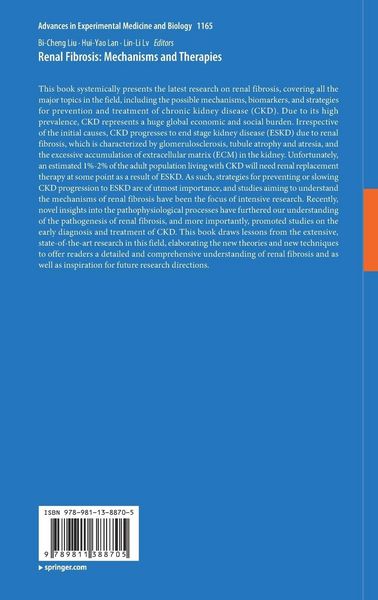
This book systemically presents the latest research on renal fibrosis, covering all the major topics in the field, including the possible mechanisms, biomarkers, and strategies for prevention and treatment of chronic kidney disease (CKD). Due to its high prevalence, CKD represents a huge global economic and social burden. Irrespective of the initial causes, CKD progresses to end stage kidney disease (ESKD) due to renal fibrosis, which is characterized by glomerulosclerosis, tubule atrophy and atresia, and the excessive accumulation of extracellular matrix (ECM) in the kidney. Unfortunately, an estimated 1%-2% of the adult population living with CKD will need renal replacement therapy at some point as a result of ESKD. As such, strategies for preventing or slowing CKD progression to ESKD are of utmost importance, and studies aiming to understand the mechanisms of renal fibrosis have been the focus of intensive research. Recently, novel insights into the pathophysiological processes have furthered our understanding of the pathogenesis of renal fibrosis, and more importantly, promoted studies on the early diagnosis and treatment of CKD. This book draws lessons from the extensive, state-of-the-art research in this field, elaborating the new theories and new techniques to offer readers a detailed and comprehensive understanding of renal fibrosis and as well as inspiration for future research directions.


Portrait


Dr. Bi-Cheng Liu is a Chair Professor and the Director of the Institute of Nephrology, Southeast University, China. He is also the Director of the Department of Medicine, Southeast University School of Medicine and Vice President of Zhongda Hospital. He is currently the Vice President of the Society of Nephrology and the Chinese Society of Renal Physiology. Prof. Liu has been working in the field of renal disease for more than 30 years, and his research, which has been funded by over 20 government grants including the National Key R&D Project, Key Research Program of National Natural Science Foundation of China, focuses on mechanisms of renal fibrosis and its biomarkers, as well as the complications of hemodialysis. He has published more than 450 articles in these fields, among them over 140 cited by SCI.  He is also the editor or chapter editor of more than 40 books.

Dr. Hui-Yao Lan is a Choh-Ming Li Professor of Biomedical Sciences jointly at the Department of Medicine& Therapeutics, and the Li Ka Shing Institute of Health Sciences, as well as Professor (by courtesy) in the School of Biomedical Sciences and the Department of Anatomical and Cellular Pathology, the Chinese University of Hong Kong, China. He is the assistant dean (research), Faculty of Medicine and Associate Director of the Li Ka Shing Institute of Health Sciences. Prof. Lan is the vice president of Kidney Physiology branch of Chinese Association for Physiological Sciences. He also serves as the associate editor of the journal "Clinical Experimental Pharmacology and Physiology",  "Frontiers in Physiology" and "Journal of Cellular and Molecular Medicine" and editorial board member of several international journals. Prof. Lan is the winner of the 1st prize in Chinese Medical Science and Technology Award in 2015 and the 2nd prize for National Science and Technology Progress Award in 2016. His research focuses on TGF-beta/Smad signaling pathway in kidney and cardiovascular diseases, and tumor microenvironments. He has published more than 280 peer-reviewed papers with h-index over 60. 

Dr. Lin-Li Lv is a professor of the Institute of Nephrology, Southeast University, China. 

Produktdetails

Einband

Gebundene Ausgabe

Erscheinungsdatum

24.08.2019

Abbildungen

XVI, 709 p. 63 illus., 55 illus. in color.

Herausgeber Bi-Cheng Liu + weitere

Produktdetails

Einband

Gebundene Ausgabe

Erscheinungsdatum

24.08.2019

Abbildungen

XVI, 709 p. 63 illus., 55 illus. in color.

Herausgeber
Verlag Springer Singapore
Seitenzahl

709

Maße (L/B/H)

24,1/16/4,5 cm

Gewicht

1193 g

Auflage

1. Auflage

Sprache

Englisch

ISBN

978-981-13-8870-5

Herstelleradresse

Springer-Verlag KG
Sachsenplatz 4-6
1201 Wien
AT

Email: ProductSafety@springernature.com

Ein neues Kapitel für Ihre Bücher

Ein neues Kapitel für Ihre Bücher

Schenken Sie Ihren alten Schätzen ein zweites Leben und erhalten Sie dafür eine Thalia Geschenkkarte.

Jetzt verkaufen
Jetzt verkaufen

Noch keine Bewertungen vorhanden

Verfassen Sie die erste Bewertung zu diesem Artikel

Helfen Sie anderen Kundinnen und Kunden durch Ihre Meinung.

Kundinnen und Kunden meinen

Bewertungen (0)

  • Produktbild: Renal Fibrosis: Mechanisms and Therapies
  • Produktbild: Renal Fibrosis: Mechanisms and Therapies

  • Prevalence and burden of chronic kidney disease.- Pathomorphism and evaluation of renal fibrosis.- Endothelial cells and renal fibrosis.- Mesangial cells and renal fibrosis.- Podocyte injury and glomerular sclerosis.- Tubular epithelial cell injury and renal fibrosis.- Monocyte-macrophages and renal fibrosis.- Pericytes and renal fibrosis.- Myofibroblast: Origin and regulation in renal fibrosis.- Mitochondrial lesion and renal fibrosis.- Metabolic nuclear receptors and renal fibrosis.- Role of renin angiotensin system in renal fibrosis.- Role of aldosterone in renal fibrosis.- TGF-β1 and renal fibrosis.- Connective tissue growth factor and renal fibrosis.- Lipid metabolism disorder and renal fibrosis.- Renal interstitial lymphangiogenesis in renal fibrosis.- Cell apoptosis and autophagy in renal fibrosis.- Pyroptosis and renal fibrosis.- Cell cycle arrest and renal fibrosis.- Inflammatory mediators and renal fibrosis.- Role of inflammasome in chronic kidney disease.- Oxidative stress and renal fibrosis.- Hypoxia and renal tubulointerstitial fibrosis.- Proteinuria and progression of chronic kidney disease.- Hypertension and renal fibrosis.- Diabetic Kidney disease and renal fibrosis.- Chronic allograft nephropathy and renal fibrosis.- Polycystic kidney disease and renal fibrosis.- Acute kidney injury and renal fibrosis.- Senescence and renal fibrosis.- Urinary biomarkers of renal fibrosis.- New therapies for the treatment of renal fibrosis.