















































KI-Beratung Beta

  • Produktbild: Children in Greek Tragedy
  • Produktbild: Children in Greek Tragedy

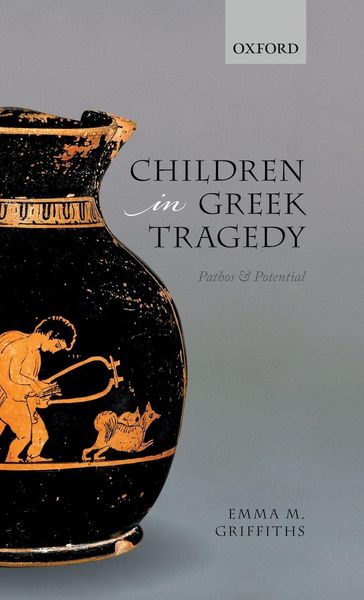
Children in Greek Tragedy Pathos and Potential

145,99 €

inkl. gesetzl. MwSt., Versandkostenfrei


Beschreibung

Astyanax is thrown from the walls of Troy; Medeia kills her children as an act of vengeance against her husband; Aias reflects with sorrow on his son's inheritance, yet kills himself and leaves Eurysakes vulnerable to his enemies. The pathos created by threats to children is a notable feature of Greek...

Beschreibung

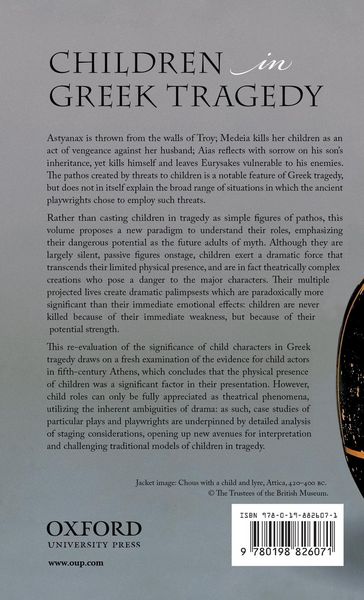
Astyanax is thrown from the walls of Troy; Medeia kills her children as an act of vengeance against her husband; Aias reflects with sorrow on his son's inheritance, yet kills himself and leaves Eurysakes vulnerable to his enemies. The pathos created by threats to children is a notable feature of Greek tragedy, but does not in itself explain the broad range of situations in which the ancient playwrights chose to employ such threats. Rather than casting children in tragedy as simple figures of pathos, this volume proposes a new paradigm to understand their roles, emphasizing their dangerous potential as the future adults of myth. Although they are largely silent, passive figures on stage, children exert a dramatic force that transcends their limited physical presence, and are in fact theatrically complex creations who pose a danger to the major characters. Their multiple projected lives create dramatic palimpsests which are paradoxically more significant than their immediate emotional effects: children are never killed because of their immediate weakness, but because of their potential strength. This re-evaluation of the significance of child characters in Greek tragedy draws on a fresh examination of the evidence for child actors in fifth-century Athens, which concludes that the physical presence of children was a significant factor in their presentation. However, child roles can only be fully appreciated as theatrical phenomena, utilizing the inherent ambiguities of drama: as such, case studies of particular plays and playwrights are underpinned by detailed analysis of staging considerations, opening up new avenues for interpretation and challenging traditional models of children in tragedy.

Produktdetails

Einband

Gebundene Ausgabe

Erscheinungsdatum

20.03.2020

Verlag Oxford Academic
Seitenzahl

338

Produktdetails

Einband

Gebundene Ausgabe

Erscheinungsdatum

20.03.2020

Verlag Oxford Academic
Seitenzahl

338

Maße (L/B/H)

22,2/14,5/2,2 cm

Gewicht

498 g

Sprache

Englisch

ISBN

978-0-19-882607-1

Herstelleradresse

Libri GmbH
Europaallee 1
36244 Bad Hersfeld
DE

Email: gpsr@libri.de

Ein neues Kapitel für Ihre Bücher

Ein neues Kapitel für Ihre Bücher

Schenken Sie Ihren alten Schätzen ein zweites Leben und erhalten Sie dafür eine Thalia Geschenkkarte.

Jetzt verkaufen
Jetzt verkaufen

Noch keine Bewertungen vorhanden

Verfassen Sie die erste Bewertung zu diesem Artikel

Helfen Sie anderen Kundinnen und Kunden durch Ihre Meinung.

Kundinnen und Kunden meinen

Bewertungen (0)

Die Leseprobe wird geladen.
  • Produktbild: Children in Greek Tragedy
  • Produktbild: Children in Greek Tragedy
    • 1: Contexts
    • 1.1: Introduction
    • 1.1.1: Revisiting Aristotle
    • 1.1.2: Uncertainty Principles
    • 1.2: Definitions
    • 1.2.1: Terminology
    • 1.2.2: Age Categories
    • 1.3: The Scholarly Tradition
    • 1.3.1: Pathetic Stereotypes
    • 1.4: The 'Universal' or 'Natural' Child
    • 1.5: Framing Pathos and Pity
    • 1.6: Embodiment
    • 2: Staging Issues
    • 2.1: The Basic Problem
    • 2.2: Re-Assessing the Evidence
    • 2.3: Basic Blocking Arrangements
    • 2.3.1: Sophokles' Aias
    • 2.3.2: Sophokles' Oidipous Tyrannos
    • 2.3.3: Euripides' Andromakhe
    • 2.3.4: Euripides' Hekabe
    • 2.3.5: Euripides' Herakleidai
    • 2.3.6: Euripides' Herakles
    • 2.3.7: Euripides' Medeia
    • 2.3.8: Euripides' Hiketides
    • 2.3.9: Euripides' Troades
    • 2.3.10: Euripides' Alkestis
    • 2.4: The Manner of Movement
    • 2.5: Embodied Identity
    • 2.6: Children as (Masked) Participants
    • 2.7: Dolls and Objects
    • 2.8: Singing and Speaking
    • 2.9: Language
    • 2.10: Speech in Alkestis
    • 2.11: Naming and Anonymity
    • 2.11.1: Named Figures
    • 2.11.2: Anonymous Figures
    • 3: Potential
    • 3.1: The Next Steps
    • 3.2: Temporal Palimpsests
    • 3.3: Socio-Historical Potential
    • 3.4: Theatrical Potential
    • 3.5: Philosophical Potential
    • 3.6: Imagery
    • 3.7: Character, Quantum Physics, and Ghosts
    • 4: Reframing Pathos
    • 4.1: An Integrated Approach
    • 4.2: Formulating Pathos
    • 4.3: Children and Emotion
    • 4.4: Biologically Determined Responses of Protection
    • 4.5: The Construction of Pity
    • 4.6: Merit and Suffering
    • 4.7: Identification: Parents and Philia
    • 4.8: Pity and Philia
    • 4.9: Supplication
    • 4.10: Pity and the Law
    • 4.11: Pathos and Potential Combined
    • 5: Plays and Playwrights
    • 5.1: Exploring the Ideas
    • 5.2: Aiskhylos
    • 5.3: Sophokles
    • 5.4: Euripides
    • 6: Conclusions and Future Directions
    • 6.1: The Value of Potential
    • 6.2: Adolescence
    • 6.3: Politics
    • 6.4: Old Age and Gender
    • 6.5: Children in Greek Literature
    • 6.6: Comedy, Satyr Play, and Ritual
    • 6.7: Final Thoughts
    • Appendix: Being an Orphan
    • Endmatter
    • Bibliography
    • Index