















































KI-Beratung Beta

Gutscheinbedingungen

Gültig bis 11.11.2026 | Gültig für Spielzeug, Filme, Musik, Software, Games, Geschenke & Trends, Schreibwaren, Hörbücher und Hörbuch-Downloads (außer Abo & Shelfies), gebrauchte Bücher, nicht preisgebundene Bücher und Kalender | Einlösbar unter thalia.de und in der Thalia App | Click & Collect nur mit Online-Zahlung (Paypal/Kreditkarte) vorab | Einzelne Artikel können ausgeschlossen sein | Nicht kombinierbar mit anderen Gutscheinen oder Preisaktionen | Nur einmal pro Einkauf einlösbar | Gutschein wird auf max. 500€ Bestellwert angerechnet | Keine Barauszahlung | Digitale Hörbücher nur für Android  | Nicht gültig für preisgebundene Artikel (aufgrund der Buchpreisbindung sind Gutscheine nicht auf Bücher, eBooks, Presse einlösbar), tolino eReader & Zubehör, Abonnements & Flatrates, Geschenkkarten, Versandkosten und Services

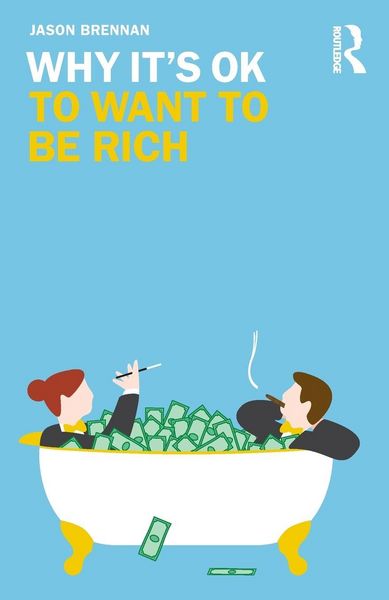
  • Produktbild: Why It's OK to Want to Be Rich
  • Produktbild: Why It's OK to Want to Be Rich

Why It's OK to Want to Be Rich

Aus der Reihe Why It's OK

39,99 €

inkl. gesetzl. MwSt., Versandkostenfrei


Beschreibung

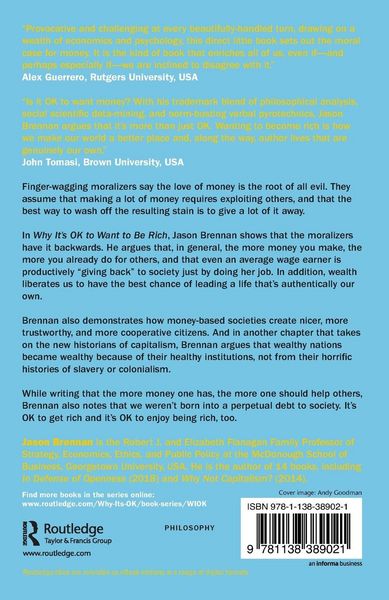
Finger-wagging moralizers say the love of money is the root of all evil. They assume that making a lot of money requires exploiting others, and that the best way to wash off the resulting stain is to give a lot of it away.

In Why It's OK to Want to Be Rich, Jason Brennan shows that the moralizers have...

Beschreibung

Finger-wagging moralizers say the love of money is the root of all evil. They assume that making a lot of money requires exploiting others, and that the best way to wash off the resulting stain is to give a lot of it away.

In Why It's OK to Want to Be Rich, Jason Brennan shows that the moralizers have it backwards. He argues that, in general, the more money you make, the more you already do for others, and that even an average wage earner is productively "giving back" to society just by doing her job. In addition, wealth liberates us to have the best chance of leading a life that's authentically our own.

Brennan also demonstrates how money-based societies create nicer, more trustworthy, and more cooperative citizens. And in another chapter that takes on the new historians of capitalism, Brennan argues that wealthy nations became wealthy because of their healthy institutions, not from their horrific histories of slavery or colonialism.

While writing that the more money one has, the more one should help others, Brennan also notes that we weren't born into a perpetual debt to society. It's OK to get rich and it's OK to enjoy being rich, too.

---

Key Features

  • Shows how the desire to become wealthy in an open and fair market helps maximize cooperation and lessens the chance of violence and war
  • Argues that it is much easier for the average for-profit business to add value to the world than it is for the average non-profit
  • Demonstrates that the kinds of virtues (e.g., conscientiousness, thoughtfulness, hard work) that lead to desirable personal and civic states (e.g., happy marriages, stable families, engaged citizens) also make people richer
  • Argues that living in small clans for most of their history has given humans a negative attitude towards anyone acquiring more than her "fair share," an attitude that's ill-suited for our market-driven, globally connected world
  • In a final, provocative chapter, maintains that ideal economic growth is infinite.

Rezension

"Is it OK to want money? With his trademark blend of philosophical analysis, social scientific data-mining, and norm-busting verbal pyrotechnics, Jason Brennan argues that it's more than just OK. Wanting to become rich is how we make our world a better place and, along the way, author lives that are genuinely our own."
-John Tomasi, Brown University

"Do you own a BMW? Are you already in business school? If so, then maybe put this book down and instead consider getting into something a bit less comfortable by Marx, Fanon, Foucault, or Elizabeth Anderson. But for the rest of us, Why It's OK to Want to Be Rich is an exhilarating, illuminating, mildly terrifying ride. Provocative and challenging at every beautifully-handled turn, drawing on a wealth of economics and psychology, this direct little book sets out the moral case for money-making it, spending it, even luxuriating in it, and not feeling bad about it. Many of us raised in the wealthiest, most capitalist, happiest societies in human history have been taught to react to such ideas with a complex mixture of rage and guilt. You might already want to throw this book across the room. Fine, fine. But read it first. You might learn something-about money, about markets, about economics, even about yourself. If nothing else, I know of no better, faster introduction to the moral case for capitalism. It is the kind of book that enriches all of us, even if-and perhaps especially if-we are inclined to disagree with it."
-Alex Guerrero, Rutgers University

Produktdetails

Einband

Taschenbuch

Erscheinungsdatum

23.09.2020

Verlag Taylor & Francis
Seitenzahl

226

Produktdetails

Einband

Taschenbuch

Erscheinungsdatum

23.09.2020

Verlag Taylor & Francis
Seitenzahl

226

Maße (L/B/H)

19,8/12,9/1,2 cm

Gewicht

246 g

Sprache

Englisch

ISBN

978-1-138-38902-1

Herstelleradresse

Libri GmbH
Europaallee 1
36244 Bad Hersfeld
DE

Email: gpsr@libri.de

Ein neues Kapitel für Ihre Bücher

Ein neues Kapitel für Ihre Bücher

Schenken Sie Ihren alten Schätzen ein zweites Leben und erhalten Sie dafür eine Thalia Geschenkkarte.

Jetzt verkaufen
Jetzt verkaufen

Noch keine Bewertungen vorhanden

Verfassen Sie die erste Bewertung zu diesem Artikel

Helfen Sie anderen Kundinnen und Kunden durch Ihre Meinung.

Kundinnen und Kunden meinen

Bewertungen (0)

Die Leseprobe wird geladen.
  • Produktbild: Why It's OK to Want to Be Rich
  • Produktbild: Why It's OK to Want to Be Rich
  • 1. The Root of All Evils 2. For the Love of Money 3.Is Money Dirty? Does Money Corrupt? 4. It's OK to Make Money 5. Rich Country, Poor Country 6. Give it Away Now? 7. Riches, Repugnance, and Remaining Doubts