















































KI-Beratung Beta

Gutscheinbedingungen

Gültig bis 11.11.2026 | Gültig für Spielzeug, Filme, Musik, Software, Games, Geschenke & Trends, Schreibwaren, Hörbücher und Hörbuch-Downloads (außer Abo & Shelfies), gebrauchte Bücher, nicht preisgebundene Bücher und Kalender | Einlösbar unter thalia.de und in der Thalia App | Click & Collect nur mit Online-Zahlung (Paypal/Kreditkarte) vorab | Einzelne Artikel können ausgeschlossen sein | Nicht kombinierbar mit anderen Gutscheinen oder Preisaktionen | Nur einmal pro Einkauf einlösbar | Gutschein wird auf max. 500€ Bestellwert angerechnet | Keine Barauszahlung | Digitale Hörbücher nur für Android  | Nicht gültig für preisgebundene Artikel (aufgrund der Buchpreisbindung sind Gutscheine nicht auf Bücher, eBooks, Presse einlösbar), tolino eReader & Zubehör, Abonnements & Flatrates, Geschenkkarten, Versandkosten und Services

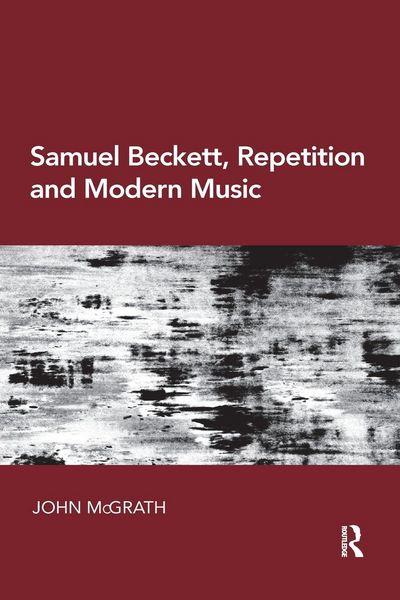
  • Produktbild: Samuel Beckett, Repetition and Modern Music
  • Produktbild: Samuel Beckett, Repetition and Modern Music

Samuel Beckett, Repetition and Modern Music

74,99 €

inkl. gesetzl. MwSt., Versandkostenfrei


Beschreibung

Music abounds in twentieth- century Irish literature. Whether it be the "thought-tormented" music of Joyce's "The Dead", the folk tunes and opera that resound throughout Ulysses, or the four- part threnody in Beckett's Watt, it is clear that the influence of music on the written word in Ireland is deeply...

Beschreibung

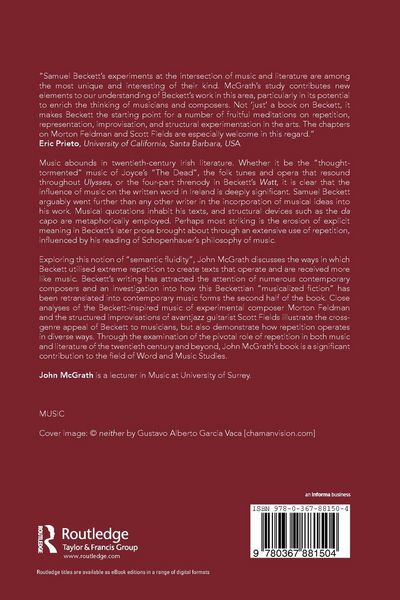
Music abounds in twentieth- century Irish literature. Whether it be the "thought-tormented" music of Joyce's "The Dead", the folk tunes and opera that resound throughout Ulysses, or the four- part threnody in Beckett's Watt, it is clear that the influence of music on the written word in Ireland is deeply significant. Samuel Beckett arguably went further than any other writer in the incorporation of musical ideas into his work. Musical quotations inhabit his texts, and structural devices such as the da capo are metaphorically employed. Perhaps most striking is the erosion of explicit meaning in Beckett's later prose brought about through an extensive use of repetition, influenced by his reading of Schopenhauer's philosophy of music. Exploring this notion of "semantic fluidity", John McGrath discusses the ways in which Beckett utilised extreme repetition to create texts that operate and are received more like music. Beckett's writing has attracted the attention of numerous contemporary composers and an investigation into how this Beckettian "musicalized fiction" has been retranslated into contemporary music forms the second half of the book. Close analyses of the Beckett- inspired music of experimental composer Morton Feldman and the structured improvisations of avantjazz guitarist Scott Fields illustrate the cross- genre appeal of Beckett to musicians, but also demonstrate how repetition operates in diverse ways. Through the examination of the pivotal role of repetition in both music and literature of the twentieth century and beyond, John McGrath's book is a significant contribution to the field of Word and Music Studies.

Rezension

"Samuel Beckett's experiments at the intersection of music and literature are among the most unique and interesting of their kind. McGrath's study contributes new elements to our understanding of Beckett's work in this area, particularly in its potential to enrich the thinking of musicians and composers. Not "just" a book on Beckett, it makes Beckett the starting point for a number of fruitful meditations on repetition, representation, improvisation, and structural experimentation in the arts. The chapters on Morton Feldman and Scott Fields are especially welcome in this regard."
Erci Prieto, University of California, Santa Barbara, USA

"John McGrath's Samuel Beckett, Repetition and Modern Music is the newest scholarly entry on this subject and a valuable addition for the critical insights it provides through meticulous analyses. The fundamental idea underlying McGrath's research is his concept of Beckett's semantic fluidity, a writing style that accommodates and encourages readers to bring their own ideas and perspectives into the work."
Michael Palmese, Louisiana State University, USA

"McGrath's volume provides a valuable contribution to Beckettian scholarship and drama academics, as well as offering a new framework theorizing repetition, which may be of interest to a wide range of music scholars working in the analysis of 20th and 21st century genres from the avant-garde, minimalism, jazz, pop and hip-hop."
Monica Esslin-Peard, University of Liverpool, UK
"...John McGrath packs a great deal into a seemingly narrowly framed monograph...his analysis of repetition in the prose works of late Beckett shift into tight and revealing focus when he looks at the data...McGrath's book is salutary in flagging the deliberately jarring tactics of the avant garde, and getting the reader to grasp what remains permanently uncanny about our pleasure in Beckett and Feldman's exploration of both the playful humour and subtle queasiness to be found within their repetitive forms."
Drew Daniel, The Wire

Produktdetails

Einband

Taschenbuch

Erscheinungsdatum

12.12.2019

Verlag Taylor & Francis
Seitenzahl

192

Produktdetails

Einband

Taschenbuch

Erscheinungsdatum

12.12.2019

Verlag Taylor & Francis
Seitenzahl

192

Maße (L/B/H)

23,4/15,6/1,1 cm

Gewicht

301 g

Sprache

Englisch

ISBN

978-0-367-88150-4

Herstelleradresse

Libri GmbH
Europaallee 1
36244 Bad Hersfeld
DE

Email: gpsr@libri.de

Ein neues Kapitel für Ihre Bücher

Ein neues Kapitel für Ihre Bücher

Schenken Sie Ihren alten Schätzen ein zweites Leben und erhalten Sie dafür eine Thalia Geschenkkarte.

Jetzt verkaufen
Jetzt verkaufen

Noch keine Bewertungen vorhanden

Verfassen Sie die erste Bewertung zu diesem Artikel

Helfen Sie anderen Kundinnen und Kunden durch Ihre Meinung.

Kundinnen und Kunden meinen

Bewertungen (0)

Die Leseprobe wird geladen.
  • Produktbild: Samuel Beckett, Repetition and Modern Music
  • Produktbild: Samuel Beckett, Repetition and Modern Music
  • 1. Music and Literature 2. Repetition in Music and Literature 3. Musico-literary Interaction in Modern Ireland and the Musical Aesthetic of Samuel Beckett 4. Beckett's Semantic Fluidity: Repetition in the Later Work 5. Beckett and Feldman: Time, Repetition and the Liminal Space 6. Improvising Beckett: Chance, Silence and Repetition