
















































KI-Beratung Beta

Gutscheinbedingungen

Gültig bis 30.11.2026 | Gültig für nicht preisgebundene fremdsprachige Bücher | Einzelne Artikel können ausgeschlossen sein | Online auf thalia.de und in der Thalia App einlösbar | Click & Collect nur mit Online-Zahlung (Paypal/Kreditkarte) vorab | Nicht kombinierbar mit anderen Gutscheinen oder Preisaktionen | Nur einmal pro Einkauf einlösbar | Gutschein wird auf max. 500€ Bestellwert angerechnet | Keine Barauszahlung | Nicht gültig für Versandkosten und Services

  • Produktbild: Militarism and the Indo-Europeanizing of Europe
  • Produktbild: Militarism and the Indo-Europeanizing of Europe

Militarism and the Indo-Europeanizing of Europe

76,99 €

inkl. gesetzl. MwSt., Versandkostenfrei


Beschreibung

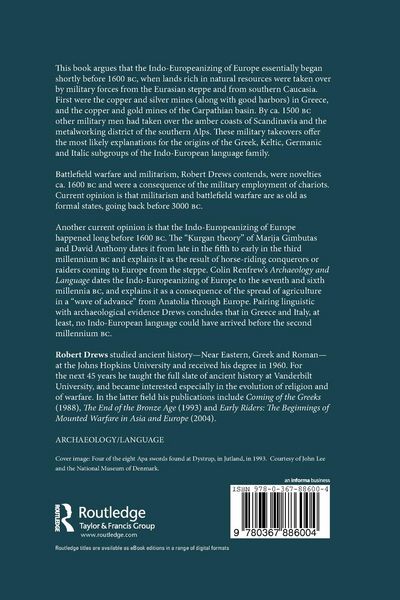
This book argues that the Indo-Europeanizing of Europe essentially began shortly before 1600 BC, when lands rich in natural resources were taken over by military forces from the Eurasian steppe and from southern Caucasia. First were the copper and silver mines (along with good harbors) in Greece, and...

Beschreibung

This book argues that the Indo-Europeanizing of Europe essentially began shortly before 1600 BC, when lands rich in natural resources were taken over by military forces from the Eurasian steppe and from southern Caucasia. First were the copper and silver mines (along with good harbors) in Greece, and the copper and gold mines of the Carpathian basin. By ca. 1500 BC other military men had taken over the amber coasts of Scandinavia and the metalworking district of the southern Alps. These military takeovers offer the most likely explanations for the origins of the Greek, Keltic, Germanic and Italic subgroups of the Indo-European language family.

Battlefield warfare and militarism, Robert Drews contends, were novelties ca. 1600 BC and were a consequence of the military employment of chariots. Current opinion is that militarism and battlefield warfare are as old as formal states, going back before 3000 BC.

Another current opinion is that the Indo-Europeanizing of Europe happened long before 1600 BC. The "Kurgan theory" of Marija Gimbutas and David Anthony dates it from late in the fifth to early in the third millennium BC and explains it as the result of horse-riding conquerors or raiders coming to Europe from the steppe. Colin Renfrew's Archaeology and Language dates the Indo-Europeanizing of Europe to the seventh and sixth millennia BC, and explains it as a consequence of the spread of agriculture in a "wave of advance" from Anatolia through Europe. Pairing linguistic with archaeological evidence Drews concludes that in Greece and Italy, at least, no Indo-European language could have arrived before the second millennium BC.

Rezension

'Drews's new book ... is clearly argued and will serve the neophyte as a convenient introduction to the voluminous research-recent and classic- in the several scholarly fields whose data are adduced here' - Journal of the American Oriental Society 141.1 (2021)

'Cet ouvrage fournit un 'modèle' pour comprendre l'histoire de la guerre européenne, avec ses armes et ses premières batailles, un champ de recherches trop souvent écarté pour des raisons idéologiques déplacées (pp. 56-57), ou simplement pour des raisons de mode. Quant à l'articulation de cette histoire avec la linguistique historique indo-européenne, beaucoup reste à faire, comme l'auteur l'admet in fine. Toutefois, son ouvrage fournit des perspectives qui respectent pour l'essentiel le travail des linguistes et qui, enrichies d'études anthropologiques et archéologiques plus larges, leur permettront d'affiner leurs propres hypothèses' - Pierre Sauzeau in Bryn Mawr Classical Review

'Today's archaeology, exemplified by the work of, for example, Helle Vandkilde or Kristian Kristiansen, is again interested in Indo-European migrations, war, weapons, and the flow of interaction throughout the Old World. Drews has studied these issues, through the lens of Near Eastern and ancient Greek history, throughout his career and across shifting trends in history and archaeology. Militarism and the Indo-Europeanizing of Europe draws on this experience to produce a synthesis from Caucasia to Scandinavia; to address at length topics previously remarked on in passing; and to comment on a number of current debates about the role and nature of militarism, warfare, chronological issues, Indo-European dispersions, the arrival of the Greeks in Greece, and the history of Europe' - Christopher Prescott in AJA

'Drews's conclusions will, no doubt, engender a vigorous response from PIE scholars over the merits of his thesis. Regardless, Militarism and the Indo-Europeanizing of Europe is a fascinating read for the student of warfare or antiquity, even without a background in archaeology, linguistics, or Indo-European studies' - Nathan Perz in Journal of Military History

Produktdetails

Einband

Taschenbuch

Erscheinungsdatum

12.12.2019

Verlag Taylor & Francis
Seitenzahl

296

Produktdetails

Einband

Taschenbuch

Erscheinungsdatum

12.12.2019

Verlag Taylor & Francis
Seitenzahl

296

Maße (L/B/H)

23,4/15,6/1,6 cm

Gewicht

453 g

Sprache

Englisch

ISBN

978-0-367-88600-4

Herstelleradresse

Produktsicherheitsverantwortliche/r
Europaallee 1
36244 Bad Hersfeld
DE

Email: gpsr@libri.de

Ein neues Kapitel für Ihre Bücher

Ein neues Kapitel für Ihre Bücher

Schenken Sie Ihren alten Schätzen ein zweites Leben und erhalten Sie dafür eine Thalia Geschenkkarte.

Jetzt verkaufen
Jetzt verkaufen

Noch keine Bewertungen vorhanden

Verfassen Sie die erste Bewertung zu diesem Artikel

Helfen Sie anderen Kundinnen und Kunden durch Ihre Meinung.

Kundinnen und Kunden meinen

Bewertungen (0)

Die Leseprobe wird geladen.
  • Produktbild: Militarism and the Indo-Europeanizing of Europe
  • Produktbild: Militarism and the Indo-Europeanizing of Europe
  • List of illustrations

    Acknowledgements

    Abbreviations

    1 The Origins and Spread of Proto-Indo-European

    2 The Kurgan Theory and the Taming of Horses

    3 Warfare in Western Eurasia in the Third and Early Second Millennium BC

    4 Chariot Warfare, the Beginning of Militarism, and its Indo-European Connection

    5 The Beginnings of Militarism in Temperate Europe

    6 The Beginning of Militarism in Greece

    7 The Question of Origins

    Appendix: The Chronological Quandary

    Bibliography of Works Cited

    Index