















































KI-Beratung Beta

Gutscheinbedingungen

Gültig bis 11.11.2026 | Gültig für Spielzeug, Filme, Musik, Software, Games, Geschenke & Trends, Schreibwaren, Hörbücher und Hörbuch-Downloads (außer Abo & Shelfies), gebrauchte Bücher, nicht preisgebundene Bücher und Kalender | Einlösbar unter thalia.de und in der Thalia App | Click & Collect nur mit Online-Zahlung (Paypal/Kreditkarte) vorab | Einzelne Artikel können ausgeschlossen sein | Nicht kombinierbar mit anderen Gutscheinen oder Preisaktionen | Nur einmal pro Einkauf einlösbar | Gutschein wird auf max. 500€ Bestellwert angerechnet | Keine Barauszahlung | Digitale Hörbücher nur für Android  | Nicht gültig für preisgebundene Artikel (aufgrund der Buchpreisbindung sind Gutscheine nicht auf Bücher, eBooks, Presse einlösbar), tolino eReader & Zubehör, Abonnements & Flatrates, Geschenkkarten, Versandkosten und Services

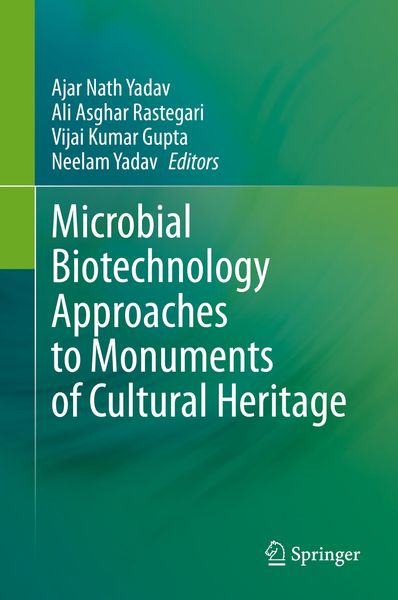
Produktbild: Microbial Biotechnology Approaches to Monuments of Cultural Heritage
- 10%

Microbial Biotechnology Approaches to Monuments of Cultural Heritage

10% sparen

142,99 € UVP 160,49 €

inkl. gesetzl. MwSt., Versandkostenfrei


Beschreibung

Produktdetails

Einband

Gebundene Ausgabe

Erscheinungsdatum

25.06.2020

Abbildungen

XV, 198 p. 19 illus., 13 illus. in color.

Herausgeber

Ajar Nath Yadav + weitere

Verlag

Springer Singapore

Seitenzahl

198

Maße (L/B/H)

24,1/16/1,8 cm

Gewicht

442 g

Auflage

1. Auflage

Sprache

Englisch

ISBN

978-981-15-3400-3

Beschreibung

Portrait


Ajar Nath Yadav
is an assistant professor (Senior Scale) in the Department of Biotechnology, Eternal University, Baru Sahib, Himachal Pradesh, India. He has 10 years of teaching and research experiences. He obtained his doctorate degree in Microbial Biotechnology in 2016, jointly from Indian Agricultural Research Institute, New Delhi and Birla Institute of Technology, Mesra, Ranchi, India. Dr. Yadav has 133 publications with h-index 27, i10-index 63, and 2203 citations. Dr. Yadav has got 12 Best Paper Presentation Awards, and “Outstanding Teacher Award”-2018. He has the lifetime membership of Association of microbiologist in India, Indian Science Congress Council and National Academy of Sciences, India.


Ali Asghar Rastegari
is currently working as an Assistant Professor in the Faculty of Biological Science, Department of Molecular and Cell Biochemistry, Falavarjan Branch, Islamic Azad University, Isfahan, I.R. Iran. Dr. Rastegari has 13 years of teaching and research experiences. Dr. Rastegari gained a Ph.D. in Molecular Biophysics, the University of Science and Research, Tehran Branch, IranIn his credit 18 research publications and published 12 abstracts in different conference. He has a lifetime membership of Iranian Society for Trace Elements Research (ISTER), The Biochemical Society of I.R.IRAN, and Member of Society for Bioinformatics in Northern Europe (SocBiN).


Vijai Kumar Gupta
from ERA Chair of Green Chemistry, Department of Chemistry and Biotechnology, School of Science, Tallinn University of Technology, Tallinn, Estonia, is one of the leading experts in the area of microbial biology and biotechnology. He is the member of International Sub-commission on Trichoderma and Hypocrea, Austria; International Society for Fungal Conservation, UK; and Secretary of European Mycological Association. Dr. Gupta is the Fellow of Prestigious- The Linnaean Society, London, UK; Fellow of Indian Mycological Association; and Fellow of Mycological Society of India. He has been honored with several awards in his career including Indian Young Scientist Award for his advanced research achievements in the field of fungal biology and biotechnology. He is the editor of leading scientific journals of high repute and having many publications in his hands with h-index 34. He is editor of many books published by international publishers.


Neelam Yadav
is senior researcher, currently working on microbial diversity from diverse sources and their biotechnological applications agriculture and allied sectors. She obtained her post graduation degree from Veer Bahadur Singh Purvanchal University, Uttar Pradesh, India. She has research interest in the area of probiotics microbes, and beneficial microbiomes from diverse sources. In her credit 35 publications in different reputed international, national journals and publishers. She is Editor/ reviewer of different international and national journals. She has the lifetime membership of Association of microbiologist in India, Indian Science Congress Council, India and National Academy of Sciences, India.

Produktdetails

Einband

Gebundene Ausgabe

Erscheinungsdatum

25.06.2020

Abbildungen

XV, 198 p. 19 illus., 13 illus. in color.

Herausgeber

Verlag

Springer Singapore

Seitenzahl

198

Maße (L/B/H)

24,1/16/1,8 cm

Gewicht

442 g

Auflage

1. Auflage

Sprache

Englisch

ISBN

978-981-15-3400-3

Herstelleradresse

Springer-Verlag GmbH
Europaplatz 3
69115 Heidelberg
DE

Email: ProductSafety@springernature.com

Ein neues Kapitel für Ihre Bücher

Ein neues Kapitel für Ihre Bücher

Schenken Sie Ihren alten Schätzen ein zweites Leben und erhalten Sie dafür eine Thalia Geschenkkarte.

Jetzt verkaufen
Jetzt verkaufen

Noch keine Bewertungen vorhanden

Verfassen Sie die erste Bewertung zu diesem Artikel

Helfen Sie anderen Kundinnen und Kunden durch Ihre Meinung.

Kundinnen und Kunden meinen

Bewertungen (0)

  • Produktbild: Microbial Biotechnology Approaches to Monuments of Cultural Heritage

  • Chapter 1. Microbial Community Present on the Reverse Side of a Deteriorated Canvas.- Chapter 2. Microbial Biocleaning Technologies for Cultural Heritage: Current Status and Future Challenges.- Chapter 3. Role of Bacterial Communities to Prevent the Microbial Growth on Cultural Heritage.- Chapter 4. Entomogenous Fungi and the Conservation of the Cultural Heritage.- Chapter 5. Microorganisms and their Enzymes as Biorestoration Agents.- Chapter 6. Bioremediation of Cultural Heritage: Removal of Organic Substances.- Chapter 7. The Role Microorganisms for the Removal of Sulphates on Artistic Stoneworks.- Chapter 8. Microbiological Tools for Cultural Heritage Conservation.- Chapter 9. Biotechnology to Restoration and Conservation.- Chapter 10. Biocement: A novel approach in the restoration of construction materials.