















































KI-Beratung Beta

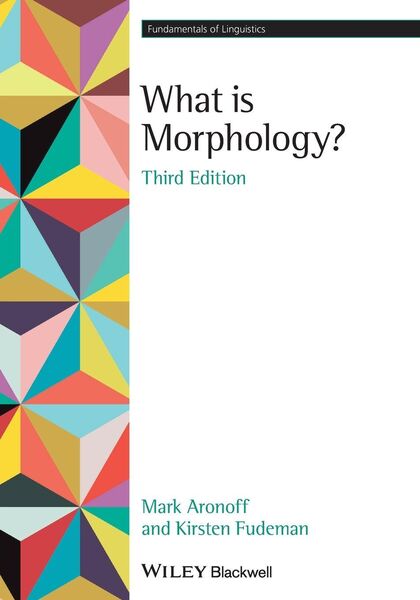
Produktbild: What is Morphology?

What is Morphology?

52,99 €

inkl. gesetzl. MwSt., Versandkostenfrei


Beschreibung

PRAISE FOR THIS EDITION

"What is Morphology? continues to be the most attractive, accessible, and entertaining introduction to morphology on the market. It is a lively conversation between the authors and their readers, which radiates enthusiasm for its subject, while stimulating readers to think about...

Beschreibung

PRAISE FOR THIS EDITION

"What is Morphology? continues to be the most attractive, accessible, and entertaining introduction to morphology on the market. It is a lively conversation between the authors and their readers, which radiates enthusiasm for its subject, while stimulating readers to think about morphology for themselves through numerous skillfully designed examples and exercises. The book is deliberately theory-neutral but leaves no doubt about the fundamental importance of morphology within linguistic theory."
-Martin Maiden, University of Oxford

"It's no surprise that What is Morphology? is now appearing in a third edition. Aronoff and Fudeman's textbook is a fun, highly accessible introduction to morphology, providing an excellent grounding in the key distinctions and theoretical issues."
-Dunstan Brown, University of York

PRAISE FOR PRIOR EDITION

"Aronoff and Fudeman have produced a clear and jargon-free introduction to contemporary morphological theory and practice. The book succeeds particularly in clarifying the empirical content, organizational principles and analytic techniques that distinguish morphology from other fields of linguistics."
-James P. Blevins, University of Cambridge

What is Morphology? Third Edition, provides a critical introduction to the central ideas and perennial issues of linguistic morphology. Assuming only minimal background in linguistics, this student-friendly textbook uses clear language and easy-to-understand examples to describe fundamental morphological phenomena and their interactions with phonology, syntax, and semantics.

The chapters of this textbook equip students with the skills needed to analyze a range of classic morphological problems through engaging examples and student-friendly explanations. Cross-linguistic data from Kujamaat Jóola, a West African language, is incorporated throughout the text to explain and clarify morphemes, morphophonology, inflection, syncretism, lexemes, and other essential concepts.

Fully revised and updated, the third edition also contains an entirely new chapter on computational linguistics, and a wealth of additional exercises, examples, and further readings.

What is Morphology? Third Edition, is the perfect textbook for undergraduate and graduate students studying morphology for the first time, a useful reference for researchers and scholars with limited experience in linguistic morphology, and a valuable resource for professionals working in areas such as speech recognition, natural language understanding, machine translation, and natural language generation.

Produktdetails

Einband

Taschenbuch

Erscheinungsdatum

10.11.2022

Verlag Wiley
Seitenzahl

336

Produktdetails

Einband

Taschenbuch

Erscheinungsdatum

10.11.2022

Verlag Wiley
Seitenzahl

336

Maße (L/B/H)

25/17,7/2 cm

Gewicht

648 g

Auflage

3 ed

Sprache

Englisch

ISBN

978-1-119-71520-7

Herstelleradresse

Libri GmbH
Europaallee 1
36244 Bad Hersfeld
DE

Email: gpsr@libri.de

Ein neues Kapitel für Ihre Bücher

Ein neues Kapitel für Ihre Bücher

Schenken Sie Ihren alten Schätzen ein zweites Leben und erhalten Sie dafür eine Thalia Geschenkkarte.

Jetzt verkaufen
Jetzt verkaufen

Noch keine Bewertungen vorhanden

Verfassen Sie die erste Bewertung zu diesem Artikel

Helfen Sie anderen Kundinnen und Kunden durch Ihre Meinung.

Kundinnen und Kunden meinen

Bewertungen (0)

Die Leseprobe wird geladen.
  • Produktbild: What is Morphology?
  • Preface viii

    Acknowledgments xiii

    Abbreviations xiv

    Remarks on Transcription xvii

    The International Phonetic Alphabet xix

    About the Companion Website xx

    1 Thinking about Morphology and Morphological Analysis 1

    1.1 What is Morphology? 1

    1.2 Morphemes 2

    1.3 Morphology in Action 4

    1.4 Background and Beliefs 9

    1.5 Introduction to Morphological Analysis 11

    1.6 Summary 20

    Introduction to Kujamaat Jóola 22

    2 Words and Lexemes 32

    2.1 What is a Word? 33

    2.2 Empirical Tests for Wordhood 36

    2.3 Types of Words 38

    2.4 Inflection vs. Derivation 45

    2.5 Two Approaches to Morphology: Item-and-Arrangement, Item-and-Process 47

    2.6 The Lexicon 52

    2.7 Summary 54

    Kujamaat Jóola Noun Classes 55

    3 Morphology and Phonology 69

    3.1 Allomorphs 70

    3.2 Prosodic Morphology 74

    3.3 Primary and Secondary Affixes 77

    3.4 Linguistic Exaptation, Leveling, and Analogy 81

    3.5 Morphophonology and Secret Languages 87

    3.6 Summary 89

    Kujamaat Jóola Morphophonology 91

    4 Derivation and the Lexicon 103

    4.1 The Saussurean Sign 103

    4.2 Motivation and Compositionality 104

    4.3 Derivation and Structure 116

    4.4 Lexicalization 122

    4.5 Summary 125

    Derivation in Kujamaat Jóola 126

    5 Derivation and Semantics 131

    5.1 The Polysemy Problem 132

    5.2 The Semantics of Derived Lexemes 134

    5.3 Summary 141

    Derivation and Verbs in Kujamaat Jóola 142

    6 Inflection 150

    6.1 What is Inflection? 152

    6.2 Inflection vs. Derivation 160

    6.3 Inventory of Inflectional Morphology Types 163

    6.4 Syncretism 170

    6.5 Typology 171

    6.6 Summary 173

    Agreement in Kujamaat Jóola 174

    7 Morphology and Syntax 187

    7.1 Morphological vs. Syntactic Inflection 188

    7.2 Structural Constraints on Morphological Inflection 189

    7.3 Inflection and Universal Grammar 191

    7.4 Grammatical Function Change 193

    7.5 Summary 200

    Kujamaat Jóola Verb Morphology 201

    8 Morphological Productivity and the Mental Lexicon 217

    8.1 What is Morphological Productivity? 218

    8.2 Productivity and Structure: Negative Prefixes in English 220

    8.3 Degrees of Productivity 221

    8.4 Salience and Productivity 226

    8.5 Testing Productivity 228

    8.6 The Mental Lexicon, Psycholinguistics, and Neurolinguistics 235

    8.7 Conclusion 240

    9 Computational Morphology 246

    9.1 Introduction 247

    9.2 Early Work 247

    9.3 Problem Specification 249

    9.4 Knowledge-based Methods 252

    9.5 Data-Driven Methods 260

    9.6 Hybrid Models 266

    9.7 Resources for Computational Morphology 267

    Acknowledgments 268

    Further Reading 269

    Exercises 270

    Glossary 274

    References 289

    Index 299