















































KI-Beratung Beta

Gutscheinbedingungen

Gültig bis 30.11.2026 | Gültig für nicht preisgebundene fremdsprachige Bücher | Einzelne Artikel können ausgeschlossen sein | Online auf thalia.de und in der Thalia App einlösbar | Click & Collect nur mit Online-Zahlung (Paypal/Kreditkarte) vorab | Nicht kombinierbar mit anderen Gutscheinen oder Preisaktionen | Nur einmal pro Einkauf einlösbar | Gutschein wird auf max. 500€ Bestellwert angerechnet | Keine Barauszahlung | Nicht gültig für Versandkosten und Services

  • Produktbild: Critique, Subversion, and Chinese Philosophy
  • Produktbild: Critique, Subversion, and Chinese Philosophy

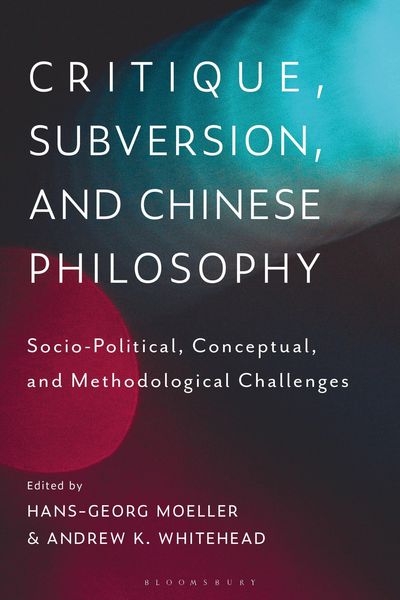
Critique, Subversion, and Chinese Philosophy Sociopolitical, Conceptual, and Methodological Challenges

138,99 €

inkl. gesetzl. MwSt., Versandkostenfrei


Beschreibung

Bringing together a number of case studies, this book shows how from early on Chinese philosophical discourses unfolded through innovation and the subversion of dominant forms of thinking. Narrowing in on the commonplace Chinese motto that "the three teachings" of Confucianism, Daoism, and Buddhism...

Beschreibung

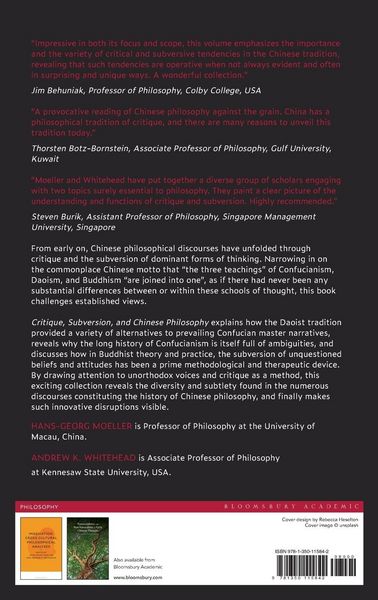
Bringing together a number of case studies, this book shows how from early on Chinese philosophical discourses unfolded through innovation and the subversion of dominant forms of thinking. Narrowing in on the commonplace Chinese motto that "the three teachings" of Confucianism, Daoism, and Buddhism "are joined into one", as if there had never been any substantial differences between or within these schools of thought, a team of esteemed contributors challenge established views. They explain how the Daoist tradition provided a variety of alternatives to prevailing Confucian master narratives, reveal why the long history of Confucianism is itself full of ambiguities, disputes, and competing ideas and discuss how in Buddhist theory and practice, the subversion of unquestioned beliefs and attitudes has been a prime methodological and therapeutic device. By drawing attention to unorthodox voices and subversion as a method, this exciting collection reveals that for too long the traditional division into "three teachings" has failed to do justice to the diversity and subtlety found in the numerous discourses constituting the history of Chinese philosophy. Critique, Subversion and Chinese Philosophy finally makes such innovative disruptions visible.

Produktdetails

Einband

Gebundene Ausgabe

Erscheinungsdatum

12.11.2020

Herausgeber Hans-Georg Moeller + weitere
Verlag Bloomsbury Academic

Produktdetails

Einband

Gebundene Ausgabe

Erscheinungsdatum

12.11.2020

Herausgeber
Verlag Bloomsbury Academic
Seitenzahl

210

Maße (L/B/H)

24/16,1/1,6 cm

Gewicht

485 g

Sprache

Englisch

ISBN

978-1-350-11584-2

Herstelleradresse

Libri GmbH
Europaallee 1
36244 Bad Hersfeld
DE

Email: gpsr@libri.de

Ein neues Kapitel für Ihre Bücher

Ein neues Kapitel für Ihre Bücher

Schenken Sie Ihren alten Schätzen ein zweites Leben und erhalten Sie dafür eine Thalia Geschenkkarte.

Jetzt verkaufen
Jetzt verkaufen

Noch keine Bewertungen vorhanden

Verfassen Sie die erste Bewertung zu diesem Artikel

Helfen Sie anderen Kundinnen und Kunden durch Ihre Meinung.

Kundinnen und Kunden meinen

Bewertungen (0)

Die Leseprobe wird geladen.
  • Produktbild: Critique, Subversion, and Chinese Philosophy
  • Produktbild: Critique, Subversion, and Chinese Philosophy
  • 1. Introduction: Conflict, Contradiction, Reconciliation: (Dis-)Harmonious Critique in Chinese Philosophies, Hans-Georg Moeller (University of Macau, Macau) and Andrew K. Whitehead (Kennesaw State University, USA)
    Part I: Critique as Method
    2. Pedagogical Self-Subversion and Critical Becoming in Early Confucian Philosophy, Geir Sigurdsson (University of Iceland, Iceland)
    3. Crisis and Critique: Zhuangzi's Philosophical Turning Point, Hans-Georg Moeller (University of Macau, Macau) and Paul J. D'Ambrosio, (East China Normal University, China)
    4. Otherwise than God and Man: Subverting Purpose and Knowledge in Zhuangzi's Perspectival Mirror, Brook Ziporyn (University of Chicago, USA)
    5. Confucius's Irony: Silent Subversion and Critique in the Analects, Dimitra Amarantidou (East China Normal University, China)
    6. Efficacious Subversion: Argument by Relegation in Chan Buddhism, Andrew K. Whitehead (Kennesaw State University, USA)
    7. Scolding the Buddhas, Abusing the Patriarchs: An Outlook on the Subversive Hermeneutics of Chan, through Case Four of the Blue Cliff Record, Rudi Capra (National University of Ireland, Galway, Ireland)
    Part II: Socio-Political Subversion
    8. To Become the King of All Under Heaven: Mengzi as a Strategist of Regime Subversion, Ting-mien Lee (University of Macau, Macau)
    9. A Daoist Critique of the Huaxia Civilization Project, Daniel Sarafinas (University of Macau, Macau)
    10. Li Zehou's Critique of Marx through the Lens of Kantian Philosophy, or the Transcendental Illusion of Class Struggle, Jana S. Rosker (University of Ljubljana, Slovenia)
    11. Kundao's Daring Odyssey: Female Daoist Discontentment and Challenge to Confucian Womanhood, Robin R. Wang (Loyola Marymount University, USA)
    Part III: Critiques of Concepts and Ideas
    12. Critique and Subversion: Rethinking Yang Zhu's Conception of "Self", Ellen Y. Zhang (Hong Kong Baptist University, Hong Kong)
    13. Subversive Cosmology in the Zhuangzi: A Revaluation of the Early Chinese Cosmos, Manuel Rivera (University of Macau, Macau)
    14. Dai Zhen's Critique of Song Confucian Ideology, Robert Carleo III (Chinese University of Hong Kong, Hong Kong)
    15. What is Critique and What Does it Subvert? Epistemic Intransparency in the Critique of Modern Society, Ady Van den Stock (Ghent University, Belgium)
    Index