















































KI-Beratung Beta

Produktbild: Bousfield Classes and Ohkawa's Theorem
Band 309

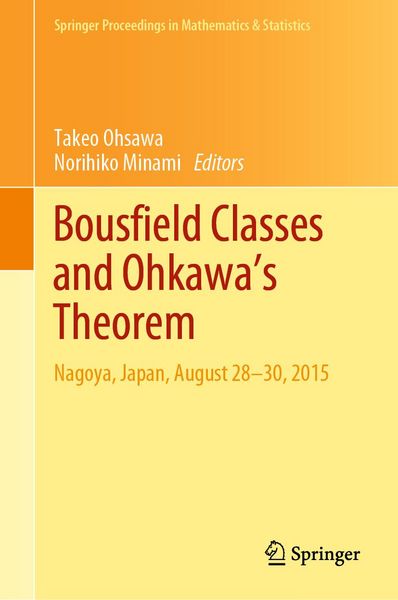
Bousfield Classes and Ohkawa's Theorem Nagoya, Japan, August 28-30, 2015

149,79 €

inkl. gesetzl. MwSt.

Beschreibung

This volume originated in the workshop held at Nagoya University, August 28-30, 2015, focusing on the surprising and mysterious Ohkawa's theorem: the Bousfield classes in the stable homotopy category SH form a set. An inspiring, extensive mathematical story can be narrated starting with Ohkawa's theorem,...

Beschreibung

This volume originated in the workshop held at Nagoya University, August 28-30, 2015, focusing on the surprising and mysterious Ohkawa's theorem: the Bousfield classes in the stable homotopy category SH form a set. An inspiring, extensive mathematical story can be narrated starting with Ohkawa's theorem, evolving naturally with a chain of motivational questions:

  • Ohkawa's theorem states that the Bousfield classes of the stable homotopy category SH surprisingly forms a set, which is still very mysterious. Are there any toy models where analogous Bousfield classes form a set with a clear meaning?
  • The fundamental theorem of Hopkins, Neeman, Thomason, and others states that the analogue of the Bousfield classes in the derived category of quasi-coherent sheaves Dqc(X) form a set with a clear algebro-geometric description. However, Hopkins was actually motivated not by Ohkawa's theorem but by his own theorem with Smithin the triangulated subcategory SHc, consisting of compact objects in SH. Now the following questions naturally occur: (1) Having theorems of Ohkawa and Hopkins-Smith in SH, are there analogues for the Morel-Voevodsky A1-stable homotopy category SH(k), which subsumes SH when k is a subfield of C?, (2) Was it not natural for Hopkins to have considered Dqc(X)c instead of Dqc(X)? However, whereas there is a conceptually simple algebro-geometrical interpretation Dqc(X)c = Dperf(X), it is its close relative Dbcoh(X) that traditionally, ever since Oka and Cartan, has been intensively studied because of its rich geometric and physical information.

This book contains developments for the rest of the storyand much more, including the chromatics homotopy theory, which the Hopkins-Smith theorem is based upon, and applications of Lurie's higher algebra, all by distinguished contributors.

Produktdetails

Format

PDF

Kopierschutz

Nein

Family Sharing

Nein

Text-to-Speech

Nein

Produktdetails

Format

PDF

Format

eBooks im PDF-Format haben eine festgelegte Seitengröße und eignen sich daher nur bedingt zum Lesen auf einem tolino eReader oder Smartphone. Für den vollen Lesegenuss empfehlen wir Ihnen bei PDF-eBooks die Verwendung eines Tablets oder Computers.

Kopierschutz

Nein

Kopierschutz

Dieses eBook können Sie uneingeschränkt auf allen Geräten der tolino Familie, allen sonstigen eReadern und am PC lesen. Das eBook ist nicht kopiergeschützt und kann ein personalisiertes Wasserzeichen enthalten. Weitere Hinweise zum Lesen von eBooks mit einem personalisierten Wasserzeichen finden Sie unter Hilfe/Downloads.

Family Sharing

Nein

Family Sharing

Mit Family Sharing können Sie eBooks innerhalb Ihrer Familie (max. sechs Mitglieder im gleichen Haushalt) teilen. Sie entscheiden selbst, welches Buch Sie mit welchem Familienmitglied teilen möchten. Auch das parallele Lesen durch verschiedene Familienmitglieder ist durch Family Sharing möglich. Um eBooks zu teilen oder geteilt zu bekommen, muss jedes Familienmitglied ein Konto bei Thalia oder einem anderen tolino-Buchhändler haben. Weitere Informationen finden Sie unter Hilfe/Family-Sharing.

Text-to-Speech

Nein

Text-to-Speech

Bedeutet Ihnen Stimme mehr als Text? Mit der Funktion Text-to-Speech können Sie sich im tolino webReader und in der aktuellen Thalia – Lesen & Hören App das eBook vorlesen lassen. Weitere Informationen finden Sie unter Hilfe/Text-to-Speech.

Erscheinungsdatum

18.03.2020

Herausgeber
Verlag Springer Nature Singapore
Seitenzahl

435 (Printausgabe)

Dateigröße

5561 KB

Sprache

Englisch

EAN

9789811515880

Barrierefreiheit
  • keine Information zur Barrierefreiheit bekannt

Noch keine Bewertungen vorhanden

Verfassen Sie die erste Bewertung zu diesem Artikel

Helfen Sie anderen Kundinnen und Kunden durch Ihre Meinung.

Kundinnen und Kunden meinen

Bewertungen (0)

Weitere Artikel finden Sie in

  • Produktbild: Bousfield Classes and Ohkawa's Theorem