Beschreibung
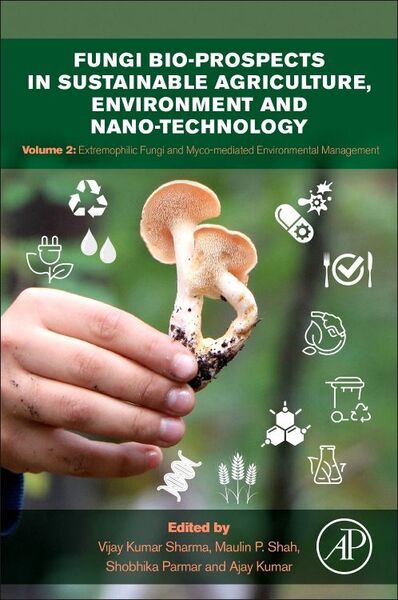
Fungi Bio-prospects in Sustainable Agriculture, Environment and Nanotechnology, Volume Two: Extremophilic Fungi and Myco-mediated Environmental Management explores varied aspects of fungal biology and their relevance in microbiology and agriculture, thus allowing for better insights on basic and advanced biotechnological application in human welfare and sustainable agriculture. Chapters throw light on different sectors of fungi, including fungi in extreme circumstances, bioremediation, complex and toxic effluents, and mycoremediation. The book was designed to explore the possibility of huge fungal diversity for present and future generation in different sectors of human life. Volume Two focuses on extremophilic fungi and myco-mediated environmental management.
Portrait
Dr.V.K. Sharma has a Ph.D. in Botany from Banaras Hindu University, Varanasi, U.P., India. He has more than eleven years of research experience, particularly in the area of endophytes. His research interest is in the bio-potential applications of endophytes and their mechanism. He also has a keen interest in emerging environmental issues and mitigation. He is currently working on the role of fungal endophytes in heavy metal stress tolerance of host plants, and mechanism. Dr. Sharma has more than thirty research articles and book chapters in journals of national and international repute to his credit. He is lifetime member of Mycological Society of India (MSI). He is also the recipient of MJ Thirumalachar Young Scientist Award Lectures by MSI in 2016. He also received Yunnan provincial government funding-II. He has also actively participated in many national and international conferences, symposia and workshops related to his research fieldMaulin P. Shah is a distinguished environmental scientist, academician, and globally recognized expert in the fields of environmental biotechnology and sustainable
wastewater treatment. He has made significant contributions to advancing eco-friendly
technologies for pollution control, particularly through innovative biological treatment processes. He holds extensive academic and research experience, with a strong focus on industrial wastewater treatment, bioremediation, and microalgae-based technologies. His work emphasizes the integration of sustainability principles with practical engineering solutions, helping industries reduce their environmental footprint.
His books cover a wide spectrum of cutting-edge domains, including industrial wastewater microbiology, bioremediation, biodegradation, algal biotechnology, biofuel, bioenergy, circular economy, metagenomics related to wastewater treatment, and enzyme engineering.Dr. Parmar has a Ph.D. in Environment Science from from Govind Ballabh Pant University of Agriculture & Technology, Pantnagar, Uttarakhand, India. She has more than eight years of research experience, particularly in the area of toxic metal pollution of water bodies and soil, their phytoremediation, bio-prospects of endophytes in host plant growth enhancement and stress tolerance, and the mechanism. She has about 12 publications in journals and edited book of international repute such as Microbial Biotechnology and Elsevier. Recently she was awarded by the Yunnan provincial government, funding-II in China.Dr. Ajay Kumar is currently working as an assistant professor at Amity Institute of Biotechnology, Amity University, Noida, India. Dr. Kumar completed his tenure (2018-2022) as a visiting scientist from Agriculture Research Organization, Volcani Center, Israel and doctoral research from Department of Botany, Institute of Science, Banaras Hindu University, Varanasi, India on the theme "Plant microbe interaction". In his research tenures, Dr. Kumar has published more than 235 scientific contributions in the form of research and review articles, books or book chapters with the leading International Journals or Publishers. He has wide area of research experience, especially in the field of Plant-Microbe Interactions, Microbial biocontrol, Postharvest management of fruits, Microbial endophytes related with the medicinal plants and cyanobacteria-pesticides interactions. Dr. Kumar actively engaged in editing book with the leading publisher like Elsevier, Springer, CRC Press, Willey and edited more than 48 books and currently serving as an Associate editor in Frontier in Microbiology, BMC Microbiology and special guest editor in Microorganisms or Plants MDPI, Journal.