
















































Brazilian Deep-Sea Biodiversity
-
- Hardcover ausgewählt
- Taschenbuch
- eBook
-
Sprache:Englisch
97,99 €
inkl. gesetzl. MwSt.,
Beschreibung
Produktdetails
Einband
Gebundene Ausgabe
Erscheinungsdatum
28.10.2020
Abbildungen
XIX, 261 p. 61 illus., 54 illus. in color.
Herausgeber
Paulo Yukio Gomes Sumida + weitereVerlag
SpringerSeitenzahl
261
Maße (L/B/H)
24,1/16/2,1 cm
Gewicht
542 g
Auflage
20001 Auflage 1st edition 2020
Sprache
Englisch
ISBN
978-3-030-53221-5
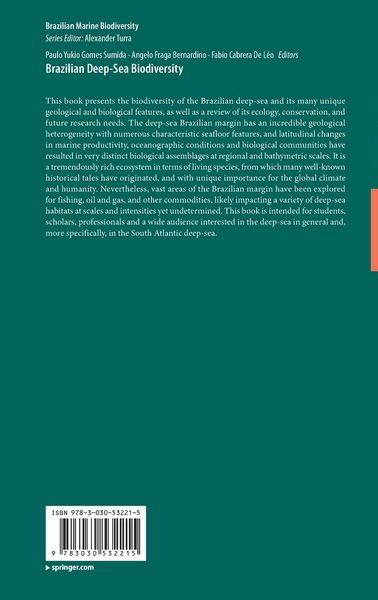
This book presents the biodiversity of the Brazilian deep-sea and its many unique geological and biological features, as well as a review of its ecology, conservation, and future research needs. The deep-sea Brazilian margin has an incredible geological heterogeneity with numerous characteristic seafloor features, and latitudinal changes in marine productivity, oceanographic conditions and biological communities have resulted in very distinct biological assemblages at regional and bathymetric scales. It is a tremendously rich ecosystem in terms of living species, from which many well-known historical tales have originated, and with unique importance for the global climate and humanity. Nevertheless, vast areas of the Brazilian margin have been explored for fishing, oil and gas, and other commodities, likely impacting a variety of deep-sea habitats at scales and intensities yet undetermined. This book is intended for students, scholars, professionals and a wide audience interested inthe deep-sea in general and, more specifically, in the South Atlantic deep-sea.
Ein neues Kapitel für Ihre Bücher
Ein neues Kapitel für Ihre Bücher
Schenken Sie Ihren alten Schätzen ein zweites Leben und erhalten Sie dafür eine Thalia Geschenkkarte.
Noch keine Bewertungen vorhanden
Verfassen Sie die erste Bewertung zu diesem Artikel
Helfen Sie anderen Kundinnen und Kunden durch Ihre Meinung.
Kurze Frage zu unserer Seite
Vielen Dank für Ihr Feedback
Wir nutzen Ihr Feedback, um unsere Produktseiten zu verbessern. Bitte haben Sie Verständnis, dass wir Ihnen keine Rückmeldung geben können. Falls Sie Kontakt mit uns aufnehmen möchten, können Sie sich aber gerne an unseren Kund*innenservice wenden.
zum Kundenservice