















































KI-Beratung Beta

Gutscheinbedingungen

Gültig bis 30.11.2026 | Gültig für nicht preisgebundene fremdsprachige Bücher | Einzelne Artikel können ausgeschlossen sein | Online auf thalia.de und in der Thalia App einlösbar | Click & Collect nur mit Online-Zahlung (Paypal/Kreditkarte) vorab | Nicht kombinierbar mit anderen Gutscheinen oder Preisaktionen | Nur einmal pro Einkauf einlösbar | Gutschein wird auf max. 500€ Bestellwert angerechnet | Keine Barauszahlung | Nicht gültig für Versandkosten und Services

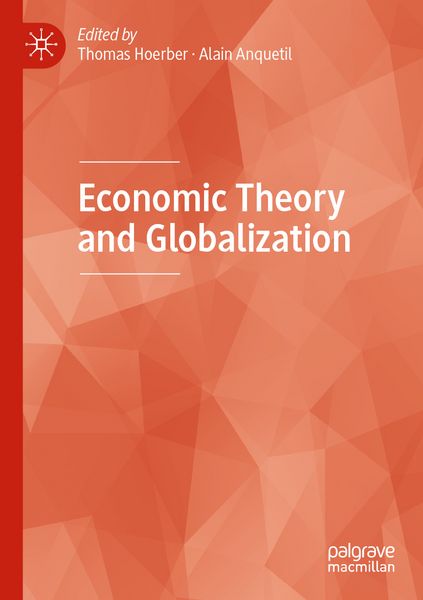
  • Produktbild: Economic Theory and Globalization
  • Produktbild: Economic Theory and Globalization

Economic Theory and Globalization

87,99 €

inkl. gesetzl. MwSt., Versandkostenfrei


Beschreibung

What do the economic theories of thought-leaders in economics, such as Smith, Keynes, Marx and Schumpeter, tell us about globalisation in the twenty-first century? Great economic theories have provided a narrative of how society should work in all its aspects, and can offer renewed usefulness for today's...

Beschreibung

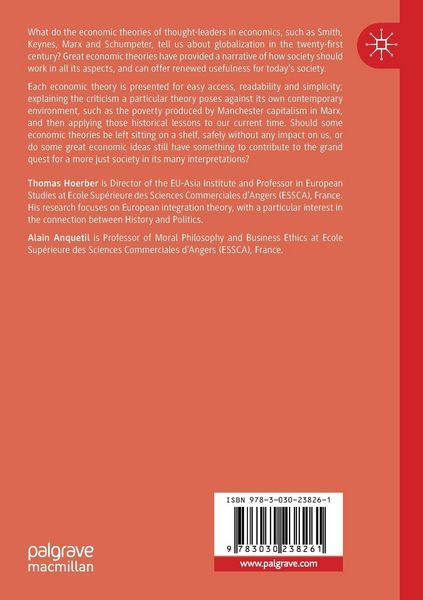
What do the economic theories of thought-leaders in economics, such as Smith, Keynes, Marx and Schumpeter, tell us about globalisation in the twenty-first century? Great economic theories have provided a narrative of how society should work in all its aspects, and can offer renewed usefulness for today's society.


Each economic theory is presented for easy access, readability and simplicity; explaining the criticism a particular theory poses against its own contemporary environment, such as the poverty produced by Manchester capitalism in Marx, and then applying those historical lessons to our current time. Should some economic theories be left sitting on a shelf, safely without any impact on us, or do some great economic ideas still have something to contribute to the grand quest for a more just society in its many interpretations?


Portrait


Thomas Hoerber
is Director of the EU-Asia Institute and Professor in European Studies at Ecole Supérieure des Sciences Commerciales d'Angers (ESSCA), France. His research focuses on European integration theory, with a particular interest in the connection between History and Politics.


Alain Anquetil
is Professor of Moral Philosophy and Business Ethics at Ecole Supérieure des Sciences Commerciales d'Angers (ESSCA), France.


Produktdetails

Einband

Taschenbuch

Erscheinungsdatum

04.09.2020

Abbildungen

XV, 262 p. 3 illus., 1 illus. in color.

Herausgeber Thomas Hoerber + weitere

Produktdetails

Einband

Taschenbuch

Erscheinungsdatum

04.09.2020

Abbildungen

XV, 262 p. 3 illus., 1 illus. in color.

Herausgeber
Verlag Springer
Seitenzahl

262

Maße (L/B/H)

21/14,8/1,6 cm

Gewicht

366 g

Auflage

1st edition 2019

Sprache

Englisch

ISBN

978-3-030-23826-1

Herstelleradresse

Springer-Verlag GmbH
Tiergartenstr. 17
69121 Heidelberg
DE

Email: ProductSafety@springernature.com

Ein neues Kapitel für Ihre Bücher

Ein neues Kapitel für Ihre Bücher

Schenken Sie Ihren alten Schätzen ein zweites Leben und erhalten Sie dafür eine Thalia Geschenkkarte.

Jetzt verkaufen
Jetzt verkaufen

Noch keine Bewertungen vorhanden

Verfassen Sie die erste Bewertung zu diesem Artikel

Helfen Sie anderen Kundinnen und Kunden durch Ihre Meinung.

Kundinnen und Kunden meinen

Bewertungen (0)

  • Produktbild: Economic Theory and Globalization
  • Produktbild: Economic Theory and Globalization

  • Chapter 1: Introduction; Thomas Hoerber, Alain Anquetil.- Chapter 2: The Social Liberalism of John Stuart Mill; Alain Anquetil.- Chapter 3: Karl Marx’s Communism and Critique of Capital; Paul Prew.- Chapter 4: Edmund Burke’s Liberalism; Thomas Hoerber.- Chapter 5: The free Liberalism of Adam Smith; Alain Anquetil.- Chapter 6: Economic Cycles by Josef Schumpeter; Assen Slim.- Chapter 7: The Bancor and International Trade Possibilities of John Maynard; David Rees.- Chapter 8: The roots of neo-liberalism in Friedrich von Hayek; Thomas Hoerber.- Chapter 9: Elinor Ostrom or the Revolution of the Commons; Fanny Verrax.- Chapter 10: The Ecological Economy of Georgescu Roegen; Gabriel Weber, Ignazio Cabras.- Chapter 11: Conclusion; Alain Anquetil, Thomas Hoerber.