















































KI-Beratung Beta

Gutscheinbedingungen

Gültig bis 30.11.2026 | Gültig für nicht preisgebundene fremdsprachige Bücher | Einzelne Artikel können ausgeschlossen sein | Online auf thalia.de und in der Thalia App einlösbar | Click & Collect nur mit Online-Zahlung (Paypal/Kreditkarte) vorab | Nicht kombinierbar mit anderen Gutscheinen oder Preisaktionen | Nur einmal pro Einkauf einlösbar | Gutschein wird auf max. 500€ Bestellwert angerechnet | Keine Barauszahlung | Nicht gültig für Versandkosten und Services

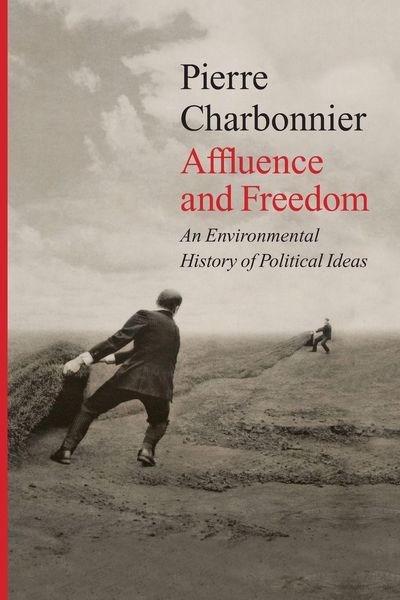
Produktbild: Affluence and Freedom

Affluence and Freedom An Environmental History of Political Ideas

24,99 €

inkl. gesetzl. MwSt., Versandkostenfrei


Beschreibung

In this pathbreaking book, Pierre Charbonnier opens up a new intellectual terrain: an environmental history of political ideas. His aim is not to locate the seeds of ecological thought in the history of political ideas as others have done, but rather to show that all political ideas, whether or not...

Beschreibung

In this pathbreaking book, Pierre Charbonnier opens up a new intellectual terrain: an environmental history of political ideas. His aim is not to locate the seeds of ecological thought in the history of political ideas as others have done, but rather to show that all political ideas, whether or not they endorse ecological ideals, are informed by a certain conception of our relationship to the Earth and to our environment. The fundamental political categories of modernity were founded on the idea that we could improve on nature, that we could exert a decisive victory over its excesses and claim unlimited access to earthly resources. In this way, modern thinkers imagined a political society of free individuals, equal and prosperous, alongside the development of industry geared towards progress and liberated from the Earth's shackles. Yet this pact between democracy and growth has now been called into question by climate change and the environmental crisis. It is therefore our duty today to rethink political emancipation, bearing in mind that this can no longer draw on the prospect of infinite growth promised by industrial capitalism. Ecology must draw on the power harnessed by nineteenth-century socialism to respond to the massive impact of industrialization, but it must also rethink the imperative to offer protection to society by taking account of the solidarity of social groups and their conditions in a world transformed by climate change. This timely and original work of social and political theory will be of interest to a wide readership in politics, sociology, environmental studies and the social sciences and humanities generally.

Rezension

"Because he speaks the language of political philosophy and not that of environmentalism, Charbonnier manages, paradoxically, to bring questions of the material conditions of existence much closer to what those who pursue the modern ideals of freedom and prosperity need in order to realize them. He might succeed in rendering political ecology mainstream."
Bruno Latour, Sciences Po, Paris
 
"Impressive and forensic"
Times Higher Education

Produktdetails

Einband

Taschenbuch

Erscheinungsdatum

21.09.2021

Verlag John Wiley & Sons
Seitenzahl

328

Produktdetails

Einband

Taschenbuch

Erscheinungsdatum

21.09.2021

Verlag John Wiley & Sons
Seitenzahl

328

Maße (L/B/H)

22,8/15,4/3 cm

Gewicht

527 g

Farbe

Seidengrau / Kaffee

Auflage

1. Auflage

Übersetzt von

Andrew Brown

Sprache

Englisch

ISBN

978-1-5095-4372-4

Herstelleradresse

Libri GmbH
Europaallee 1
36244 Bad Hersfeld
DE

Email: gpsr@libri.de

Ein neues Kapitel für Ihre Bücher

Ein neues Kapitel für Ihre Bücher

Schenken Sie Ihren alten Schätzen ein zweites Leben und erhalten Sie dafür eine Thalia Geschenkkarte.

Jetzt verkaufen
Jetzt verkaufen

Noch keine Bewertungen vorhanden

Verfassen Sie die erste Bewertung zu diesem Artikel

Helfen Sie anderen Kundinnen und Kunden durch Ihre Meinung.

Kundinnen und Kunden meinen

Bewertungen (0)

Die Leseprobe wird geladen.
  • Produktbild: Affluence and Freedom
  • Acknowledgements
     
    Foreword
     
    Introduction

    Chapter One. The critique of ecological reason
     
    The fabric of liberty
     
    The other history. Ecology and the labour question
     
    Subsisting, dwelling, knowing
     
    Autonomy and abundance

    Chapter Two. Sovereignty and property. Political philosophy and the land
     
    The political affordances of the land
     
    Grotius: Empire and possession
     
    Locke: the improving citizen

    Chapter Three. Grain and the market. The order of commerce and the organic economy in the eighteenth century
     
    The good use of the land
     
    The agrarian kingdom of the Physiocrats
     
    The liberal pact: Adam Smith
     
    Two types of growth
     
    Fichte: the ubiquity of the moderns

    Chapter Four. The new ecological regime
     
    From one liberalism to another
     
    The paradoxes of autonomy: Guizot
     
    The paradoxes of abundance: Jevons
     
    Colonial extractions
     
    Extraction-autonomy: Tocqueville

    Chapter Five. Industrial democracy. From Proudhon to Durkheim
     
    Revolutions and industry
     
    Property and labour
     
    Proudhon as critic of the liberal pact
     
    The fraternal idiom
     
    Durkheim: 'carbon sociology'
     
    The political affordances of coal

    Chapter Six. The technocratic hypothesis. Saint-Simon and Veblen
     
    Material flows and market arrangements
     
    The technological normativity of the moderns
     
    Laying bare the productive schema
     
    Veblen and the cult of efficiency
     
    The engineer and property

    Chapter Seven. Nature in a market society
     
    Marx as a thinker of autonomy
     
    Putting the forest to good use
     
    Technology and agronomy
     
    Conquering the globe
     
    Karl Polanyi: protecting society, protecting nature
     
    Disembedding
     
    Socialism, liberalism, conservatism

    Chapter Eight. The great acceleration and the eclipse of nature
     
    Freedom from want
     
    Emancipation and acceleration: Herbert Marcuse
     
    Oil and atomic power: invisible energies

    Chapter Nine. Risks and limits: the end of certainties
     
    Alarms and controversies
     
    The critique of development and political naturalism
     
    Risk and the reinvention of autonomy
     
    The impasse: between collapse and resilience

    Chapter Ten. The end of the modern exception and political ecology
     
    Symmetrizations
     
    Authority and composition
     
    Under naturalism lies production
     
    Unequal ecological exchange
     
    Provincializing critique
     
    A new conceptual cartography
     
    Changing expectations of justice
     
    Autonomy without abundance
     
    Towards a new critical subject

    Chapter Eleven. The self-protection of the Earth.
     
    Changing expectations of justice
     
    Autonomy without abundance
     
    Towards a new critical subject

    Conclusion. Reinventing liberty

    Notes
     
    Bibliography Index