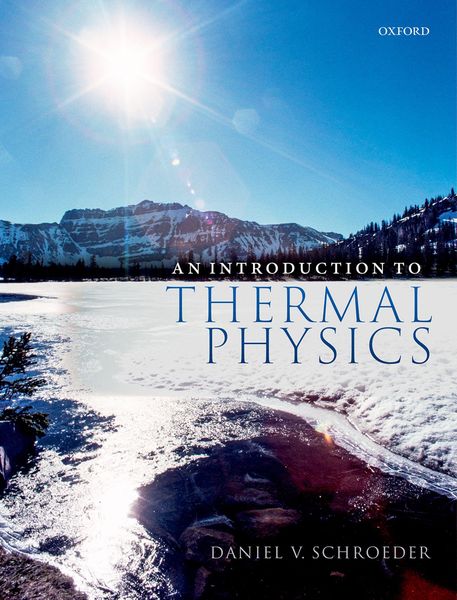
An Introduction to Thermal Physics
-
- Hardcover
- Taschenbuch
- eBook ausgewählt
-
Form:Einzelkauf Download
-
Sprache:Englisch
38,49 €
inkl. gesetzl. MwSt.Beschreibung
Produktdetails
Format
Kopierschutz
Ja
Family Sharing
Nein
Text-to-Speech
Nein
Erscheinungsdatum
15.12.2020
Verlag
OUP eBookSeitenzahl
432 (Printausgabe)
Dateigröße
13672 KB
Sprache
Englisch
EAN
9780192648105
Thermal physics deals with collections of large numbers of particles - typically 10 to the 23rd power or so. Examples include the air in a balloon, the water in a lake, the electrons in a chunk of metal, and the photons given off by the sun. We can't possibly follow every detail of the motions of so many particles. So in thermal physics we assume that these motions are random, and we use the laws of probability to predict how the material as a whole ought to behave. Alternatively, we can measure the bulk properties of a material, and from these infer something about the particles it is made of.
This book will give you a working understanding of thermal physics, assuming that you have already studied introductory physics and calculus. You will learn to apply the general laws of energy and entropy to engines, refrigerators, chemical reactions, phase transformations, and mixtures. You will also learn to use basic quantum physics and powerful statistical methods to predict in detail how temperature affects molecular speeds, vibrations of solids, electrical and magnetic behaviors, emission of light, and exotic low-temperature phenomena. The problems and worked examples explore applications not just within physics but also to engineering, chemistry, biology, geology, atmospheric science, astrophysics, cosmology, and everyday life.
This book will give you a working understanding of thermal physics, assuming that you have already studied introductory physics and calculus. You will learn to apply the general laws of energy and entropy to engines, refrigerators, chemical reactions, phase transformations, and mixtures. You will also learn to use basic quantum physics and powerful statistical methods to predict in detail how temperature affects molecular speeds, vibrations of solids, electrical and magnetic behaviors, emission of light, and exotic low-temperature phenomena. The problems and worked examples explore applications not just within physics but also to engineering, chemistry, biology, geology, atmospheric science, astrophysics, cosmology, and everyday life.
Noch keine Bewertungen vorhanden
Verfassen Sie die erste Bewertung zu diesem Artikel
Helfen Sie anderen Kundinnen und Kunden durch Ihre Meinung.
Kurze Frage zu unserer Seite
Vielen Dank für Ihr Feedback
Wir nutzen Ihr Feedback, um unsere Produktseiten zu verbessern. Bitte haben Sie Verständnis, dass wir Ihnen keine Rückmeldung geben können. Falls Sie Kontakt mit uns aufnehmen möchten, können Sie sich aber gerne an unseren Kund*innenservice wenden.
zum Kundenservice