















































KI-Beratung Beta

Gutscheinbedingungen

Gültig bis 30.11.2026 | Gültig für nicht preisgebundene fremdsprachige Bücher | Einzelne Artikel können ausgeschlossen sein | Online auf thalia.de und in der Thalia App einlösbar | Click & Collect nur mit Online-Zahlung (Paypal/Kreditkarte) vorab | Nicht kombinierbar mit anderen Gutscheinen oder Preisaktionen | Nur einmal pro Einkauf einlösbar | Gutschein wird auf max. 500€ Bestellwert angerechnet | Keine Barauszahlung | Nicht gültig für Versandkosten und Services

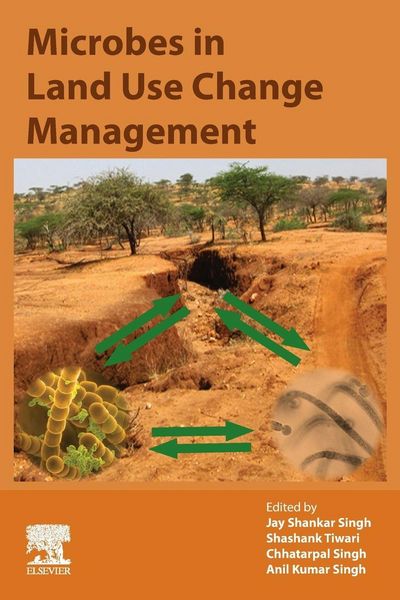
  • Produktbild: Microbes in Land Use Change Management
  • Produktbild: Microbes in Land Use Change Management

Microbes in Land Use Change Management

149,99 €

inkl. gesetzl. MwSt., Versandkostenfrei


Beschreibung

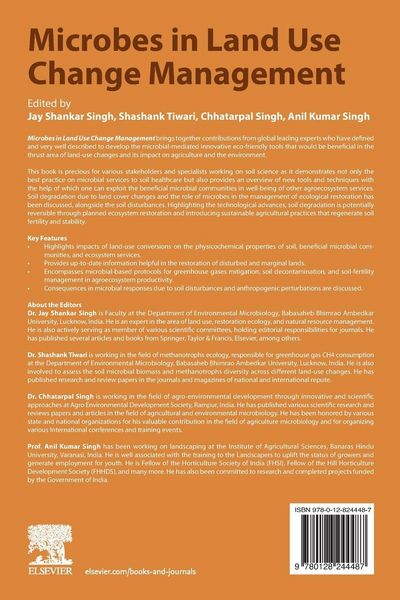
Microbes in Land Use Change Management details the various roles of microbial resources in management of land uses and how the microbes can be used for the source of income due to their cultivation for the purpose of biomass and bioenergy production. Using various techniques, the disturbed and marginal...

Beschreibung

Microbes in Land Use Change Management details the various roles of microbial resources in management of land uses and how the microbes can be used for the source of income due to their cultivation for the purpose of biomass and bioenergy production. Using various techniques, the disturbed and marginal lands may also be restored eco-friendly in present era to fulfil the feeding needs of mankind around the globe.

Microbes in Land Use Change Management provides standard and up to date information towards the land use change management using various microbial technologies to enhance the productivity of agriculture. Needless to say that Microbes in Land Use Change Management also considers the areas including generation of alternative energy sources, restoration of degraded and marginal lands, mitigation of global warming gases and next generation -omics technique etc.

Land use change affects environment conditions and soil microbial community. Microbial population and its species diversity have influence in maintaining ecosystem balance. The study of changes of microbial population provides an idea about the variation occurring in a specific area and possibilities of restoration.

Meant for a multidisciplinary audience Microbes in Land Use Change Management shows the need of next-generation omics technologies to explore microbial diversity.

Portrait

Dr. Jay Shankar Singh is Faculty at the Department of Environmental Microbiology, Babasaheb Bhimrao Ambedkar University, Lucknow, India. He is an expert in the area of land use, restoration ecology, and natural resource management. He is also actively serving as member of various scientific committees, holding editorial responsibilities for journals. He has published several articles and books from Springer, Taylor & Francis, Elsevier, among others.Dr. Shashank Tiwari is working in the field of methanotrophs ecology, responsible for greenhouse gas CH4 consumption at the Department of Environmental Microbiology, Babasaheb Bhimrao Ambedkar University, Lucknow, India. He is also involved to assess the soil microbial biomass and methanotrophs diversity across different land-use changes. He has published research and review papers in the journals and magazines of national and international repute.Dr. Chhatarpal Singh is working in the field of agro-environmental development through innovative and scientific approaches at Agro Environmental Development Society, Rampur, India. He has published various scientific research and reviews papers and articles in the field of agricultural and environmental microbiology. He has been honored by various state and national organizations for his valuable contribution in the field of agriculture microbiology and for organizing various International conferences and training events.Prof. Anil Kumar Singh has been working on landscaping at the Institute of Agricultural Sciences, Banaras Hindu University, Varanasi, India. He is well associated with the training to the Landscapers to uplift the status of growers and generate employment for youth. He is Fellow of the Horticulture Society of India (FHSI), Fellow of the Hill Horticulture Development Society (FHHDS), and many more. He has also been committed to research and completed projects funded by the Government of India.

Produktdetails

Einband

Taschenbuch

Erscheinungsdatum

25.08.2021

Herausgeber Jay Shankar Singh + weitere
Verlag Elsevier Science & Technology

Produktdetails

Einband

Taschenbuch

Erscheinungsdatum

25.08.2021

Herausgeber
Verlag Elsevier Science & Technology
Seitenzahl

610

Maße (L/B/H)

22,9/15,2/3,1 cm

Gewicht

806 g

Sprache

Englisch

ISBN

978-0-12-824448-7

EU-Ansprechpartner

Elsevier B.V.
Radarweg 29
1043 NX Amsterdam
NL
productsafety@elsevier.com

Herstelleradresse

Elsevier Science & Technology
London Wall 125
EC2Y 5AS London
GB
tradeorders@elsevier.com

Ein neues Kapitel für Ihre Bücher

Ein neues Kapitel für Ihre Bücher

Schenken Sie Ihren alten Schätzen ein zweites Leben und erhalten Sie dafür eine Thalia Geschenkkarte.

Jetzt verkaufen
Jetzt verkaufen

Noch keine Bewertungen vorhanden

Verfassen Sie die erste Bewertung zu diesem Artikel

Helfen Sie anderen Kundinnen und Kunden durch Ihre Meinung.

Kundinnen und Kunden meinen

Bewertungen (0)

Die Leseprobe wird geladen.
  • Produktbild: Microbes in Land Use Change Management
  • Produktbild: Microbes in Land Use Change Management
  • 1. Temperature sensitivity of litter and soil organic matter decomposition: perspective of soil microbial community structure and function 
    2. Adaptation of bacterial communities and plant strategies for amelioration and eco-restoration of an organometallic industrial waste polluted site 
    3. Effect of soil biofilms on ecological function and impact on soil properties 
    4. Alteration in microbial population density composition in different land use systems 
    5. Molecular characterization of bacterial community succession and analysis of physiochemical properties in a compost of solid organic waste from Gandhinagar, Gujarat, India 
    6. Molecular technologies for the early detection of fungal phytopathogens associated with cereal crops 
    7. Applicability of fungi in agriculture and environmental sustainability 
    8. Litterfall decomposition of selected plant species and nutrient
    cycling in Madhupur Sal (Shorea robusta Roth) forest of Bangladesh 
    9. Bioactivity of soil microorganisms for agriculture development 
    10. Next generation OMICS: a tool to understand the diversity of soil microbiota and improvement of agricultural sustainability 
    11. Microbial associations in ecological reclamation and restoration of marginal lands 
    12. Assessment of microbial biomass for production of ecofriendly
    single-cell protein, bioenergy, and other useful products 
    13. Participation and understanding of plant microbes' interaction in plant health and growth by combating mercury stress: a sustainable approach towards agricultural practices 
    14. The role of plant growth promoting bacteria in mineralization of endosulfan and its metabolites 
    15. Response of microbial populations to landscape dynamics 
    16. Soil-plant-microbial interactions for soil fertility management and sustainable agriculture 
    17. Endophytic microbial interaction with legume crop for developing resistance against nutrient stress 
    18. Function-driven microbial genomics for ecofriendly agriculture 
    19. Role of microbial communities in restoration disturbed lands 
    20. Impact of microbial biofilm on crop productivity and agricultural sustainability 
    21. Valuing each patch of land: utilizing plant-microbe interactions for the betterment of agriculture 
    22. Tripartite interactions: plant-Pseudomonas putida-microRNAs in agricultural  productivity 
    23. Next-generation omics technologies to explore microbial diversity