















































KI-Beratung Beta

Gutscheinbedingungen

Gültig bis 30.11.2026 | Gültig für nicht preisgebundene fremdsprachige Bücher | Einzelne Artikel können ausgeschlossen sein | Online auf thalia.de und in der Thalia App einlösbar | Click & Collect nur mit Online-Zahlung (Paypal/Kreditkarte) vorab | Nicht kombinierbar mit anderen Gutscheinen oder Preisaktionen | Nur einmal pro Einkauf einlösbar | Gutschein wird auf max. 500€ Bestellwert angerechnet | Keine Barauszahlung | Nicht gültig für Versandkosten und Services

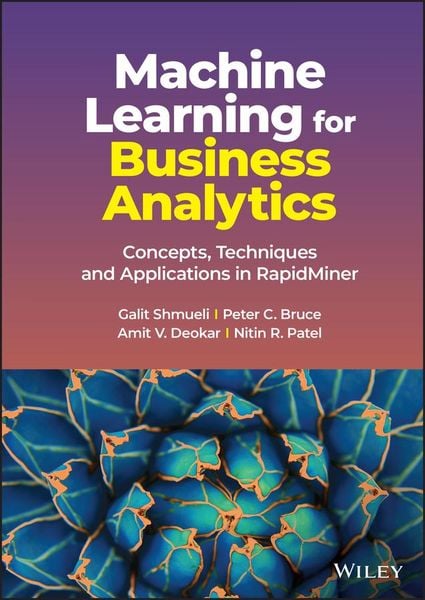
Produktbild: Machine Learning for Business Analytics

Machine Learning for Business Analytics Concepts, Techniques and Applications in Rapidminer

176,99 €

inkl. gesetzl. MwSt., Versandkostenfrei


Beschreibung

Machine Learning for Business Analytics   Machine learning--also known as data mining or data analytics--is a fundamental part of data science. It is used by organizations in a wide variety of arenas to turn raw data into actionable information.   Machine Learning for Business Analytics: Concepts, Techniques...

Beschreibung

Machine Learning for Business Analytics
 
Machine learning--also known as data mining or data analytics--is a fundamental part of data science. It is used by organizations in a wide variety of arenas to turn raw data into actionable information.
 
Machine Learning for Business Analytics: Concepts, Techniques and Applications in RapidMiner provides a comprehensive introduction and an overview of this methodology. This best-selling textbook covers both statistical and machine learning algorithms for prediction, classification, visualization, dimension reduction, rule mining, recommendations, clustering, text mining, experimentation and network analytics. Along with hands-on exercises and real-life case studies, it also discusses managerial and ethical issues for responsible use of machine learning techniques.
 
This is the seventh edition of Machine Learning for Business Analytics, and the first using RapidMiner software. This edition also includes:
* A new co-author, Amit Deokar, who brings experience teaching business analytics courses using RapidMiner
* Integrated use of RapidMiner, an open-source machine learning platform that has become commercially popular in recent years
* An expanded chapter focused on discussion of deep learning techniques
* A new chapter on experimental feedback techniques including A/B testing, uplift modeling, and reinforcement learning
* A new chapter on responsible data science
* Updates and new material based on feedback from instructors teaching MBA, Masters in Business Analytics and related programs, undergraduate, diploma and executive courses, and from their students
* A full chapter devoted to relevant case studies with more than a dozen cases demonstrating applications for the machine learning techniques
* End-of-chapter exercises that help readers gauge and expand their comprehension and competency of the material presented
* A companion website with more than two dozen data sets, and instructor materials including exercise solutions, slides, and case solutions
 
This textbook is an ideal resource for upper-level undergraduate and graduate level courses in data science, predictive analytics, and business analytics. It is also an excellent reference for analysts, researchers, and data science practitioners working with quantitative data in management, finance, marketing, operations management, information systems, computer science, and information technology.

Produktdetails

Einband

Gebundene Ausgabe

Erscheinungsdatum

08.03.2023

Verlag John Wiley & Sons Inc
Seitenzahl

736

Produktdetails

Einband

Gebundene Ausgabe

Erscheinungsdatum

08.03.2023

Verlag John Wiley & Sons Inc
Seitenzahl

736

Maße (L/B/H)

25,6/17,9/3,2 cm

Gewicht

1294 g

Auflage

1. Auflage

Sprache

Englisch

ISBN

978-1-119-82879-2

Herstelleradresse

Libri GmbH
Europaallee 1
36244 Bad Hersfeld
DE

Email: gpsr@libri.de

Ein neues Kapitel für Ihre Bücher

Ein neues Kapitel für Ihre Bücher

Schenken Sie Ihren alten Schätzen ein zweites Leben und erhalten Sie dafür eine Thalia Geschenkkarte.

Jetzt verkaufen
Jetzt verkaufen

Noch keine Bewertungen vorhanden

Verfassen Sie die erste Bewertung zu diesem Artikel

Helfen Sie anderen Kundinnen und Kunden durch Ihre Meinung.

Kundinnen und Kunden meinen

Bewertungen (0)

Die Leseprobe wird geladen.
  • Produktbild: Machine Learning for Business Analytics
  • Foreword by Ravi Bapna xxi
     
    Preface to the RapidMiner Edition xxiii
     
    Acknowledgments xxvii
     
    PART I PRELIMINARIES
     
    CHAPTER 1 Introduction 3
     
    1.1 What Is Business Analytics? 3
     
    1.2 What Is Machine Learning? 5
     
    1.3 Machine Learning, AI, and Related Terms 5
     
    1.4 Big Data 7
     
    1.5 Data Science 8
     
    1.6 Why Are There So Many Different Methods? 9
     
    1.7 Terminology and Notation 9
     
    1.8 Road Maps to This Book 12
     
    1.9 Using RapidMiner Studio 14
     
    CHAPTER 2 Overview of the Machine Learning Process 19
     
    2.1 Introduction 19
     
    2.2 Core Ideas in Machine Learning 20
     
    2.3 The Steps in a Machine Learning Project 23
     
    2.4 Preliminary Steps 25
     
    2.5 Predictive Power and Overfitting 32
     
    2.6 Building a Predictive Model with RapidMiner 37
     
    2.7 Using RapidMiner for Machine Learning 45
     
    2.8 Automating Machine Learning Solutions 47
     
    2.9 Ethical Practice in Machine Learning 52
     
    PART II DATA EXPLORATION AND DIMENSION REDUCTION
     
    CHAPTER 3 Data Visualization 63
     
    3.1 Introduction 63
     
    3.2 Data Examples 65
     
    3.3 Basic Charts: Bar Charts, Line Charts, and Scatter Plots 66
     
    3.4 Multidimensional Visualization 75
     
    3.5 Specialized Visualizations 87
     
    3.6 Summary: Major Visualizations and Operations, by Machine Learning Goal 92
     
    CHAPTER 4 Dimension Reduction 97
     
    4.1 Introduction 97
     
    4.2 Curse of Dimensionality 98
     
    4.3 Practical Considerations 98
     
    4.4 Data Summaries 100
     
    4.5 Correlation Analysis 103
     
    4.6 Reducing the Number of Categories in Categorical Attributes 105
     
    4.7 Converting a Categorical Attribute to a Numerical Attribute 107
     
    4.8 Principal Component Analysis 107
     
    4.9 Dimension Reduction Using Regression Models 117
     
    4.10 Dimension Reduction Using Classification and Regression Trees 119
     
    PART III PERFORMANCE EVALUATION
     
    CHAPTER 5 Evaluating Predictive Performance 125
     
    5.1 Introduction 125
     
    5.2 Evaluating Predictive Performance 126
     
    5.3 Judging Classifier Performance 131
     
    5.4 Judging Ranking Performance 146
     
    5.5 Oversampling 151
     
    PART IV PREDICTION AND CLASSIFICATION METHODS
     
    CHAPTER 6 Multiple Linear Regression 163
     
    6.1 Introduction 163
     
    6.2 Explanatory vs. Predictive Modeling 164
     
    6.3 Estimating the Regression Equation and Prediction 166
     
    6.4 Variable Selection in Linear Regression 171
     
    CHAPTER 7 k-Nearest Neighbors (k-NN) 189
     
    7.1 The k-NN Classifier (Categorical Label) 189
     
    7.2 k-NN for a Numerical Label 200
     
    7.3 Advantages and Shortcomings of k-NN Algorithms 202
     
    CHAPTER 8 The Naive Bayes Classifier 209
     
    8.1 Introduction 209
     
    8.2 Applying the Full (Exact) Bayesian Classifier 211
     
    8.3 Solution: Naive Bayes 213
     
    8.4 Advantages and Shortcomings of the Naive Bayes Classifier 223
     
    CHAPTER 9 Classification and Regression Trees 229
     
    9.1 Introduction 229
     
    9.2 Classification Trees 232
     
    9.3 Evaluating the Performance of a Classification Tree 240
     
    9.4 Avoiding Overfitting 245
     
    9.5 Classification Rules from Trees 255
     
    9.6 Classification Trees for More Than Two Classes 256
     
    9.7 Regression Trees 256
     
    9.8 Improving Prediction: Random Forests and Boosted Trees 259
     
    9.9 Advantages and Weaknesses of a Tree 261
     
    CHAPTER 10 Logistic Regression 269
     
    10.1 Introduction 269
     
    10.2 The