















































KI-Beratung Beta

Gutscheinbedingungen

Gültig bis 30.11.2026 | Gültig für nicht preisgebundene fremdsprachige Bücher | Einzelne Artikel können ausgeschlossen sein | Online auf thalia.de und in der Thalia App einlösbar | Click & Collect nur mit Online-Zahlung (Paypal/Kreditkarte) vorab | Nicht kombinierbar mit anderen Gutscheinen oder Preisaktionen | Nur einmal pro Einkauf einlösbar | Gutschein wird auf max. 500€ Bestellwert angerechnet | Keine Barauszahlung | Nicht gültig für Versandkosten und Services

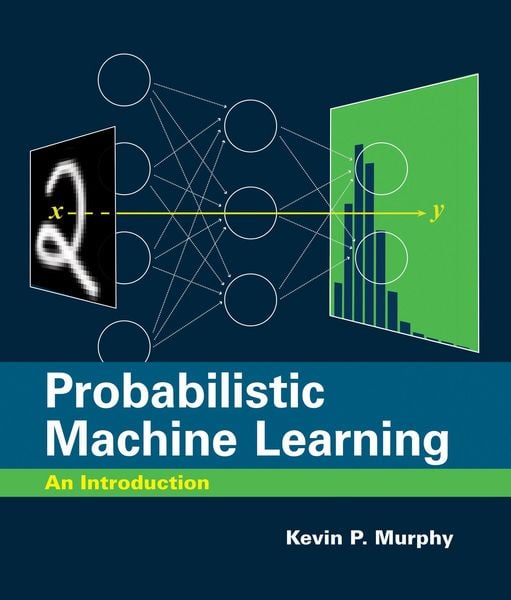
Produktbild: Probabilistic Machine Learning

Probabilistic Machine Learning An Introduction

152,99 €

inkl. gesetzl. MwSt., Versandkostenfrei


Beschreibung

A detailed and up-to-date introduction to machine learning, presented through the unifying lens of probabilistic modeling and Bayesian decision theory. This book offers a detailed and up-to-date introduction to machine learning (including deep learning) through the unifying lens of probabilistic modeling...

Beschreibung

A detailed and up-to-date introduction to machine learning, presented through the unifying lens of probabilistic modeling and Bayesian decision theory.
This book offers a detailed and up-to-date introduction to machine learning (including deep learning) through the unifying lens of probabilistic modeling and Bayesian decision theory. The book covers mathematical background (including linear algebra and optimization), basic supervised learning (including linear and logistic regression and deep neural networks), as well as more advanced topics (including transfer learning and unsupervised learning). End-of-chapter exercises allow students to apply what they have learned, and an appendix covers notation.
 
Probabilistic Machine Learning grew out of the author’s 2012 book, Machine Learning: A Probabilistic Perspective. More than just a simple update, this is a completely new book that reflects the dramatic developments in the field since 2012, most notably deep learning. In addition, the new book is accompanied by online Python code, using libraries such as scikit-learn, JAX, PyTorch, and Tensorflow, which can be used to reproduce nearly all the figures; this code can be run inside a web browser using cloud-based notebooks, and provides a practical complement to the theoretical topics discussed in the book. This introductory text will be followed by a sequel that covers more advanced topics, taking the same probabilistic approach.

Produktdetails

Einband

Gebundene Ausgabe

Erscheinungsdatum

01.03.2022

Abbildungen

444

Verlag Mit Press

Produktdetails

Einband

Gebundene Ausgabe

Erscheinungsdatum

01.03.2022

Abbildungen

444

Verlag Mit Press
Seitenzahl

944

Maße (L/B/H)

23,3/20,8/3,7 cm

Gewicht

1558 g

Sprache

Englisch

ISBN

978-0-262-04682-4

Herstelleradresse

Libri GmbH
Europaallee 1
36244 Bad Hersfeld
DE

Email: gpsr@libri.de

Ein neues Kapitel für Ihre Bücher

Ein neues Kapitel für Ihre Bücher

Schenken Sie Ihren alten Schätzen ein zweites Leben und erhalten Sie dafür eine Thalia Geschenkkarte.

Jetzt verkaufen
Jetzt verkaufen

Noch keine Bewertungen vorhanden

Verfassen Sie die erste Bewertung zu diesem Artikel

Helfen Sie anderen Kundinnen und Kunden durch Ihre Meinung.

Kundinnen und Kunden meinen

Bewertungen (0)

Die Leseprobe wird geladen.
  • Produktbild: Probabilistic Machine Learning
  • 1 Introduction 1
    I Foundations 29
    2 Probability: Univariate Models 31
    3 Probability: Multivariate Models 75
    4 statistics 103
    5 Decision Theory 163
    6 Information Theory 199
    7 Linear Algebra 221
    8 Optimization 269
    II Linear Models 315
    9 Linear Discriminant Analysis 317
    10 Logistic Regression 333
    11 Linear Regression 365
    12 Generalized Linear Models * 409
    III Deep Neural Networks 417
    13 Neural Networks for Structured Data 419
    14 Neural Networks for Images 461
    15 Neural Networks for Sequences 497
    IV Nonparametric Models 539
    16 Exemplar-based Methods 541
    17 Kernel Methods * 561
    18 Trees, Forests, Bagging, and Boosting 597
    V Beyond Supervised Learning 619
    19 Learning with Fewer Labeled Examples 621
    20 Dimensionality Reduction 651
    21 Clustering 709
    22 Recommender Systems 735
    23 Graph Embeddings * 747
    A Notation 767