















































KI-Beratung Beta

Gutscheinbedingungen

Gültig bis 30.11.2026 | Gültig für nicht preisgebundene fremdsprachige Bücher | Einzelne Artikel können ausgeschlossen sein | Online auf thalia.de und in der Thalia App einlösbar | Click & Collect nur mit Online-Zahlung (Paypal/Kreditkarte) vorab | Nicht kombinierbar mit anderen Gutscheinen oder Preisaktionen | Nur einmal pro Einkauf einlösbar | Gutschein wird auf max. 500€ Bestellwert angerechnet | Keine Barauszahlung | Nicht gültig für Versandkosten und Services

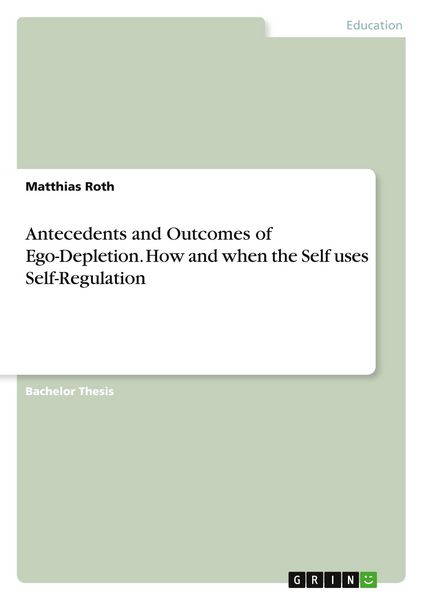
Produktbild: Antecedents and Outcomes of Ego-Depletion. How and when the Self uses Self-Regulation

Antecedents and Outcomes of Ego-Depletion. How and when the Self uses Self-Regulation

27,95 €

inkl. gesetzl. MwSt., Versandkostenfrei


Beschreibung

Bachelor Thesis from the year 2018 in the subject Didactics - Business economics, Economic Pedagogy, grade: 1,7, University of Mannheim, language: English, abstract: This thesis tries to achieve a better understanding of how and when the self uses self-regulation and why it breaks down some times. Self-regulatory...

Beschreibung

Bachelor Thesis from the year 2018 in the subject Didactics - Business economics, Economic Pedagogy, grade: 1,7, University of Mannheim, language: English, abstract: This thesis tries to achieve a better understanding of how and when the self uses self-regulation and why it breaks down some times. Self-regulatory success is related to enabling people to delay gratification and thus to reach long-term goals. In contrast, self-regulatory failure is associated with smoking, crime, divorces, depression, obsessive thoughts and school underachievement. Responsible for such acts of volition? The Self. Over the past two decades, a growing body of social psychology research has examined how all these favourable or maladaptive outcomes are related. Baumeister et al. (1998) concentrated on the "controlling aspect of the self" and suggested that all acts of volition draw on a limited resource. Making use of this resource for self-regulatory responses means to deplete it, which indicates to have less of it for the following task involving self-regulation. Muraven, Tice, and Baumeister (1998) proposed a strength model to explain the hypothesis of regulatory depletion. A large number of studies can be traced back to these antecedents and brought supporting evidence. However, in recent years, this paradigm has been questioned. This thesis provides an overview of how the research has progressed, from the roots to the present day. In the next section, the most important terms are defined and related. In a literature review, evidence for and against the underlying theories by visiting many empirical findings from different spheres is presented and linked to the theory. The thesis is completed by implications for marketers how to make use of the findings to boost sales. At the end, several limitations and possibilities for future research are exhibited.

Produktdetails

Einband

Taschenbuch

Erscheinungsdatum

25.08.2021

Abbildungen

1 Farbabb.

Verlag GRIN

Produktdetails

Einband

Taschenbuch

Erscheinungsdatum

25.08.2021

Abbildungen

1 Farbabb.

Verlag GRIN
Seitenzahl

64

Maße (L/B/H)

21/14,8/0,5 cm

Gewicht

107 g

Auflage

1. Auflage

Sprache

Englisch

ISBN

978-3-346-40042-0

Herstelleradresse


Email: info@bod.de

Ein neues Kapitel für Ihre Bücher

Ein neues Kapitel für Ihre Bücher

Schenken Sie Ihren alten Schätzen ein zweites Leben und erhalten Sie dafür eine Thalia Geschenkkarte.

Jetzt verkaufen
Jetzt verkaufen

Noch keine Bewertungen vorhanden

Verfassen Sie die erste Bewertung zu diesem Artikel

Helfen Sie anderen Kundinnen und Kunden durch Ihre Meinung.

Kundinnen und Kunden meinen

Bewertungen (0)

Weitere Artikel finden Sie in

  • Produktbild: Antecedents and Outcomes of Ego-Depletion. How and when the Self uses Self-Regulation