















































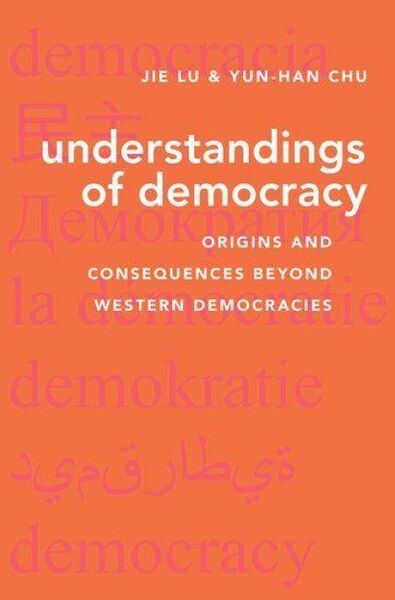
Understandings of Democracy Origins and Consequences Beyond Western Democracies
85,99 €
inkl. gesetzl. MwSt.,
Beschreibung
Produktdetails
Einband
Gebundene Ausgabe
Erscheinungsdatum
14.12.2021
Verlag
Oxford AcademicSeitenzahl
230
Maße (L/B/H)
24,4/16,5/2,8 cm
Gewicht
454 g
Sprache
Englisch
ISBN
978-0-19-757040-1
The rise of authoritarian populism and declining popular confidence in democratic institutions has, of late, prompted many declarations that democracy is in crisis. Nevertheless, democracy still enjoys its supremacy in contemporary political discourse, with limited meaningful alternatives. Few of today's authoritarian leaders publicly denounce democracy; instead, they are more inclined to present their regimes as democracies. Furthermore, public opinion surveys show that ordinary citizens still widely and deeply appreciate democracy, even in societies with limited practice of democracy. Democracy is still the "only game" in contemporary political discourse. Given the popularity of democracy, the hotly debated and discussed crisis of democracy is puzzling. If most people love democracy and politicians have to live with democracy (whether they like it or not), how can democracy be in trouble? More specifically, if people love democracy, shouldn't they despise authoritarian leaders and regimes, or even join the advocates of democracy to rebel against authoritarianism? To address these questions, Understandings of Democracy looks at both the practices of political elites and key dynamics that drive mass attitudes and behaviors. Jie Lu and Yun-han Chu argue that mass attitudes and behaviors are greatly affected by how people understand democracy. More specifically, they make the following arguments: people hold distinct understandings of democracy; popular conceptions of democracy are significantly shaped by surrounding socioeconomic and political contexts; such varying conceptions generate different baselines for people to assess democratic practices and to establish their views of democracy; and such distinct conceptions also drive political participation in different ways. Overall, popular understandings of democracy shape how citizens respond to authoritarian or populist practices and offer significant explanatory power for understanding why democracy is in trouble in today's world, even when most people profess to love democracy. Using large-scale comparative surveys and survey experiments from seventy-two societies and a national survey in the United States, Understandings of Democracy captures how people respond when presented with the tradeoffs between the intrinsic and instrumental values of democracy, as well as the attitudinal and behavioral implications of such responses.
Ein neues Kapitel für Ihre Bücher
Ein neues Kapitel für Ihre Bücher
Schenken Sie Ihren alten Schätzen ein zweites Leben und erhalten Sie dafür eine Thalia Geschenkkarte.
Noch keine Bewertungen vorhanden
Verfassen Sie die erste Bewertung zu diesem Artikel
Helfen Sie anderen Kundinnen und Kunden durch Ihre Meinung.
Kurze Frage zu unserer Seite
Vielen Dank für Ihr Feedback
Wir nutzen Ihr Feedback, um unsere Produktseiten zu verbessern. Bitte haben Sie Verständnis, dass wir Ihnen keine Rückmeldung geben können. Falls Sie Kontakt mit uns aufnehmen möchten, können Sie sich aber gerne an unseren Kund*innenservice wenden.
zum Kundenservice